
HSA vs FSA: Which Health Savings Account Actually Fits You?
Insurance Writer
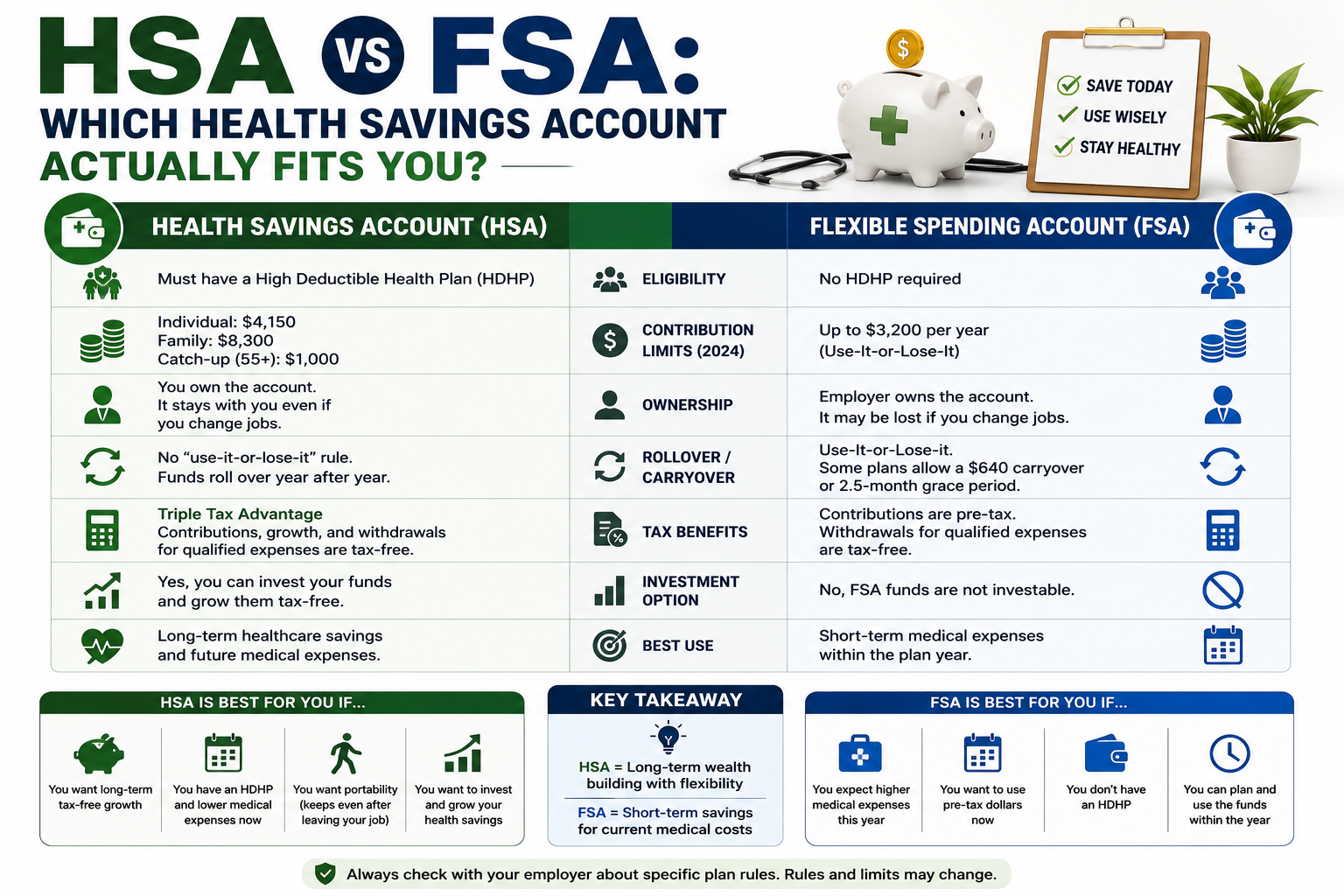
The Core Difference
Both HSAs (Health Savings Accounts) and FSAs (Flexible Spending Accounts) let you set aside pre-tax money for healthcare costs, but they work very differently. An HSA is yours permanently — the balance rolls over every year and stays with you even if you change jobs. An FSA is employer-owned and typically "use it or lose it" within the plan year, with only a limited carryover allowed.
Eligibility: The Biggest Deciding Factor
You can only open an HSA if you're enrolled in a High-Deductible Health Plan (HDHP). If your employer doesn't offer an HDHP, or you're on a standard PPO/HMO plan, an HSA isn't available to you — an FSA is generally your only pre-tax healthcare savings option in that case.
2026 Contribution Limits
| Account Type | 2026 Limit |
|---|---|
| HSA — Self-only coverage | $4,400 |
| HSA — Family coverage | $8,750 |
| HSA — Catch-up (age 55+) | +$1,000 |
| Health FSA | $3,400 |
| FSA carryover to next year | Up to $680 |
| Dependent Care FSA | $7,500 |
Key Differences at a Glance
- Rollover: HSA — unlimited, funds never expire. FSA — limited carryover (up to $680 in 2026) or a short grace period, depending on your employer's plan; anything beyond that is forfeited.
- Portability: HSA — stays with you if you change jobs or health plans. FSA — tied to your employer; you generally lose access when you leave, aside from any remaining claims window.
- Investment option: HSA — many providers let you invest the balance once it crosses a threshold, similar to a retirement account. FSA — no investment option; it's strictly a spending account.
- After age 65: HSA funds can be withdrawn for any purpose without penalty (though non-medical withdrawals are taxed as income), making it function like a bonus retirement account later in life. FSA has no such flexibility.
Which One Fits You?
If you're on an HDHP and can afford to pay some medical costs out-of-pocket in exchange for lower premiums, an HSA is generally the stronger long-term choice — it triples as a healthcare fund, a tax-free investment vehicle, and a backup retirement account. If you're on a standard PPO/HMO with predictable annual healthcare costs (routine prescriptions, regular doctor visits, planned procedures), an FSA can still meaningfully reduce your taxable income, even with the use-it-or-lose-it risk.
Common Mistakes to Avoid
1. Over-contributing to an FSA without planning your actual spending. Since FSA funds mostly don't roll over, contributing more than you'll realistically spend in a year risks forfeiting the excess — estimate conservatively based on your actual healthcare usage.
2. Not investing HSA funds once you have a cushion. Many people let HSA balances sit in cash indefinitely. Once you've built a reasonable buffer for near-term medical costs, investing the rest (where your provider allows) lets it grow tax-free for decades.
3. Assuming HSA and FSA can always be used together. In most cases, you can't contribute to a full-purpose HSA and a general-purpose FSA in the same year — a "limited-purpose FSA" (covering only dental/vision) is usually the workaround if you have both.
4. Forgetting HSA funds are yours even after leaving a job. Unlike an FSA, an HSA doesn't disappear when you change employers — the balance and any investments stay with you, so there's no rush to "spend it down" before switching jobs.
5. Not keeping receipts for HSA withdrawals. The IRS can ask for proof that HSA withdrawals were used for qualified medical expenses — keeping receipts avoids issues if you're ever audited.
Key Takeaway: An HSA is the more powerful long-term tool — triple tax advantages, no expiration, and portability — but it's only available if you're on a high-deductible health plan. An FSA is the fallback option for everyone else, still useful for reducing taxable income on predictable healthcare costs, just with more restrictive rollover rules.
Frequently Asked Questions
Can I have both an HSA and an FSA at the same time?
Generally not with a full-purpose FSA, since having both usually disqualifies you from HSA contributions. A limited-purpose FSA covering only dental and vision expenses is typically the exception that allows both.
What happens to unused FSA money at year-end?
Depending on your employer's plan, up to $680 can carry over to the next year (2026 limit), or you may get a short grace period to use remaining funds. Anything beyond that is generally forfeited.
Does my HSA balance disappear if I switch jobs?
No — an HSA is owned by you individually, not your employer. The balance and any investments stay with you regardless of job changes, unlike an FSA which is tied to your employer's plan.
Can I invest the money in my HSA?
Many HSA providers let you invest funds beyond a certain cash threshold, similar to a brokerage or retirement account, and the growth is tax-free when used for qualified medical expenses.
What's the Dependent Care FSA, and is it different?
Yes — it's a separate account for childcare or dependent care costs, not medical expenses, with its own 2026 limit of $7,500. It follows similar use-it-or-lose-it rules as a health FSA.