
How Inflation Quietly Erodes Your Savings (And What Actually Beats It)
Investing Writer
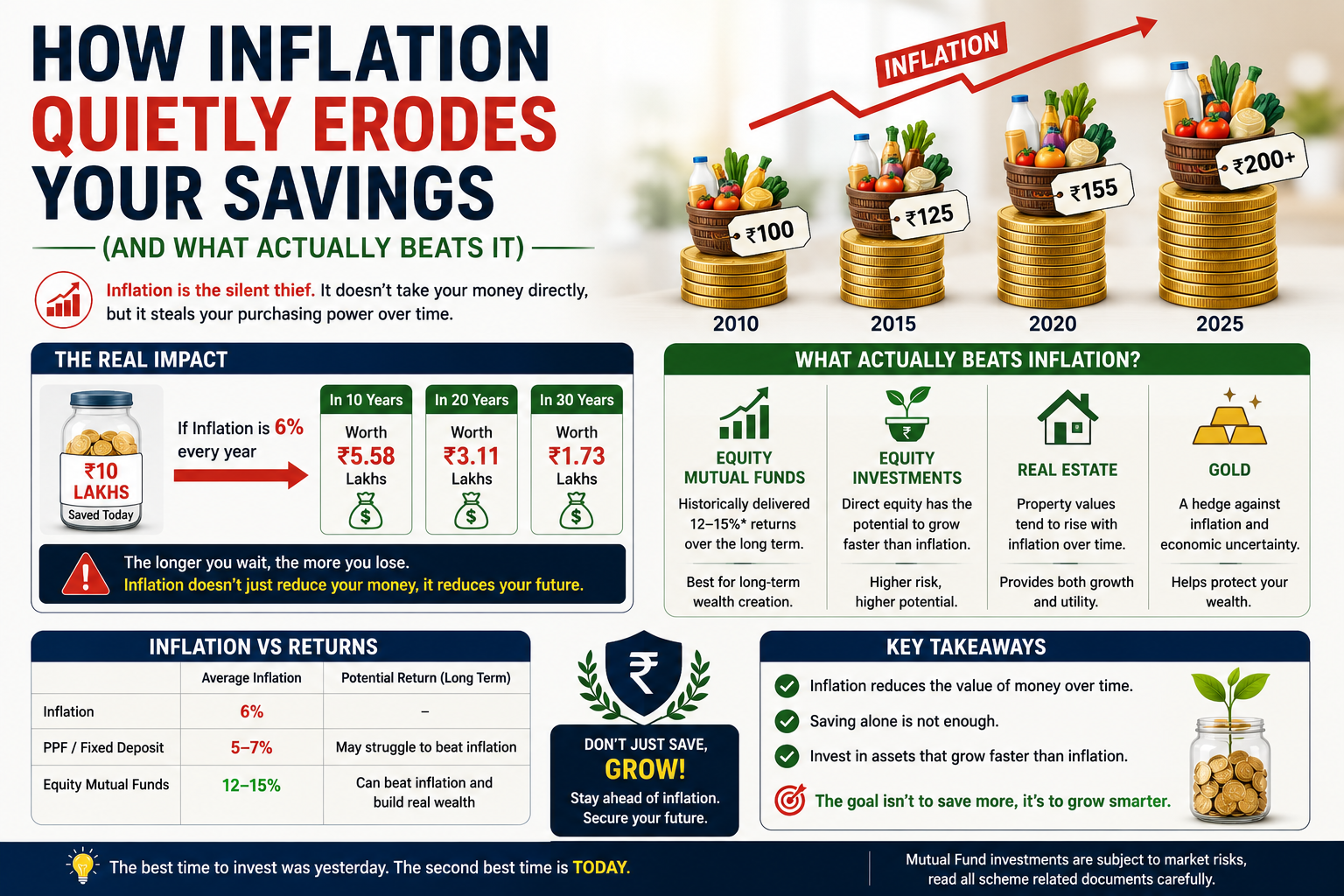
Why "Safe" Money Can Still Lose Value
Money sitting in a low-interest savings account feels safe because the number on the screen never goes down. But if inflation is running higher than your savings account's interest rate, your money's purchasing power is shrinking every year, even though the dollar amount stays the same or grows slightly. This is the quiet risk that a lot of savers overlook — nominal safety isn't the same as real, inflation-adjusted safety.
Nominal Return vs. Real Return
Nominal return is the interest rate you actually see quoted. Real return is that rate minus inflation — the number that actually reflects how much more (or less) you can buy with your money. If your savings account pays 2% and inflation is running at 3%, your real return is roughly -1%, meaning your money is losing purchasing power despite technically "earning interest."
A Simplified Example
| Scenario | Nominal Growth | After Inflation (Real) |
|---|---|---|
| $10,000 in a 1% savings account, 3% inflation, 10 years | Grows to ~$11,046 | Real purchasing power actually falls |
| $10,000 in an investment averaging 8%, 3% inflation, 10 years | Grows to ~$21,589 | Real purchasing power roughly doubles |
The first scenario looks safe because the balance never drops, but in real terms, you're falling behind. The second scenario carries more short-term volatility, but historically has been far more likely to outpace inflation over long periods.
What Actually Tends to Beat Inflation Over Time
- Stocks/equity index funds: Historically the strongest long-term inflation-beater, though with significant short-term volatility
- Real estate: Property values and rents have historically tended to rise with (or above) inflation over long periods, though returns vary significantly by market and timing
- I Bonds and TIPS: Treasury securities specifically designed to adjust with inflation, offering more direct (though modest) inflation protection
- High-yield savings accounts / CDs: Can sometimes keep pace with inflation during certain rate environments, but often lag during high-inflation periods
Why This Matters Most for Long-Term Goals
The inflation-erosion effect compounds the same way investment growth does — a small annual gap between your return and inflation can add up to a large real loss in purchasing power over 20-30 years. This is especially important for retirement savings, where money sitting mostly in cash or low-yield accounts for decades can end up buying meaningfully less than expected by the time it's actually needed.
Common Mistakes to Avoid
1. Keeping large amounts of long-term savings entirely in cash. Cash and basic savings accounts are appropriate for an emergency fund and near-term needs, but holding decades-long retirement savings entirely in cash means near-certain real losses to inflation over time.
2. Only looking at nominal returns when evaluating an investment. A 5% return sounds solid, but if inflation is running at 4%, your real gain is closer to 1% — always mentally (or literally) subtract inflation when judging whether a return is actually good.
3. Assuming past inflation-beating performance guarantees future results. Stocks and real estate have historically outpaced inflation over long periods, but this isn't guaranteed for any specific shorter stretch of time — diversification and time horizon both matter.
4. Not adjusting long-term financial goals for inflation. A retirement number calculated in today's dollars needs to be inflated forward to your actual retirement date — failing to do this can leave you meaningfully short of what you'll actually need.
5. Panicking and moving to cash during high-inflation periods. Ironically, shifting to cash specifically because inflation is high often makes the erosion problem worse, not better — that's typically when growth assets matter most for preserving purchasing power.
Key Takeaway: A savings account balance that never goes down can still be quietly losing you money in real terms if its interest rate trails inflation. For long-term goals, real (inflation-adjusted) return — not just the number on your statement — is what actually determines whether your money is growing or shrinking in terms of what it can buy.
Frequently Asked Questions
What's the difference between nominal and real return?
Nominal return is the raw interest rate or growth you see quoted. Real return subtracts inflation from that number, showing how much your purchasing power actually changed — the figure that matters most for long-term planning.
Is it bad to keep an emergency fund in cash if inflation erodes it?
No — an emergency fund's job is liquidity and safety for near-term needs, not inflation-beating growth. Some erosion is an acceptable trade-off for money you might need on short notice; it's long-term savings sitting in cash that's the bigger concern.
What are TIPS and how do they help with inflation?
Treasury Inflation-Protected Securities (TIPS) are government bonds whose principal value adjusts based on inflation, offering a more direct hedge than regular bonds, though typically with lower overall returns than stocks.
Why do stocks tend to beat inflation over the long run?
Company revenues and earnings tend to grow along with (or faster than) general price levels over time, which has historically translated into stock returns that outpace inflation over long horizons — though not necessarily in any given short period.
How do I know if my savings account is losing to inflation?
Compare your account's interest rate to the current inflation rate. If your rate is lower, your real return is negative — meaning your money's purchasing power is declining even as the balance grows.