
Health Insurance Open Enrollment Checklist: 10 Things to Do Before You Enroll
Insurance Writer
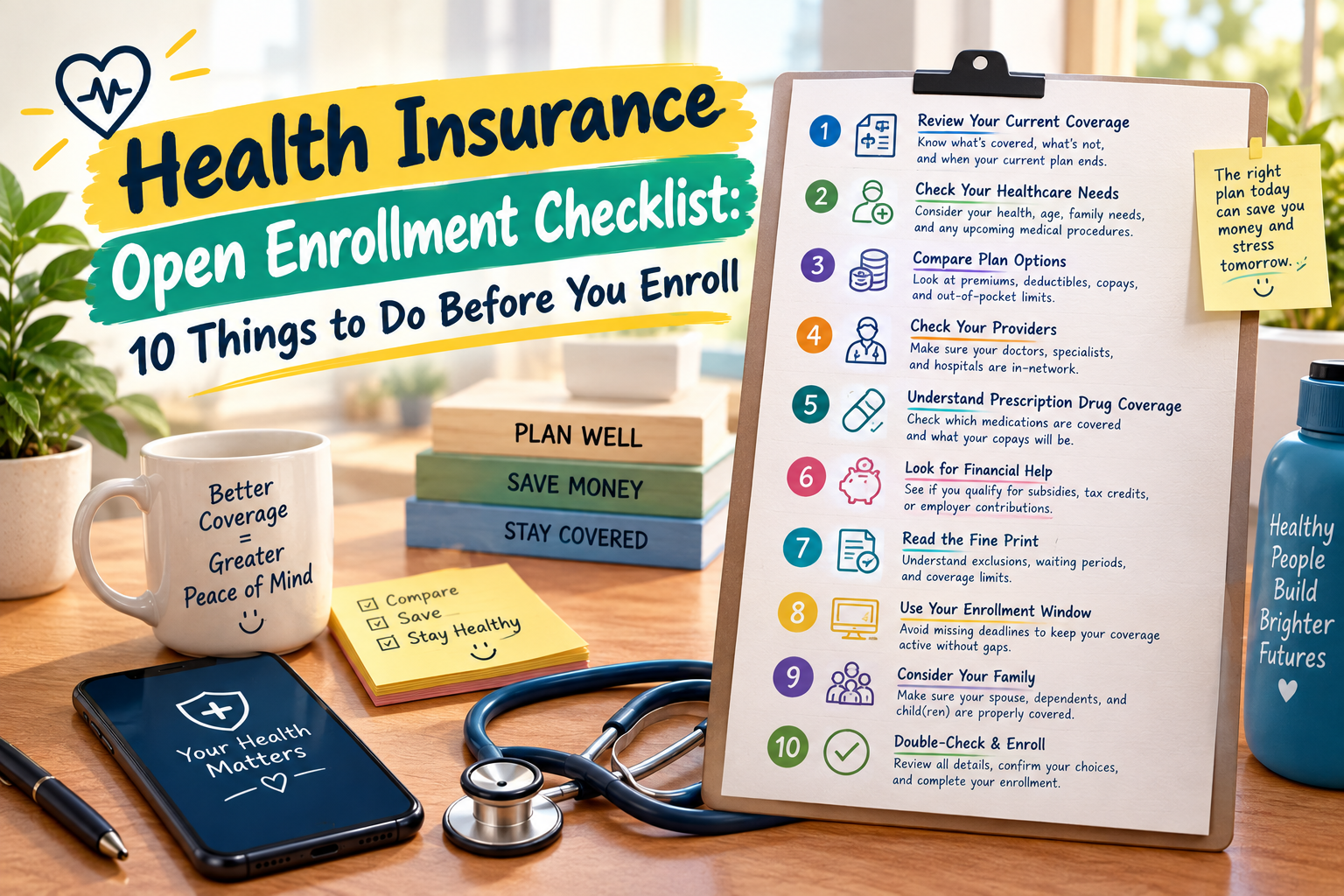
Open enrollment only comes around once a year, and once it closes, you're generally locked into your choices until the next cycle or a qualifying life event. That makes it one of the highest-leverage windows in personal finance — a few focused checks can save you hundreds or even thousands of dollars over the coming year. Here's a practical checklist to work through before you hit submit.
1. Confirm Your Exact Enrollment Deadline
Marketplace open enrollment typically runs November 1 to January 15 in most states, but state-run exchanges can set their own window. Employer deadlines are set independently and don't have to match. Confirm both dates first, since missing either one means waiting for the next cycle or a qualifying life event to get back in.
2. Re-Shop Even If You're Happy With Your Current Plan
Premiums, deductibles, and networks can all change year to year — even for the exact same plan name with the same insurer. Auto-renewing without checking can mean missing a lower-cost option or an unexpected change to your current plan's terms.
3. Check Whether Your Doctors Are Still In-Network
Provider networks shift annually. A doctor or hospital that was in-network last year isn't guaranteed to be in-network this year, even on the same plan. Confirm directly with the provider's office or your insurer before assuming continuity.
4. Check Your Prescription Drug Formulary
If you take a regular medication, check where it sits on each plan's drug formulary for the coming year. The same drug can move tiers — and copay amounts — from one year to the next, even under the same insurer.
5. Compare Premium, Deductible, and Out-of-Pocket Max Together
Don't compare plans on premium alone. A lower monthly cost paired with a much higher deductible can end up costing more overall if you need care during the year. Look at all three numbers side by side, not one at a time.
6. Recheck Your Subsidy Eligibility
If you're on the Marketplace, update your income and household information for the coming year. A pay change, a new dependent, or a change in household size can shift your premium tax credit meaningfully in either direction.
7. Decide Between Employer Coverage and the Marketplace, If Both Apply
If your employer's plan passes the IRS affordability and minimum value tests, you generally won't qualify for a Marketplace subsidy even if you decline the employer plan. Run both numbers before assuming either option is automatically better.
8. Review HSA and FSA Elections
If you're enrolling in a high-deductible health plan, confirm it actually qualifies for an HSA — not every high-deductible plan does. FSA elections also need to be made fresh each year and typically don't roll over fully, so estimate your expected medical expenses realistically.
9. Add or Remove Dependents Correctly
Open enrollment is the time to add a new dependent (or confirm one aging off, such as a child turning 26) without needing a separate qualifying life event. Double-check dependent details are accurate, since errors here can delay claims later.
10. Save Your Confirmation and Enrollment Summary
Once you've enrolled, save a copy of your confirmation, plan summary, and the effective date. This becomes useful if a billing or enrollment dispute comes up later, and it's a quick reference for your deductible and out-of-pocket numbers throughout the year.
Common Mistakes
1. Letting a plan auto-renew without checking it. Even loyal, unchanged plans can shift enough year to year to justify a second look.
2. Missing the enrollment deadline entirely. Outside a qualifying life event, missing the window means waiting for the next cycle.
3. Not verifying network and formulary changes. Both can change annually even when the plan name stays the same.
4. Forgetting to update income for subsidy purposes. Outdated income information can mean paying more — or getting a surprise repayment at tax time.
Key Takeaway: Open enrollment rewards a bit of yearly diligence — checking your network, formulary, subsidy eligibility, and the full cost picture (not just the premium) before the window closes.
Frequently Asked Questions
How long does open enrollment usually last?
Marketplace open enrollment typically runs November 1 to January 15 in most states, though state-run exchanges can set their own window. Employer open enrollment dates are set separately by each company.
What if I miss open enrollment?
You'd generally need to wait until the next open enrollment period, unless you qualify for a Special Enrollment Period through a qualifying life event, which typically gives you a 60-day window to enroll.
Should I switch plans even if my current one still works fine?
It's worth comparing regardless — premiums, networks, and formularies change annually, and a plan that was a good fit last year isn't guaranteed to remain the best option this year.