
The Biggest Misconception About Tax Brackets
Here's the myth: "If I earn one more dollar and it pushes me into the next bracket, all my income gets taxed at that higher rate." This is false, and it's one of the most persistent misunderstandings in personal finance. The US uses a marginal tax system — only the portion of your income that falls within each bracket is taxed at that bracket's rate. Everything below it is still taxed at the lower rates that applied to those earlier dollars.
How Marginal Brackets Actually Work
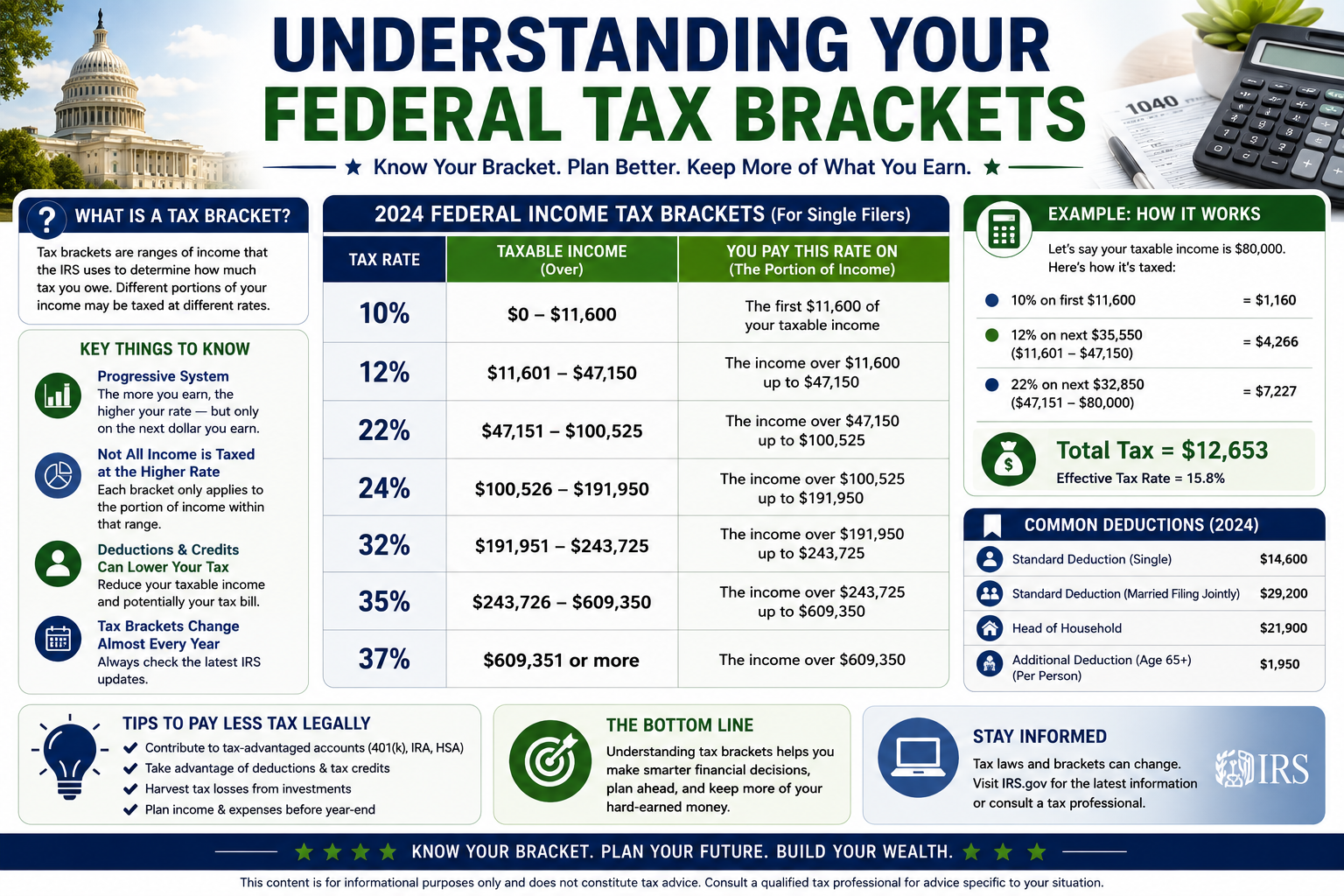
Federal income tax brackets apply progressively. For a single filer in a simplified example with brackets at 10%, 12%, and 22%:
- The first portion of income (say, up to $11,600) is taxed at 10%.
- The next portion (from $11,600 to $47,150) is taxed at 12%.
- Only income above that threshold, up to the next limit, is taxed at 22%.
So if your taxable income lands in the 22% bracket, you are not paying 22% on your entire income — you're paying 10% on the first slice, 12% on the next slice, and 22% only on the amount that falls into that top slice.
Marginal Rate vs Effective Rate
Your marginal tax rate is the rate applied to your last dollar of income — the bracket you're technically "in." Your effective tax rate is your total tax bill divided by your total income, which blends all the brackets you passed through. The effective rate is almost always meaningfully lower than the marginal rate, and it's the number that actually reflects what percentage of your income went to federal tax.
Filing Status Changes Everything
Tax brackets differ significantly by filing status — Single, Married Filing Jointly, Married Filing Separately, and Head of Household all have different income thresholds for each bracket. Married couples filing jointly generally see wider brackets than single filers, which is part of why filing status matters so much for tax planning.
Taxable Income vs Gross Income
Brackets apply to your taxable income, not your gross salary. Taxable income is what's left after subtracting the standard deduction (or itemized deductions) and any above-the-line adjustments, such as traditional 401(k) or HSA contributions. This is why contributing to a 401(k) or HSA doesn't just build savings — it directly reduces the income your brackets are calculated against.
Why This Matters for Financial Decisions
Understanding marginal brackets changes how you think about raises, bonuses, freelance income, and retirement account contributions. A raise that nudges you into a higher bracket will never reduce your take-home pay — only the incremental income above the threshold is taxed at the new rate. Similarly, contributing more to a traditional 401(k) is most valuable when it reduces income that would otherwise be taxed at your highest marginal rate.
Estimating Your Bracket and Take-Home Pay
Because brackets, standard deductions, and thresholds are updated annually and vary by filing status, the easiest way to see where you land is to run your numbers through a calculator rather than trying to do the layered math by hand. Use the Federal Tax calculator to estimate your bracket, effective tax rate, and take-home pay based on your actual income and filing status.
Bottom Line
Tax brackets are progressive, not a cliff — moving into a higher bracket only affects the income above that threshold. Knowing the difference between your marginal and effective rate helps you make smarter decisions about raises, retirement contributions, and year-end tax planning.