
Social Security: When Should You Actually Start Claiming?
Retirement Writer
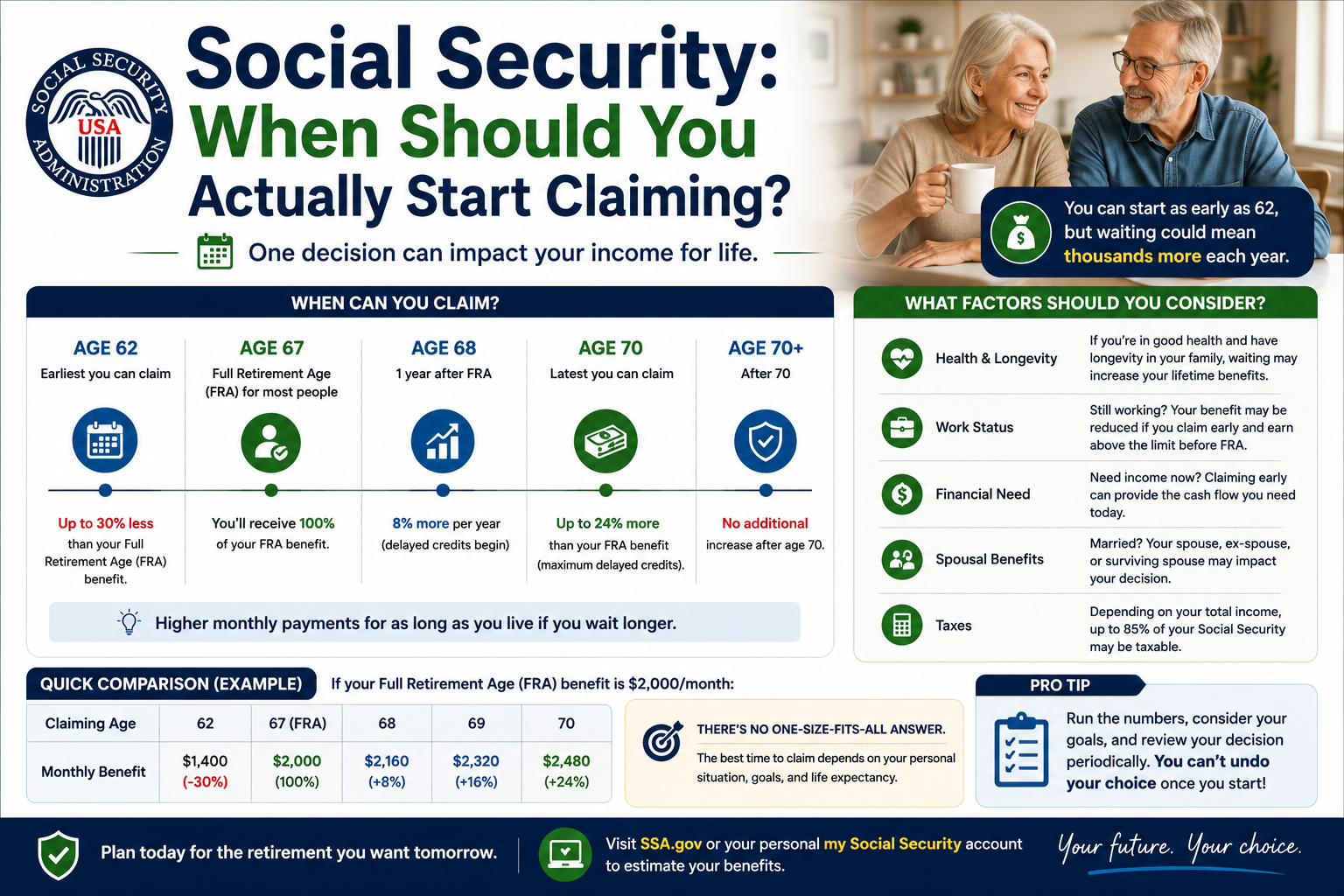
Your Three Main Claiming Windows
You can start Social Security retirement benefits anywhere between age 62 and 70, and the age you choose permanently affects your monthly amount. There are three key reference points: age 62 (earliest possible, but permanently reduced), your Full Retirement Age or FRA (100% of your earned benefit), and age 70 (the maximum, with delayed retirement credits added on top).
What's Your Full Retirement Age?
Your FRA depends on your birth year. For anyone born in 1960 or later, FRA is 67 — this is now the standard for most people currently planning their claiming strategy. Earlier birth years have a slightly lower FRA (as low as 66), based on a gradual phase-in from a 1983 law.
How Much Claiming Early or Late Actually Costs (or Pays) You
| Claiming Age | Effect on Monthly Benefit |
|---|---|
| 62 (earliest, FRA 67) | Permanently reduced by about 30% |
| FRA (67, for most) | 100% of your earned benefit (PIA) |
| 70 (latest) | Increased by about 8% per year of delay past FRA — up to roughly 124% of your FRA amount |
These adjustments are permanent for the rest of your life — there's no "catching up" later if you claim early and change your mind, beyond a narrow one-time withdrawal option within 12 months of first claiming.
Why Claim Early?
- You need the income now — health issues, job loss, or an early retirement that requires cash flow
- You have a shorter-than-average life expectancy, based on your health or family history
- You'd rather have more money in your 60s while you can still actively use it, accepting a smaller check for longer
Why Delay to 70?
- You have other income or savings to cover expenses in the meantime
- You expect to live well into your 80s or beyond, making the larger lifetime total from delaying worthwhile
- You're the higher earner in a married couple — since a surviving spouse can inherit your higher benefit amount, delaying protects your spouse's income too
Working While Claiming Before FRA
If you claim before reaching FRA and continue working, your benefits can be temporarily reduced if your earnings exceed the annual limit — $24,480 for 2026 if you won't reach FRA this year, with $1 withheld for every $2 earned above that. This reduction isn't truly "lost," though — the SSA recalculates your benefit upward once you reach FRA to account for months withheld.
Common Mistakes to Avoid
1. Claiming at 62 purely out of habit or default. Many people claim as soon as they're eligible without running the numbers — for those likely to live into their 80s, delaying often results in significantly more lifetime income despite the smaller early checks.
2. Not factoring in spousal and survivor benefits. In a married couple, the higher earner's claiming decision affects what the surviving spouse eventually receives — this makes the decision a household one, not just an individual one.
3. Assuming working while claiming means permanently losing money. The earnings-test reduction before FRA isn't gone forever; your benefit is recalculated upward at FRA to credit back the months that were withheld.
4. Ignoring taxes on Social Security benefits. Depending on your total income, up to 85% of your Social Security benefit can be taxable at the federal level — factor this into your overall retirement income planning, not just the gross benefit amount.
5. Treating the "break-even age" as the only factor. Break-even analysis (the age at which delaying "pays off" versus claiming early) is useful, but health, other income sources, and whether you're still working all matter just as much as the pure math.
Key Takeaway: There's no universally "right" claiming age — it depends on your health, other income, marital status, and whether you're still working. But understanding the roughly 30% reduction at 62 versus the roughly 8%-per-year boost from delaying to 70 gives you the framework to make an informed decision rather than defaulting to the earliest possible age.
Frequently Asked Questions
What is my Full Retirement Age if I was born in 1965?
Your FRA is 67, same as anyone born in 1960 or later. The gradual phase-in from earlier, lower FRAs was completed for people born in that range.
How much do I lose by claiming at 62 instead of 67?
For someone with an FRA of 67, claiming at 62 results in a permanent reduction of about 30% compared to your full benefit amount.
Does delaying past 70 increase my benefit further?
No — delayed retirement credits stop accruing at age 70. There's no additional benefit to waiting beyond that age, so most people who plan to delay should claim by 70 at the latest.
Can I change my mind after I start claiming?
There's a narrow window — within 12 months of first claiming, you can withdraw your application and repay what you've received, effectively resetting your claiming decision. After that window, the decision is permanent.
Will working while collecting benefits before FRA reduce my check permanently?
No — while your check may be temporarily reduced if you earn above the annual limit, the SSA recalculates and increases your benefit once you reach FRA to credit back the amount withheld.