
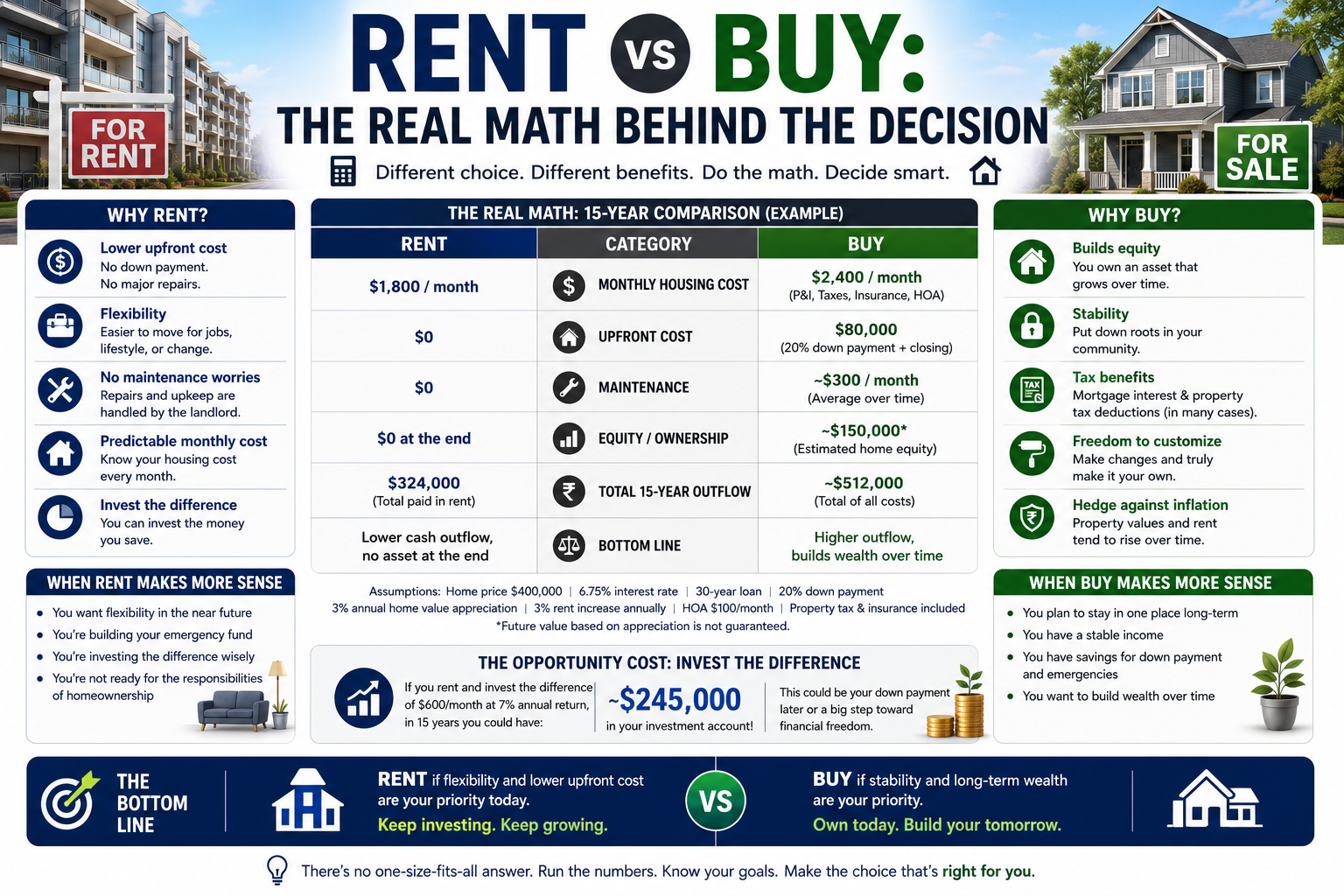
Why the Common Advice is Incomplete
The usual argument for buying is simple: rent payments build no equity, while mortgage payments do. But this framing leaves out most of the real costs of ownership — property taxes, maintenance, homeowners insurance, closing costs, and the opportunity cost of the down payment. Once those are included, the comparison looks very different depending on your market and timeline.
The Hidden Costs of Owning
A mortgage payment is only part of what it costs to own a home. A realistic comparison needs to account for:
- Property taxes — often 1–2% of home value annually, varying widely by state and county.
- Maintenance and repairs — commonly estimated at 1–2% of home value per year for upkeep, appliances, and eventual big-ticket repairs like a roof or HVAC system.
- Homeowners insurance — a recurring annual cost that renters' insurance doesn't come close to matching.
- Closing costs — typically 2–5% of the purchase price when you buy, and real estate agent commissions (usually 5–6%) when you eventually sell.
- Opportunity cost of the down payment — the money tied up in a down payment could otherwise be invested, and that foregone return is a real cost of ownership.
What Renting Actually Offers
Renting isn't just "throwing money away" — it buys flexibility and predictability. You're not on the hook for a burst pipe or a failed AC unit, you can relocate for a job without selling a property, and the money you'd have spent on a down payment can be invested instead, where it has the potential to grow.
The Break-Even Timeline
Because buying involves large upfront costs (closing costs) and large exit costs (agent commissions), it typically takes several years of owning before the equity you build outweighs those transaction costs compared to renting and investing the difference. If you expect to move within 2–3 years, renting is very often the financially safer choice — you avoid paying transaction costs twice in a short window.
Run the Comparison for Your Situation
Because home prices, rents, mortgage rates, and property taxes vary enormously by location, there's no single answer that applies everywhere. Use the Rent vs Buy calculator to compare your actual numbers — your local rent, home price, down payment, mortgage rate, and how long you plan to stay — and see which option comes out ahead over your specific timeline.
When Buying Tends to Win
- You plan to stay in the home for 7+ years, giving equity and appreciation time to outweigh transaction costs.
- Rents in your area are high relative to home prices (a low price-to-rent ratio).
- You value stability, control over the property, and predictable housing costs over the long run (fixed-rate mortgage payments don't rise with inflation the way rent typically does).
When Renting Tends to Win
- You're likely to relocate within a few years for work or lifestyle reasons.
- Home prices in your area are high relative to rents (a high price-to-rent ratio).
- You'd rather keep your capital liquid and invested rather than tied up in a down payment and home equity.
Bottom Line
Neither renting nor buying is inherently the smarter financial move — it depends on how long you'll stay, your local price-to-rent ratio, and what you'd do with the money otherwise spent on a down payment. The honest version of this decision requires running your actual numbers, not leaning on a one-size-fits-all cliché.