
PPF vs FD: Which is Better for Long-Term Savings?
Finzony Team
Finzony Desk
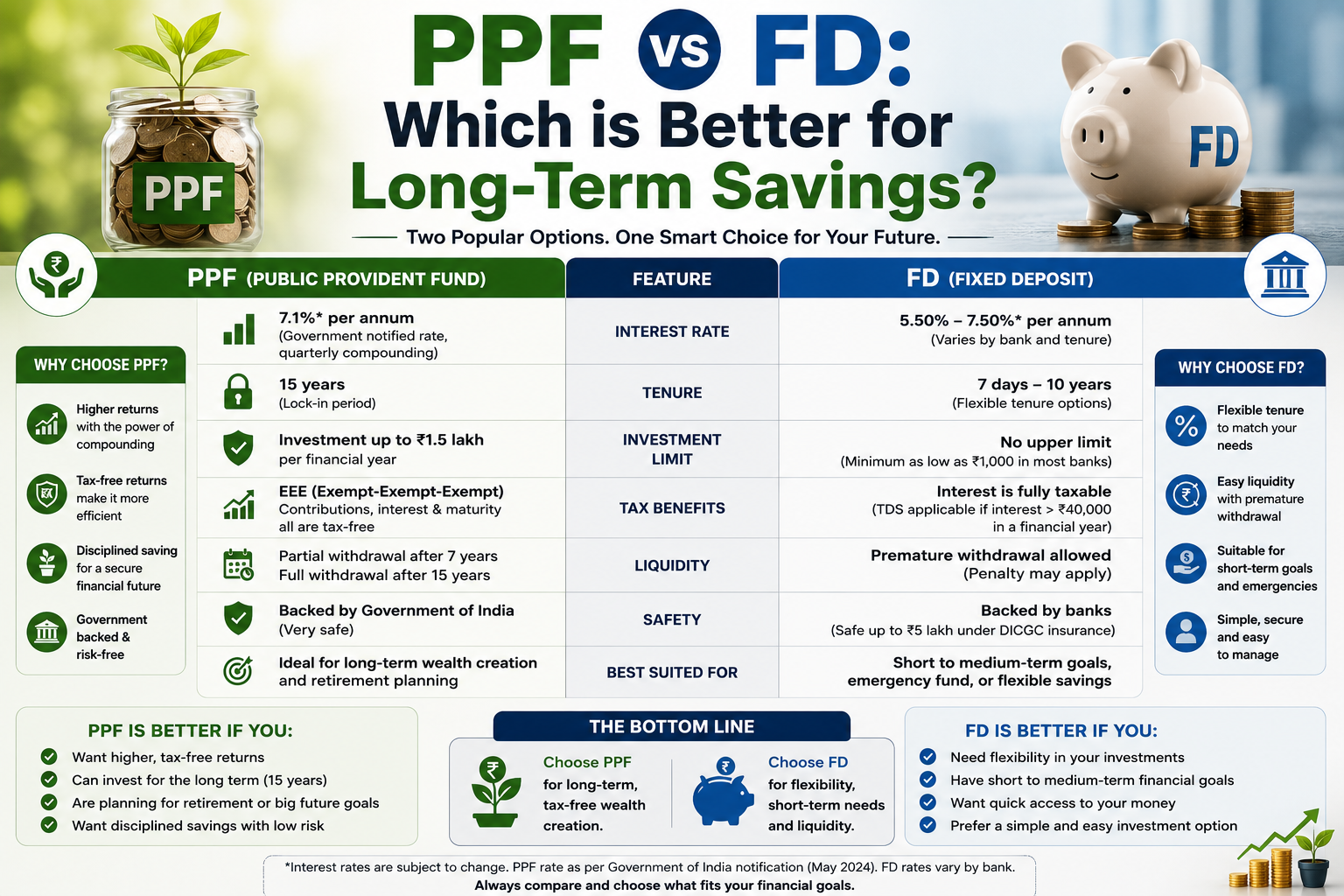
PPF vs FD: The Quick Answer
If your goal is long-term, tax-efficient wealth building — think retirement, a child's education 15 years away — the Public Provident Fund (PPF) usually wins. If you need flexibility, shorter tenures, or guaranteed access to your money in 1–5 years, a Fixed Deposit (FD) is the better fit. The right answer depends less on which product is "better" and more on what you need the money to do.
How PPF Works
PPF is a government-backed savings scheme with a mandatory 15-year lock-in (extendable in blocks of 5 years). You can invest between ₹500 and ₹1.5 lakh per financial year, and the interest rate is revised quarterly by the government — currently in the 7–7.1% range historically, though it moves with prevailing rates.
What makes PPF genuinely powerful is its EEE tax status: the amount you invest is deductible under Section 80C, the interest earned is completely tax-free, and the maturity amount is tax-free too. No other government-backed instrument offers all three exemptions together.
How Fixed Deposits Work
A bank or post office FD lets you lock in a lump sum for a tenure of your choosing — anywhere from 7 days to 10 years — at a fixed interest rate agreed upon at booking. Senior citizens typically get an additional 0.25–0.5% over standard rates.
FDs are simple and liquid: you can break them early (usually with a small penalty), and premature withdrawal is far easier than PPF. But the interest is fully taxable at your income slab rate, which significantly eats into real returns if you're in the 20% or 30% tax bracket.
Side-by-Side Comparison
- Returns: PPF's rate is set quarterly by the government; FD rates vary by bank and tenure, and can sometimes be higher on paper — but only PPF's return is fully tax-free.
- Tax treatment: PPF is EEE (fully exempt). FD interest is added to your taxable income and taxed at your slab rate, with TDS deducted if interest crosses ₹40,000/₹50,000 a year.
- Lock-in: PPF locks your money for 15 years, with partial withdrawal allowed from year 7. FDs can be booked for any tenure and broken early if needed.
- Risk: Both are considered extremely safe. PPF carries a sovereign guarantee. Bank FDs are insured up to ₹5 lakh per bank under DICGC.
- Investment limit: PPF caps annual investment at ₹1.5 lakh. FDs have no upper limit.
Which One Actually Grows Your Money Faster?
Because PPF interest compounds annually and is completely tax-free, its effective return is almost always higher than an FD's post-tax return for anyone in the 20% or 30% tax bracket — even when the FD's headline rate looks similar or slightly higher. For someone in the lowest tax bracket, the gap narrows, and FD flexibility may matter more than the small tax edge PPF offers.
Use a PPF calculator alongside an FD calculator to run your own numbers — enter the same amount and compare the maturity value after accounting for tax on the FD side.
When FD Makes More Sense Than PPF
FDs are the better choice when you need the money within a few years — an emergency fund top-up, a down payment you're saving for over 2–3 years, or short-term parking of a bonus. PPF's 15-year lock-in makes it unsuitable for any goal closer than a decade away.
A Practical Approach: Use Both
Most financial planners don't treat this as an either/or choice. A common structure is to max out PPF's ₹1.5 lakh annual limit for long-term, tax-free compounding, while keeping FDs for near-term goals and emergency liquidity. Together they cover both ends of the safety spectrum — one for decades, one for months and years.
Bottom Line
For a goal that's 10+ years away, PPF's tax-free compounding is hard to beat among safe instruments. For anything shorter, or if you value easy access to your money, an FD is the more practical tool. Match the product to the timeline, not the other way around.