
Intraday vs Swing Trading: Which Trading Style Suits You Best?
Finzony Editorial Team
Finzony Desk
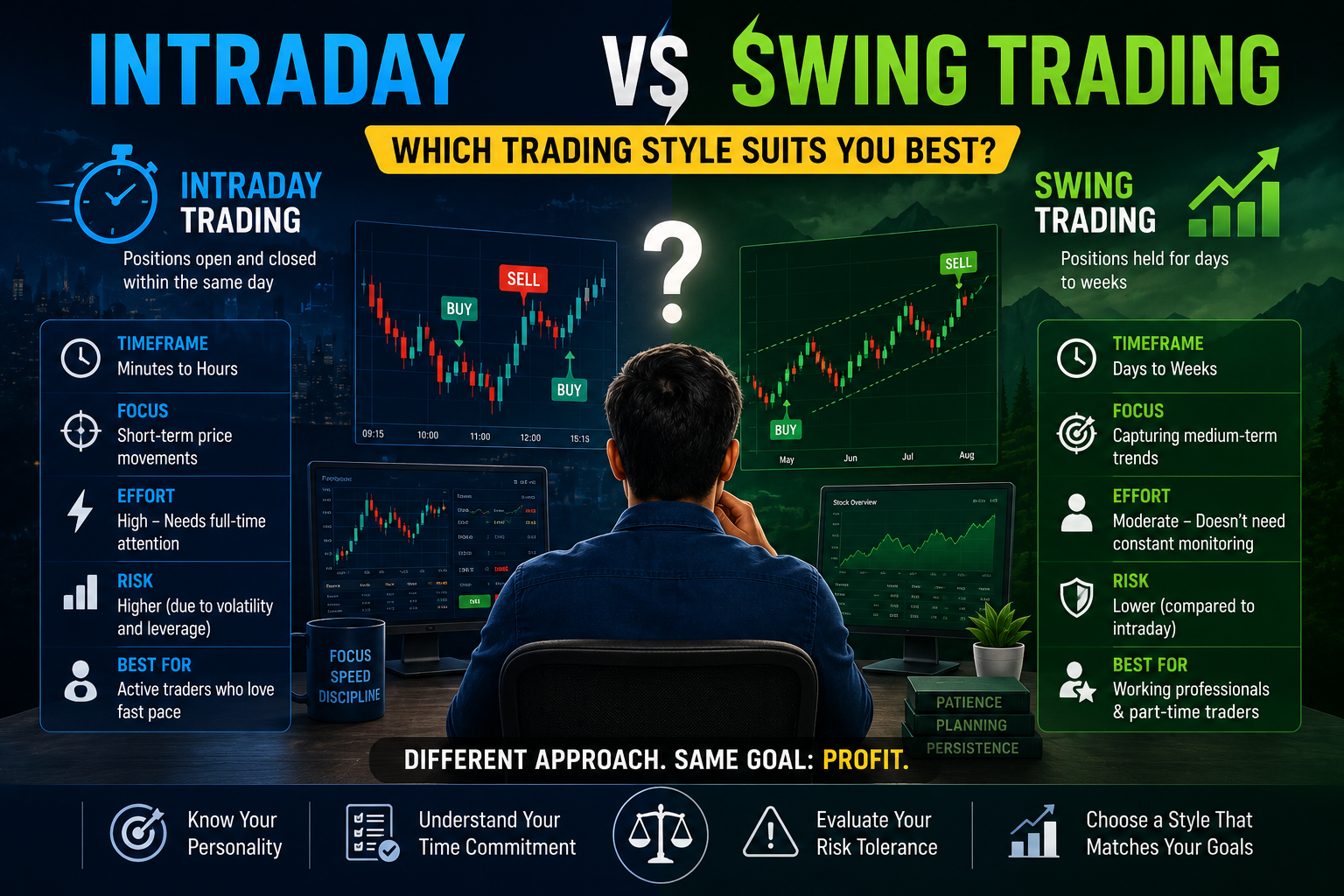
Intraday trading and swing trading both promise faster returns than long-term investing — but they demand very different amounts of time, capital, and nerve. Here's an honest comparison to help you pick the style that actually fits your life.
Two Very Different Games, Both Called "Trading"
New traders often lump intraday and swing trading together as "short-term trading," but in practice they demand almost opposite skill sets. Intraday trading means buying and selling the same stock within a single trading session — every position is closed by 3:30 pm, no exceptions. Swing trading holds positions for a few days to a few weeks, riding a bigger move without needing to watch every tick.
Side-by-Side Comparison
| Intraday Trading | Swing Trading | |
|---|---|---|
| Holding period | Minutes to hours (same day) | Days to a few weeks |
| Time commitment | Full attention during market hours | 10–20 minutes of analysis, a few times a day |
| Leverage | Often 5x–20x via MIS margin | Usually little to no leverage |
| Overnight risk | None — flat by end of day | Yes — gaps from global news can hit hard |
| Brokerage & taxes | Higher (more trades) — taxed as speculative business income | Lower — taxed as short-term capital gains (STCG) if held as a delivery trade |
| Skill needed early on | Fast decision-making, chart reading under pressure | Patience, trend identification, risk-per-trade discipline |
Who Should Consider Intraday Trading
Intraday suits people who can genuinely sit at a screen for market hours, are comfortable with leverage (and the losses it can amplify), and can execute a stop-loss without hesitation. It is not a good fit for anyone with a full-time job that doesn't allow screen access from 9:15 am to 3:30 pm — reacting to price ten minutes late, in this style, is often the difference between a small loss and a large one.
Who Should Consider Swing Trading
Swing trading fits people who want market exposure beyond long-term investing but can't watch a screen all day. Positions are analysed once or twice daily, stop-losses are wider, and overnight/weekend gaps are an accepted risk in exchange for not needing constant attention. It's a more realistic style for salaried professionals.
The single biggest reason new traders lose money isn't picking the wrong stock — it's picking the wrong style for their actual daily schedule and risk appetite, and then being forced into rushed decisions because of it.
Costs Most Beginners Underestimate
Every trade carries brokerage, STT (Securities Transaction Tax), exchange charges, and GST — and on intraday trading specifically, this happens twice per trade (entry and exit), often several times a day. A strategy that looks profitable on a chart can quietly lose money once real transaction costs are added in. Always backtest with costs included, not just raw price movement.
A Realistic Starting Point
Most experienced traders recommend beginners start with swing trading, or even paper trading, before touching intraday leverage. It gives you time to actually study your own mistakes — journal every trade, review it that evening, and adjust — without the pressure of a same-day deadline.
Frequently Asked Questions
Can I do both intraday and swing trading with the same capital?
Technically yes, but most brokers require you to keep intraday (MIS) and delivery (CNC) positions clearly separated, and mixing styles early on tends to blur your risk management. It's better to master one first.
How much capital do I need to start intraday trading in India?
There's no fixed minimum, but risking money you can't afford to lose — or capital meant for emergencies — is a common and costly mistake among beginners.
Is swing trading taxed differently from intraday trading?
Yes. Intraday trading gains are treated as speculative business income, while swing trades held as delivery are typically taxed as short-term capital gains. Rules can change, so check the latest Income Tax guidance or a CA before filing.
New to trading altogether? Our free Trading Basics course in the Finzony Academy covers order types, risk management, and chart reading from the ground up.