
HRA Exemption Explained: How to Save Tax on Rent
Finzony Team
Finzony Desk
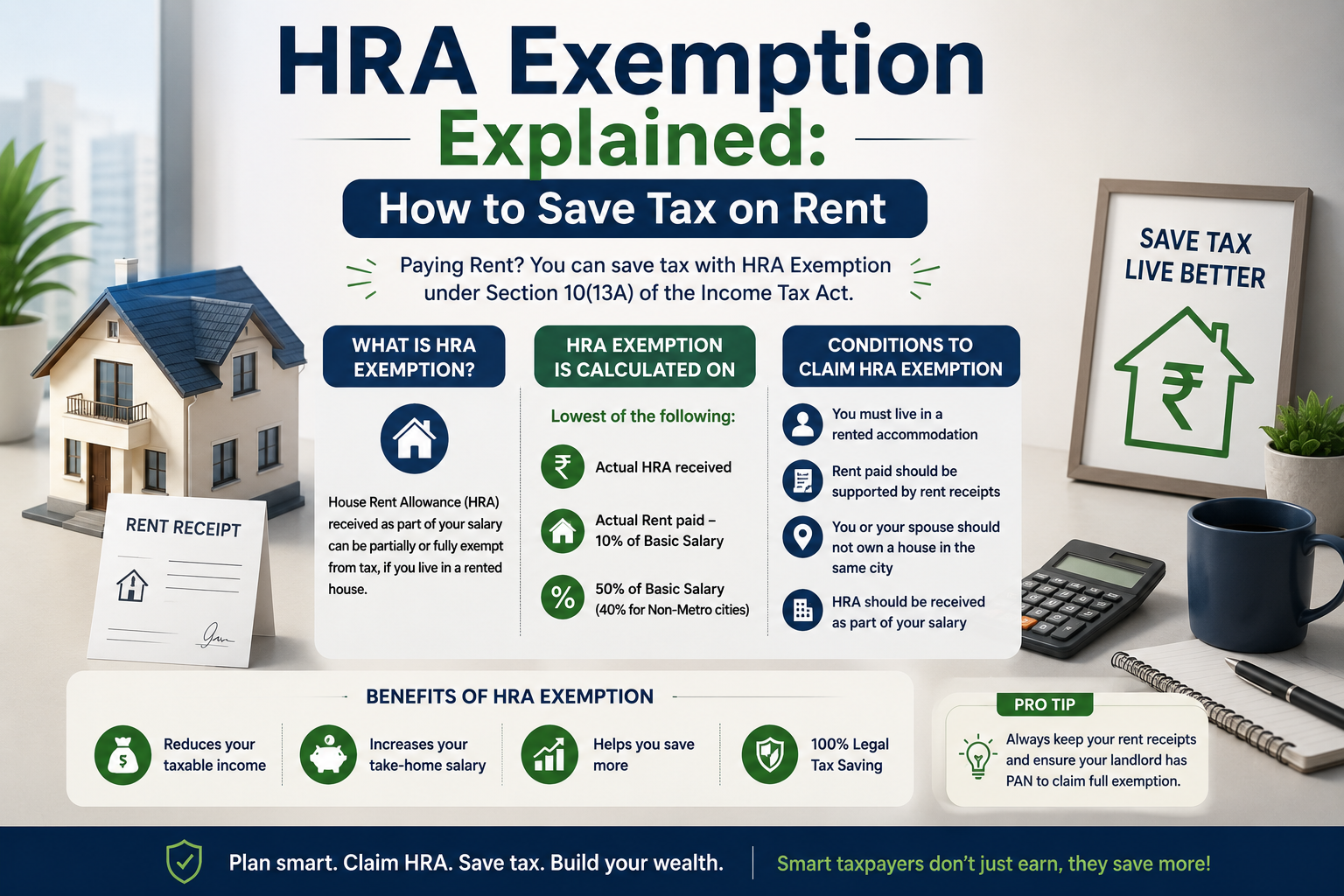
House Rent Allowance (HRA) is one of the most valuable tax breaks available to salaried employees who pay rent — but only if you're in the old tax regime, and only if you calculate it right. Get the formula wrong and you either overclaim (inviting a notice) or underclaim (losing money you're entitled to).
Who can claim HRA exemption?
Exemption is available under Section 10(13A) of the Income Tax Act, and it applies only if all three conditions are met:
- You receive HRA as part of your salary structure
- You actually live in rented accommodation
- You genuinely pay rent for it
Important: HRA exemption is available only under the old tax regime. If you've opted for the new regime, your entire HRA is fully taxable regardless of how much rent you pay.
The HRA exemption formula
The exempt amount is the lowest of these three figures:
- Actual HRA received from your employer
- 50% of (Basic Salary + DA) for metro cities, or 40% for non-metro cities
- Rent paid minus 10% of (Basic Salary + DA)
Whichever of the three is smallest becomes your tax-free HRA. The rest gets added back to your taxable salary.
Which cities count as "metro" for HRA?
From FY 2026-27, the metro list for the 50% rate has expanded to 8 cities:
- Delhi, Mumbai, Kolkata, Chennai (existing metros)
- Bengaluru, Pune, Hyderabad, Ahmedabad (newly added)
All other cities fall under the 40% non-metro rate.
Worked example
Priya works in Bengaluru, earns a basic salary of ₹60,000/month, receives HRA of ₹27,000/month, and pays rent of ₹25,000/month.
- Actual HRA received: ₹27,000 × 12 = ₹3,24,000
- 50% of basic (metro): ₹30,000 × 12 = ₹3,60,000
- Rent paid − 10% of basic: (₹25,000 − ₹6,000) × 12 = ₹2,28,000
The lowest of the three is ₹2,28,000 — that's Priya's tax-free HRA. The remaining ₹96,000 of her HRA gets added to her taxable income.
Don't have HRA in your salary?
If you're self-employed or your salary doesn't include an HRA component, you can still claim rent paid as a deduction under Section 80GG — provided you, your spouse, or your minor child don't own a house in the city you live and work in.
Documentation you'll need
- Monthly rent receipts signed by the landlord
- Landlord's PAN, mandatory if annual rent exceeds ₹1 lakh
- A registered rent agreement, ideally, for higher-value claims
Note: you can claim HRA even while paying rent to a parent, as long as the payment is genuine and documented — but not to a spouse.
Old regime vs new regime for HRA claimants
If you pay significant rent and also invest under Section 80C, the old regime often works out cheaper despite its higher slab rates. Since the new regime is now the default, you need to actively opt for the old regime when filing your return if HRA benefits you. Use Finzony's HRA Calculator and Tax Calculator to compare both regimes with your actual numbers before deciding.
This article is for educational purposes only and does not constitute tax advice. Tax rules and city classifications are subject to change — verify current provisions before filing your return, and consult a qualified CA for your specific situation.