
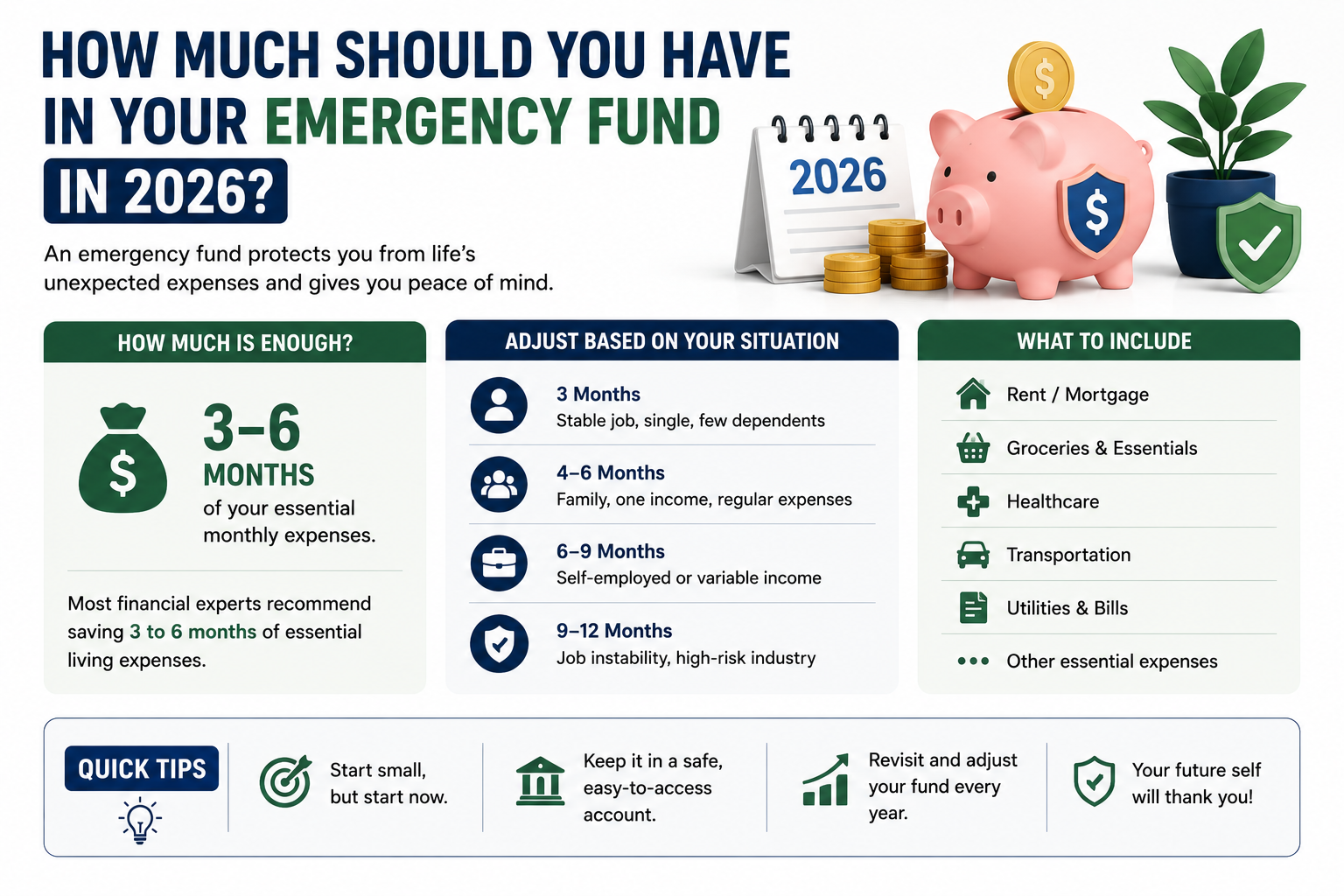
Why the Generic Rule Doesn't Work for Everyone
The standard "3-6 months of expenses" advice treats a tenured government employee and a 1099 freelancer as if they carry the same risk. They don't. A framework that accounts for income stability, dependents, and fixed obligations gets you a number you can actually trust — not just repeat.
Step 1: Calculate Your True Monthly Baseline
List only essential, non-negotiable monthly costs: rent or mortgage, utilities, groceries, insurance premiums, minimum debt payments, and transportation. Leave out discretionary spending — dining out, subscriptions, entertainment. This is a survival number for a period without income, not your normal lifestyle budget. For most households, this baseline runs 60-75% of their total monthly spending.
Step 2: Score Your Income Stability
| Situation | Recommended Fund |
|---|---|
| Stable salaried job, resilient industry, dual-income household | 3 months of essentials |
| Salaried but single income supporting a household | 4-5 months |
| Commission-based, freelance, or volatile industry | 6-9 months |
| Business owner with irregular cash flow | 9-12 months |
A tech employee in a stable role with a working spouse and no kids can reasonably sit at the lower end. A single-income freelancer supporting two kids should be planning for the higher end — a job search after an income disruption in that situation commonly takes longer and costs more than people budget for.
Step 3: Adjust for Fixed Obligations
The more fixed, hard-to-cut costs you carry — a mortgage, a car loan, private school tuition, medical needs — the less flexibility you have to shrink your monthly baseline if income actually stops. Two households with identical income can need very different emergency fund sizes purely based on how much of their budget is fixed versus flexible.
A Worked Example
Take a household with $4,500/month in essential expenses, one stable salaried earner, a working spouse, and a mortgage plus one car loan. Base recommendation: 4 months = $18,000. Because they have meaningful fixed obligations (mortgage + car loan) but dual income as a buffer, $18,000-$22,500 is a reasonable target range — not the generic $13,500-$27,000 that a blanket "3-6 months" rule would suggest.
Where to Actually Keep It
An emergency fund needs to be liquid and capital-safe, not growth-focused — this money is insurance, not an investment. A high-yield savings account is the right home for it: FDIC-insured, accessible within a day or two, and earning meaningfully more than a standard checking or savings account. Avoid locking any of it into CDs with early-withdrawal penalties or into the market, where a downturn could hit exactly when you need the cash most.
Building It Without Wrecking Your Budget
You don't need the full target saved before it starts helping — even one month of expenses set aside measurably reduces financial stress and gives you room to make better decisions instead of panic decisions. Automate a fixed transfer on payday, treat it as a non-negotiable line item like rent, and build in stages: first to one month, then three, then your full calculated target.
When to Reassess
Recalculate your target whenever a major life event changes your baseline — having a child, taking on a mortgage, switching from salaried to freelance work, or a spouse leaving the workforce. Your emergency fund isn't a set-once number; it should move with your actual financial exposure.
FAQs
Should I build my emergency fund or pay off debt first? Most planners recommend at least $1,000-$2,000 as a starter buffer before aggressively paying down debt, then building the full fund once high-interest debt is cleared.
Does a HELOC or credit line count as an emergency fund? No — it's a backup, not a substitute. Credit access can be reduced or pulled entirely during the same economic downturns that cause job loss in the first place.
Should retirees size their emergency fund differently? Yes — retirees on fixed income often keep a larger cash buffer (12+ months) specifically to avoid selling investments during a market downturn to cover expenses.