
How Much House Can You Actually Afford? The 28/36 Rule Explained
Home Buying Writer
What Is the 28/36 Rule?
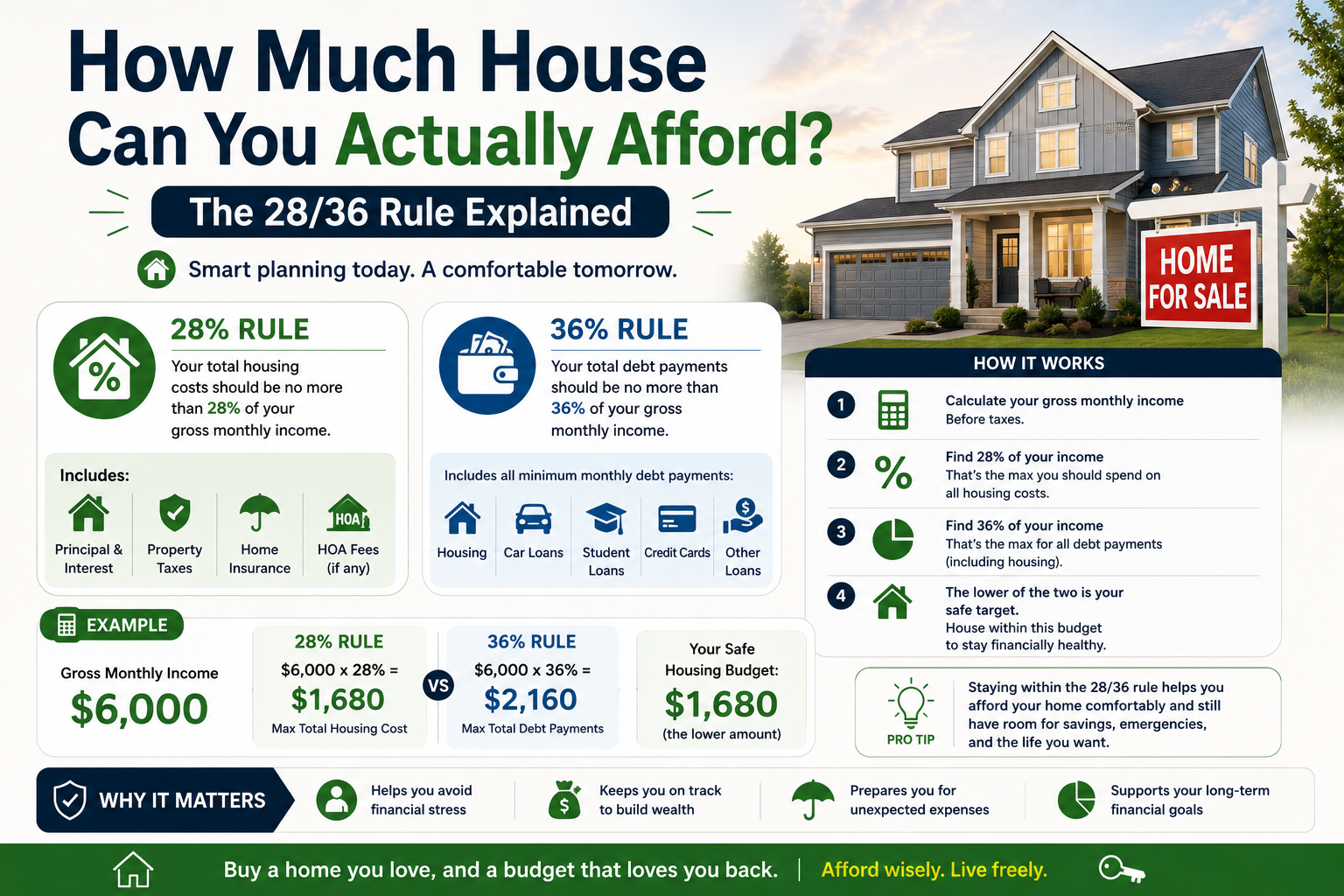
The 28/36 rule is a widely used guideline lenders and financial planners use to figure out how much house you can actually afford — not just how much a lender is willing to approve you for. It has two parts: your total housing costs shouldn't exceed 28% of your gross monthly income (the "front-end ratio"), and your total debt payments — housing plus car loans, student loans, credit cards, and anything else — shouldn't exceed 36% of your gross monthly income (the "back-end ratio").
How to Calculate Your Numbers
Start with your gross monthly income (before taxes). Multiply by 0.28 to get your maximum recommended housing payment — this includes principal, interest, property taxes, homeowners insurance, and any HOA fees (often bundled as "PITIA"). Multiply by 0.36 to get your maximum recommended total debt payment, including that housing number plus every other monthly debt obligation you carry.
A Worked Example
| Item | Amount |
|---|---|
| Gross monthly income | $7,000 |
| 28% front-end limit (max housing payment) | $1,960 |
| 36% back-end limit (max total debt) | $2,520 |
| Existing car loan + student loan payments | $400 |
| Actual max housing payment (back-end constrained) | $2,120 |
In this example, the front-end ratio alone would allow a $1,960 housing payment, but existing debt eats into the back-end limit — so the real ceiling is actually set by the 36% rule once other debts are factored in, not the 28% number in isolation.
Why Lenders (and You) Should Care About Both Numbers
Many first-time buyers only look at the front-end 28% number and forget that a car loan or student loan payment can meaningfully shrink what they can actually afford in housing. Lenders check both ratios during underwriting, and even if a lender approves you at a higher back-end ratio (some go up to 43-50% for certain loan programs), that doesn't mean it's a comfortable payment for your actual budget — it just means the lender is willing to take the risk.
What Counts as "Housing Cost" in the 28% Number
- Principal and interest on the mortgage
- Property taxes
- Homeowners insurance
- Mortgage insurance (PMI), if your down payment is under 20%
- HOA or condo fees, if applicable
Common Mistakes to Avoid
1. Using pre-tax income without adjusting for take-home pay. The 28/36 rule uses gross income, but it's worth also sanity-checking the payment against your actual take-home pay, since taxes and other deductions reduce what's really available each month.
2. Ignoring how other debts shrink your housing budget. A car loan or student loan payment doesn't just sit separately — it directly reduces how much house you can afford under the 36% back-end limit, even if your income alone would support more.
3. Stretching to a lender's maximum approval. Getting approved for a higher amount than the 28/36 guideline suggests doesn't mean it's the smart choice — approval reflects lender risk tolerance, not your actual comfort or financial cushion.
4. Forgetting maintenance and utility costs. The 28% figure covers PITIA, not ongoing maintenance, repairs, or higher utility bills that typically come with owning versus renting — budget separately for these.
5. Not revisiting the numbers if income or debt changes. A ratio calculated once at pre-approval can shift significantly if you take on new debt or your income changes before closing — recalculate close to your actual purchase date.
Key Takeaway: The 28/36 rule gives you two checks, not one — a housing-only limit (28%) and a total-debt limit (36%) — and the lower of the two, after accounting for your actual existing debts, is your real affordability ceiling, regardless of what a lender might approve you for.
Frequently Asked Questions
Is the 28/36 rule a hard limit lenders enforce?
No — it's a widely used guideline, not a strict legal requirement. Many lenders approve borrowers above 36% back-end, especially for certain loan programs, but exceeding the guideline generally means less financial cushion.
Does the 28% number include utilities and maintenance?
No — it covers principal, interest, property taxes, homeowners insurance, mortgage insurance if applicable, and HOA fees (PITIA). Utilities, maintenance, and repairs should be budgeted for separately, on top of that number.
What if my debt-to-income ratio is already above 36%?
You may still qualify for a mortgage, but your affordable housing budget shrinks accordingly. Paying down existing debt before house hunting is one of the most effective ways to increase what you can comfortably afford.
Should I use gross or net income to calculate my ratios?
The standard 28/36 rule uses gross (pre-tax) monthly income, which is also what lenders typically use. It's still worth double-checking the resulting payment against your actual take-home pay for a realistic budget.
Can I afford more house if I have no other debt?
Potentially yes — with no other debt, the 36% back-end limit and 28% front-end limit are closer together, so you may be able to use closer to the full 28% for housing without hitting the total-debt ceiling.