
How Credit Scores Work in the US (and How to Improve Yours)
Personal Finance Writer
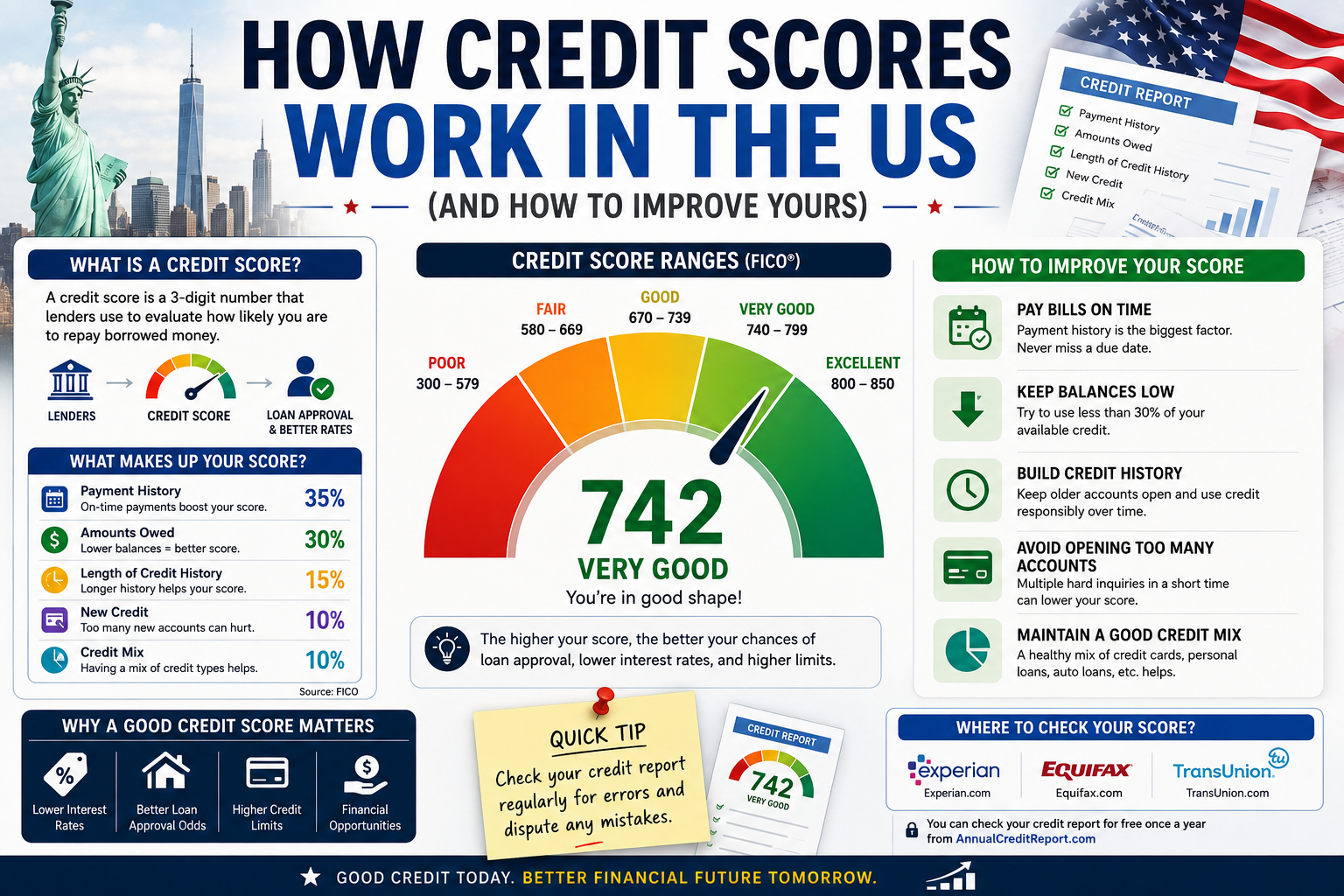
Your credit score quietly affects your mortgage rate, your car loan, even some job applications — yet most people have never actually seen the math behind it. Here's exactly what goes into it and what to do about it.
What a Credit Score Actually Measures
A credit score is a three-digit number, typically 300 to 850, that estimates how likely you are to repay borrowed money on time. Lenders use it to decide whether to approve you for credit and what interest rate to charge — a higher score generally means lower rates, because you're seen as lower risk. The most widely used scoring model in the US is FICO, though VantageScore is also common.
The Five Factors, and How Much Each One Weighs
| Factor | Weight | What It Means |
|---|---|---|
| Payment history | 35% | Have you paid bills on time? The single biggest factor. |
| Amounts owed (utilization) | 30% | How much of your available credit you're actually using |
| Length of credit history | 15% | How long your accounts have been open, on average |
| Credit mix | 10% | A mix of cards, loans, and mortgages, handled responsibly |
| New credit | 10% | Recent applications and hard inquiries |
Notice that payment history and utilization together make up almost two-thirds of your score. If you improve nothing else, focusing on these two moves the needle the most.
Credit Utilization: The Number Most People Ignore
Utilization is the percentage of your available credit that you're currently using. If you have a $10,000 total credit limit across your cards and carry a $3,000 balance, your utilization is 30%. Most experts recommend staying under 30%, and under 10% if you're actively trying to raise your score before a big application like a mortgage.
Utilization is calculated from your statement balance, not what you eventually pay off. Paying your card in full every month can still show high utilization if a large purchase posts right before your statement closes — timing your payments around the statement date can make a real difference.
Practical Steps to Raise Your Score
- Never miss a payment. Set up autopay for at least the minimum due, even on accounts you rarely use.
- Pay down revolving balances before your statement closing date, not just before the due date.
- Keep old accounts open. Closing your oldest card shortens your average credit history and can hurt your score.
- Space out new applications. Each hard inquiry has a small, short-term impact — applying for five cards in a month adds up.
- Check your credit report for errors. Incorrect late payments or accounts that aren't yours are more common than people realize, and disputing them can raise your score quickly.
Where to Check Your Score and Report for Free
You're entitled to a free copy of your credit report from all three bureaus (Equifax, Experian, TransUnion) weekly at AnnualCreditReport.com — the only site authorized by federal law for this. Many banks and credit card issuers also show your FICO or VantageScore for free as part of your online account.
Frequently Asked Questions
How long does a late payment stay on my credit report?
Typically up to seven years, though its impact on your score fades over time, especially if you build a strong on-time payment history afterward.
Does checking my own credit score hurt it?
No. Checking your own score or report is a "soft inquiry" and has zero effect on your credit. Only "hard inquiries" from actual credit applications can cause a small, temporary dip.
What's a "good" credit score in the US?
Generally, 670–739 is considered good, 740–799 very good, and 800+ exceptional under the FICO scale — though exact thresholds can vary slightly by lender.
Want a complete beginner-to-confident roadmap for your money? Our free Personal Finance 101 course in the Finzony Academy covers budgeting, credit, and building an emergency fund from scratch.