
The Core Difference
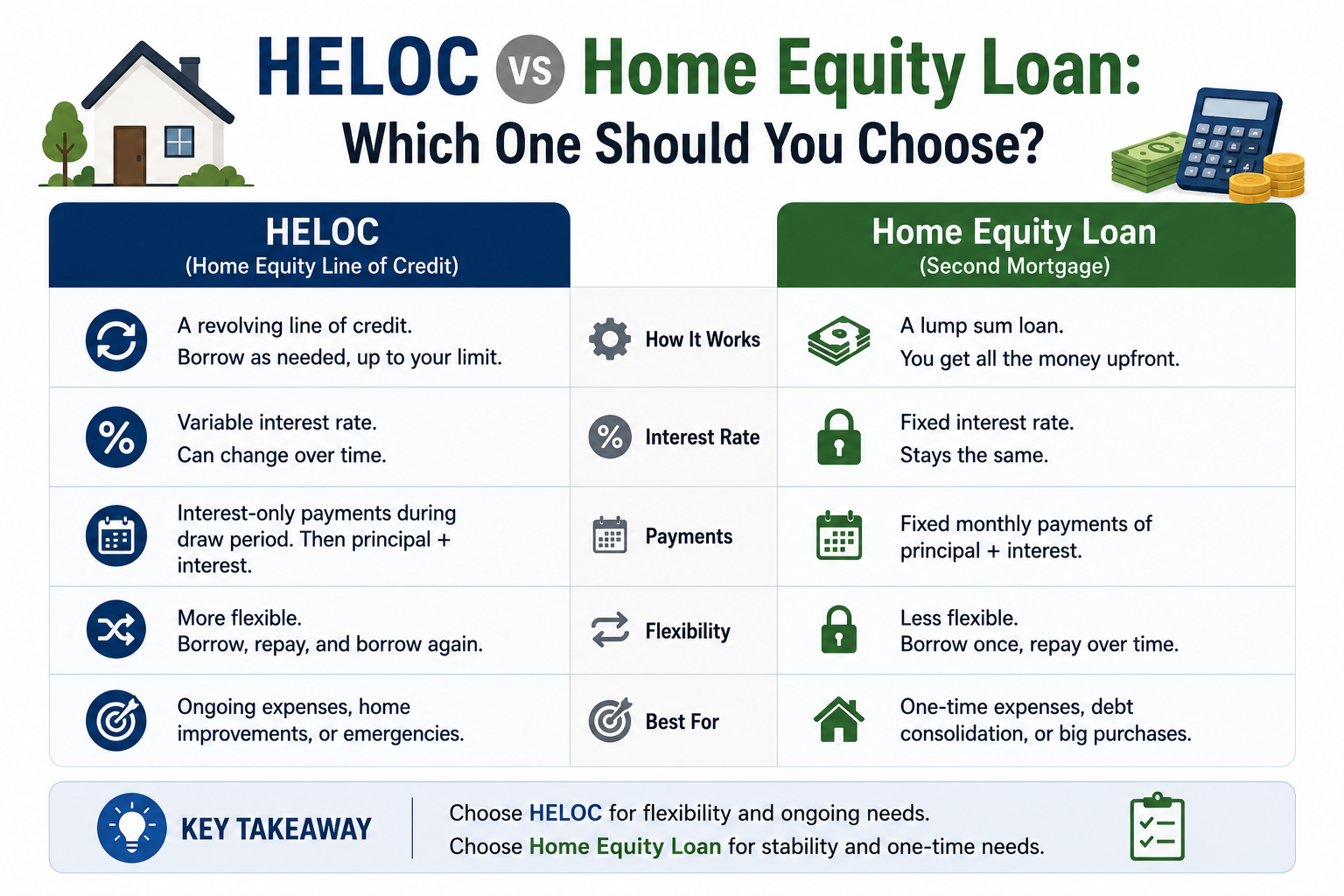
A home equity loan gives you a single lump-sum payout upfront, at a fixed interest rate, repaid in fixed monthly installments over a set term — functionally a second mortgage. A HELOC (home equity line of credit) works like a credit card secured by your house: you get an approved credit limit and draw from it as needed, paying interest only on what you actually use, typically at a variable rate tied to the prime rate.
How Much You Can Actually Borrow
Both are sized off your combined loan-to-value (CLTV) ratio — most lenders cap total borrowing (your existing mortgage plus the new loan) at 80-85% of your home's appraised value. Example: a home worth $500,000 with $300,000 left on the mortgage has $200,000 in equity. At an 85% CLTV cap, the lender allows borrowing up to $425,000 total — meaning you could access up to $125,000 through a HELOC or home equity loan.
Rate Structure — Where the Real Difference Shows Up
| Feature | Home Equity Loan | HELOC |
|---|---|---|
| Rate type | Fixed | Variable (usually) |
| Payout | Lump sum upfront | Draw as needed |
| Payment | Fixed from day one | Interest-only during draw period, then jumps |
| Best for | One-time known cost | Ongoing or uncertain expenses |
HELOCs typically have a 10-year draw period where you can borrow, repay, and re-borrow, followed by a 10-20 year repayment period where the balance converts to fixed principal-and-interest payments. That transition is where a lot of borrowers get caught off guard — a $600 interest-only payment can jump to $1,400+ once principal repayment kicks in.
Closing Costs and Fees
Home equity loans often carry closing costs similar to a mortgage — appraisal, origination, and title fees, typically 2-5% of the loan amount. HELOCs sometimes waive closing costs but may carry an annual maintenance fee and, in some cases, an early-closure fee if you pay it off within the first few years. Always ask for the full fee schedule before comparing rates — a slightly higher rate with no fees can beat a lower rate loaded with costs.
When a Home Equity Loan Makes Sense
Use it when you know the exact number you need and want payment certainty: a $40,000 kitchen renovation with a fixed contractor quote, consolidating high-interest credit card debt into one predictable payment, or covering a one-time medical or legal expense. The fixed rate protects you if interest rates rise after you borrow.
When a HELOC Makes Sense
Use it when your need is ongoing or uncertain: a multi-phase home renovation where costs may change, tuition payments spread over several years, or simply as a financial safety net you may never fully draw on. You only pay interest on what you've actually withdrawn, which makes it far cheaper than a lump sum loan if you don't end up needing the full amount.
The Risk Both Share
Both use your house as collateral. Miss enough payments and the lender can foreclose — this isn't unsecured debt like a credit card. Before signing anything, model your worst-case payment (for a HELOC, assume rates rise 2-3 points) and make sure you could still cover it alongside your primary mortgage.
FAQs
Can I get a HELOC and a home equity loan at the same time? Technically yes, if you have enough equity, but most lenders and financial advisors would flag that as over-leveraging your home.
Is the interest tax-deductible? Interest on both is deductible only if the funds are used to buy, build, or substantially improve the home securing the loan — not for debt consolidation or other personal expenses, under current federal rules.
Which closes faster? HELOCs often close faster (sometimes 2-3 weeks) since many lenders skip a full appraisal in favor of an automated valuation, while home equity loans typically follow a full mortgage-style underwriting timeline.