
EPF vs PPF: Which Retirement Tool Should You Choose?
Finzony Team
Finzony Desk
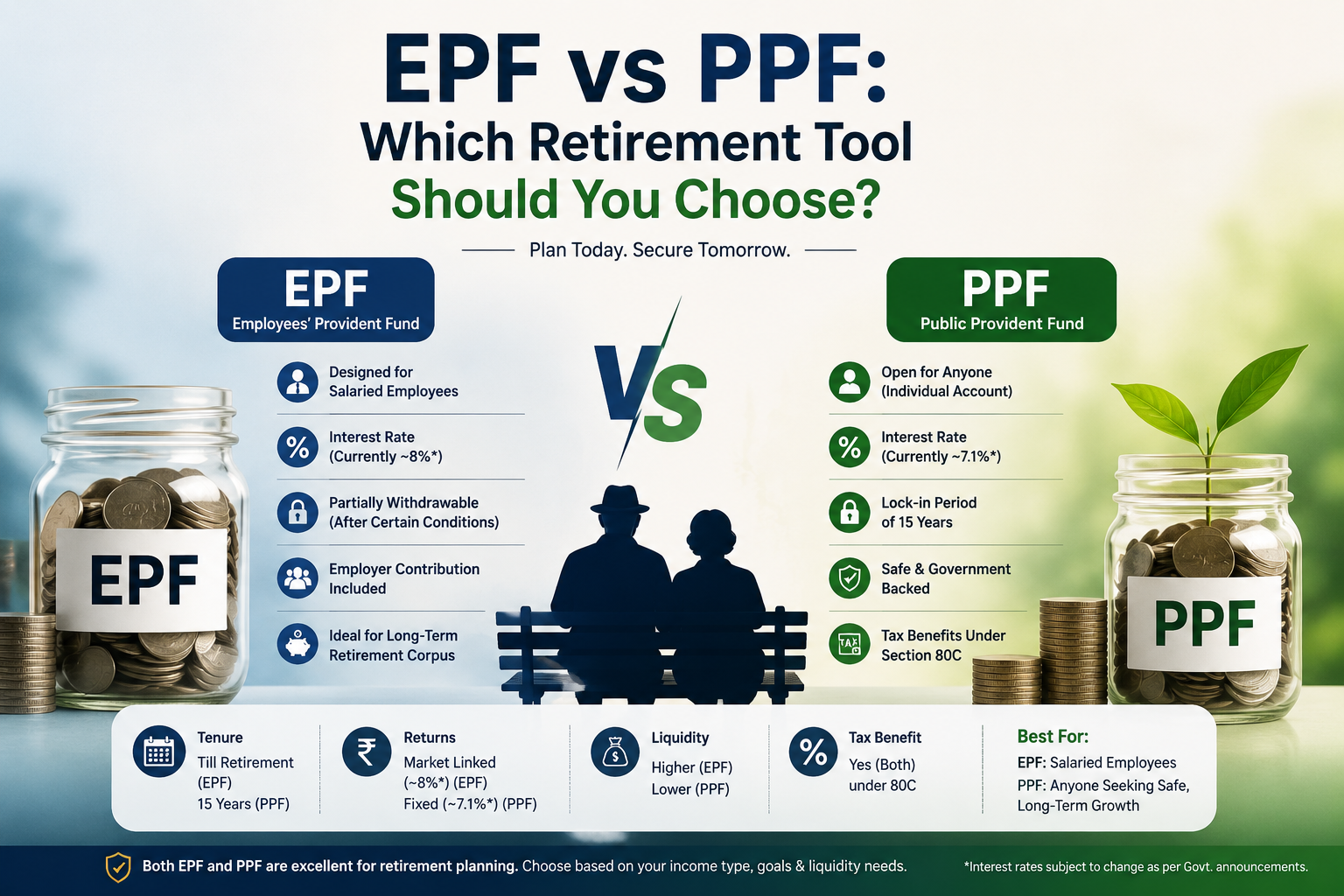
If you're salaried in India, EPF is probably already deducting a chunk of your paycheck every month. If you're self-employed or want to save beyond what EPF offers, PPF is the go-to alternative. Both are government-backed, both are tax-free at maturity — but they're built for different situations.
What is EPF?
The Employees' Provident Fund (EPF) is a mandatory retirement scheme for salaried employees at organisations with 20+ staff. Both you and your employer contribute 12% of your basic salary + dearness allowance every month. The current EPF interest rate is 8.25% per annum, reviewed annually by the EPFO.
- Automatic — deducted directly from salary, no action needed
- Employer match effectively doubles your contribution
- Withdrawal allowed after 5 years of continuous service (tax-free), or earlier for specific needs like medical emergencies or home purchase
- Not available to self-employed individuals or freelancers
What is PPF?
The Public Provident Fund (PPF) is a voluntary long-term savings scheme open to every Indian resident, whether salaried, self-employed, or not working at all. The current PPF interest rate is 7.1% per annum, set quarterly by the Ministry of Finance and unchanged since April 2020.
- Open to anyone — one account per person, 15-year lock-in
- Minimum ₹500, maximum ₹1.5 lakh per financial year
- Partial withdrawals allowed from year 7; loans available from year 3
- Extendable in blocks of 5 years after maturity
EPF vs PPF: Side by Side
| Factor | EPF | PPF |
|---|---|---|
| Interest rate | 8.25% p.a. | 7.1% p.a. |
| Who can open | Salaried employees only | Any Indian resident |
| Lock-in | Till retirement/job change | 15 years |
| Contribution | 12% of basic + DA (mandatory) | ₹500–₹1.5 lakh/year (voluntary) |
| Employer match | Yes | No |
| Tax treatment | EEE (Exempt-Exempt-Exempt) | EEE (Exempt-Exempt-Exempt) |
Which one should you choose?
If you're salaried, EPF isn't optional — and you shouldn't try to opt out, since the employer match alone makes it one of the highest guaranteed returns available. The real question is whether to also open a PPF account on top of it.
It usually makes sense to add PPF if:
- You've maxed out your ₹1.5 lakh Section 80C limit through EPF and still have room to invest more tax-free
- You're self-employed or a freelancer with no EPF access at all
- You want a second, more flexible long-term bucket — PPF allows partial withdrawals earlier than EPF's full-service lock-in
For most salaried employees, the practical approach is: let EPF do the heavy lifting through payroll, and use PPF as a top-up once other 80C options (like ELSS or life insurance premiums) are accounted for.
Do the math for your situation
Run your numbers through Finzony's EPF Calculator and PPF Calculator to see exactly how much each will grow to by your target retirement age.
This article is for educational purposes only and does not constitute financial advice. Interest rates are revised quarterly/annually by the government and may change from what's stated here — always check the latest EPFO/Ministry of Finance notification before making investment decisions.