
Debt Snowball vs. Avalanche: Which Payoff Method Is Actually Faster?
Debt Writer
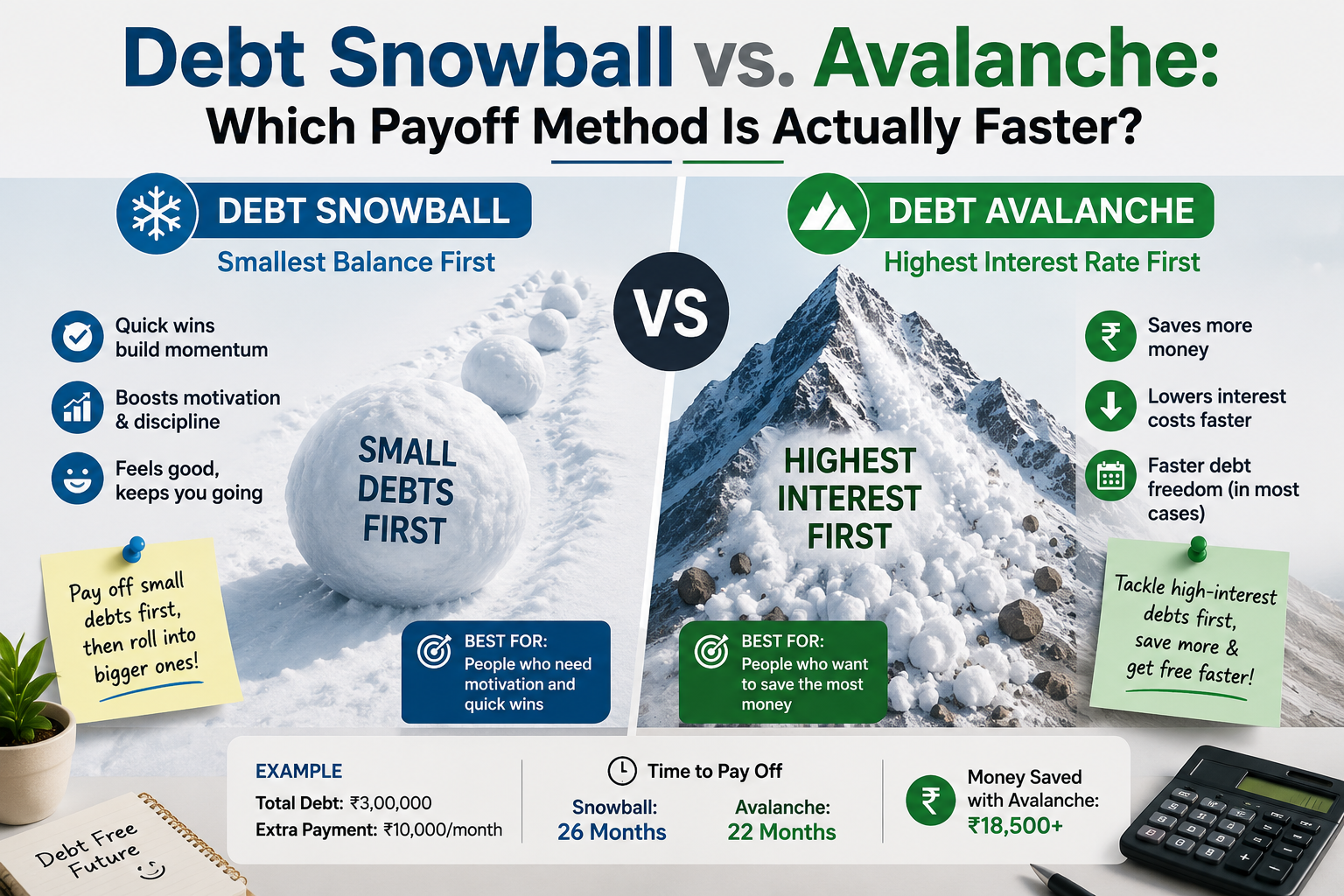
If you've got more than one debt and you're ready to attack it, you'll run into this fork in the road almost immediately: pay off the smallest balance first, or the one charging the most interest? These are the two most talked-about debt payoff strategies — the snowball and the avalanche — and the "right" one depends less on math and more on how you're wired.
The debt snowball
List your debts from smallest balance to largest, ignoring interest rates completely. Pay minimums on everything except the smallest, and throw every extra dollar at that one until it's gone. Then roll what you were paying on it into the next-smallest balance, and repeat — like a snowball picking up size as it rolls downhill.
The debt avalanche
List your debts from highest interest rate to lowest, ignoring the balance size. Pay minimums on everything except the highest-rate debt, and throw every extra dollar there first. Once it's paid off, move to the next-highest rate.
The math favors the avalanche
Because the avalanche eliminates your most expensive debt first, it minimizes the total interest you pay over the life of your payoff plan. If pure math were the only factor, avalanche wins every time — sometimes saving hundreds or even thousands of dollars compared to snowball, depending on your balances and rates.
The bigger the gap between your highest and lowest interest rates, the more the avalanche method saves you compared to the snowball.
So why does anyone use the snowball?
Because paying off debt isn't just a math problem — it's a motivation problem. Knocking out a full balance, even a small one, gives you a real win early on. That first "paid in full" is a genuine psychological boost, and for a lot of people, that boost is the difference between sticking with a payoff plan for years and giving up after a few months.
Research on the topic has found that people using the snowball method often stick with their debt payoff plan longer than those using strictly interest-rate-based approaches — even though the snowball can cost more in total interest. A method that gets finished beats a cheaper method that gets abandoned.
A quick way to decide
| Choose Avalanche if... | Choose Snowball if... |
|---|---|
| You're disciplined and motivated by saving money, not quick wins | You've tried paying off debt before and lost motivation partway through |
| The interest rate gap between your debts is large | You have several small debts and want early wins to build momentum |
| You want the mathematically optimal payoff | You want the plan you're most likely to actually finish |
Neither is wrong
Both methods lead to the same place: zero debt. The best one is the one you'll actually stick with until the last payment is gone — a cheaper plan on paper that you abandon in month four doesn't beat a slightly more expensive plan you finish.
Want a full plan, not just the two methods?
This is just the strategy piece. Our free course covers the full picture — understanding what your debt is really costing you, building a realistic payoff timeline, and staying debt-free once you get there.
→ Start the Debt Payoff Strategies course, or go straight to the Debt Snowball lesson or the Debt Avalanche lesson for a full worked example of each.