
Critical Illness Insurance in India (2026)
Finzony Team
Finzony Desk
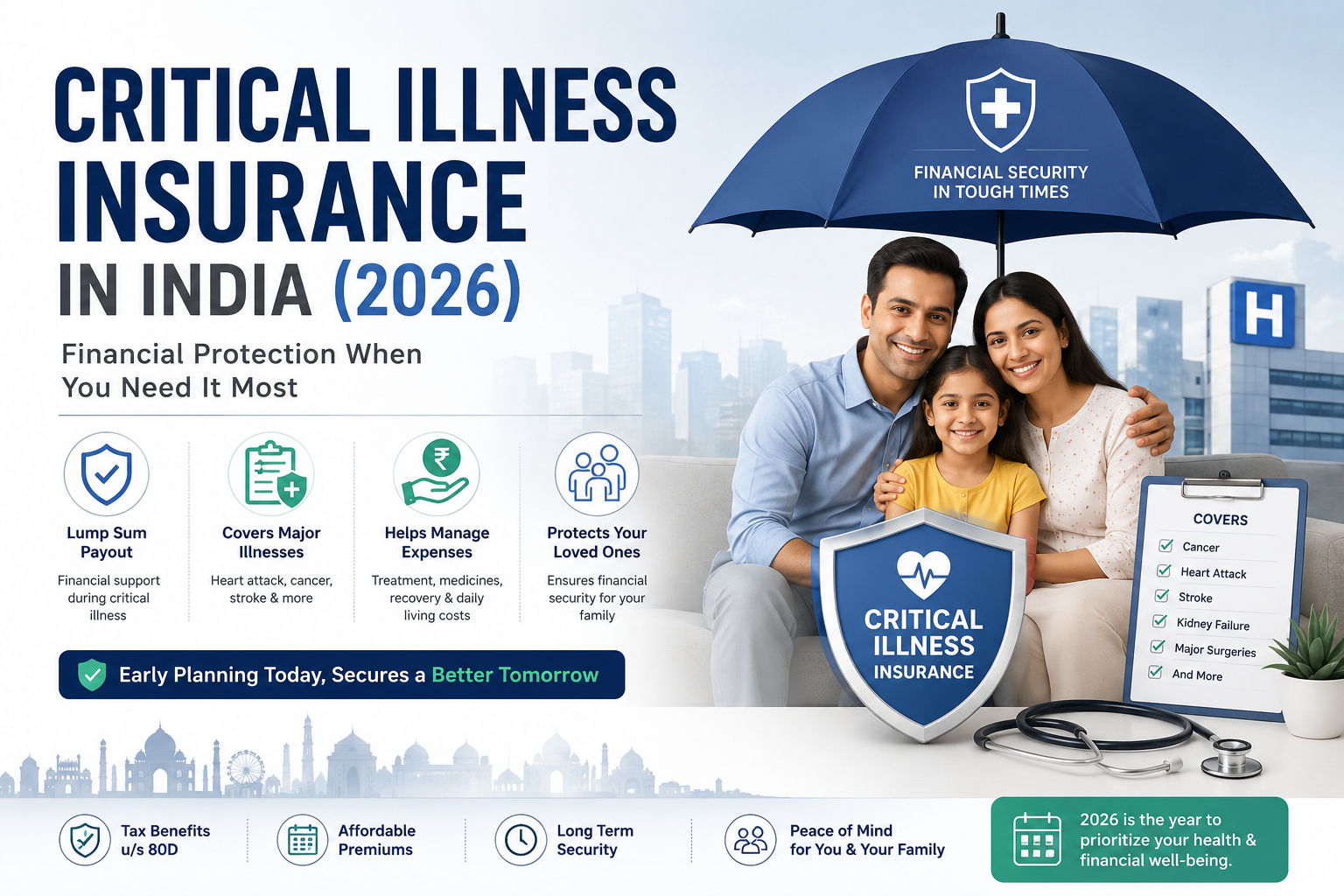
Critical Illness Insurance in India (2026): Complete Guide to Coverage, Waiting Periods & Tax Benefits
A heart attack, cancer diagnosis, or kidney failure doesn't just cost you a hospital bill — it costs you months of income, follow-up treatment, special diets, home care, and sometimes travel for a second opinion. Regular health insurance covers the hospital bill. It doesn't cover any of the rest. That gap is exactly what critical illness insurance is built to fill.
This guide breaks down how critical illness insurance actually works in India, what changed in 2026, and how to pick a plan that won't leave you disappointed at claim time.
What Is Critical Illness Insurance?
Critical illness insurance is a benefit-based policy — not a reimbursement policy. That distinction matters a lot. With regular health insurance, the insurer pays (or reimburses) your actual hospital bills. With critical illness cover, the moment you're diagnosed with a listed illness and it's confirmed by the required medical tests, the insurer pays out the entire sum insured as a lump sum, regardless of what you actually spend.
If you hold a ₹20 lakh critical illness policy and are diagnosed with a covered cancer, you get ₹20 lakh directly in your bank account. No bills, no receipts, no restrictions on how you use it — EMIs, a caregiver's salary, your child's school fees, or the family's monthly expenses while you're not earning.
What's New in 2026
Two regulatory changes make 2026 a genuinely good time to buy or upgrade critical illness cover:
A standardized 64-disease list. Until recently, every insurer defined "heart attack" or "stroke" slightly differently, and coverage ranged anywhere from 10 to 40+ conditions depending on the company. IRDAI has now mandated a standardized list of 64 critical illnesses that all insurers must use with identical medical definitions. This makes comparing plans far easier, and it also means you no longer lose your waiting-period progress when porting your policy to a different insurer — the underlying disease definitions are now the same everywhere.
GST removal on health insurance premiums. With GST removed from health insurance premiums in late 2025, critical illness and health premiums have become close to 18% cheaper than before — making this a good window to lock in higher coverage for roughly the same budget you'd have set aside earlier.
There's also a 5-year moratorium rule now in place: once you've continuously renewed a policy for 5 years, the insurer can no longer reject a claim by citing non-disclosure of an old medical detail — a common reason claims used to get stuck in disputes.
Diseases Typically Covered
While the exact list depends on your insurer and plan tier, the standardized 64-condition list generally spans four broad categories:
- Cardiovascular — heart attack, coronary artery bypass surgery, stroke
- Cancer — covered at various stages depending on the plan (some cover early-stage, others only major-stage cancers — this is a critical detail to check before buying)
- Organ-related — kidney failure, major organ transplant, liver disease
- Neurological — paralysis, multiple sclerosis with persisting symptoms, coma
Cheaper or older plans may only cover 10-20 of these conditions. If your family has a history of a specific illness — say, diabetes-related kidney disease or early-onset cancer — check that the exact condition and its precise definition (not just the category) is on your shortlisted plan's list before you buy.
Waiting Period and Survival Period — The Two Clauses That Decide Your Claim
These two clauses trip up more claims than almost anything else, so it's worth understanding them clearly.
Waiting period — the window right after you buy the policy during which no claim is payable, even if you're diagnosed with a covered illness. This typically ranges from 30 to 90 days, though some plans push it to 180 days. It exists to stop people from buying a policy after they already suspect something is wrong.
Survival period — after diagnosis, you must survive a minimum number of days (commonly 15 to 30 days) for the claim to be valid. If the insured person passes away before the survival period ends, the critical illness benefit typically isn't paid — though a regular term or life insurance payout, if held separately, would still apply.
Some plans also apply a waiting period between conditions (often 12 months) if you're claiming for a second, different illness under a multi-pay plan.
Practical takeaway: shorter waiting and survival periods are genuinely valuable features, not just fine print — they directly affect whether your family actually receives the payout when it matters.
Tax Benefits Under Section 80D
Premiums paid for critical illness insurance qualify for a tax deduction under Section 80D, whether bought as a standalone policy or as a rider on a term insurance plan:
- ₹25,000 per year for individuals below 60
- ₹50,000 per year for senior citizens
This deduction is separate from your 80C investments, making critical illness cover one of the more tax-efficient ways to protect your finances against a major health event.
Standalone Policy vs. Rider on Term Insurance
You can access critical illness coverage two ways:
As a rider on a term insurance plan — cheaper upfront and simple to manage, since it's bundled with a policy you likely already hold. The downside: the rider often terminates once you make a claim, or once the base term policy ends, and coverage amounts are usually capped lower than a standalone plan would offer.
As a standalone critical illness policy — a dedicated policy purchased independently of any life insurance. These tend to offer higher sum insured limits, sometimes multi-pay structures (where you can claim more than once for different illness categories), and continue independently regardless of what happens to any other policy you hold. If you're under 30, locking in a standalone plan early is a smart move — premiums stay low and you avoid future medical underwriting complications if health issues develop later.
How Much Coverage Do You Need?
A simple starting point: estimate your monthly household expenses (rent/EMI, groceries, utilities, existing loan payments) and multiply by 12-18 months — the realistic recovery and reduced-income window for a serious illness. If your monthly expenses run ₹1 lakh, a cover in the ₹12-18 lakh range is a reasonable starting figure, before factoring in the treatment cost itself, which can easily run into several lakhs for cancer or cardiac procedures at a good private hospital.
Also factor in medical inflation — running well above 10% annually in India — which means a sum insured that looks generous today may fall short in five or ten years. Reviewing and topping up your cover periodically is worth doing, not a one-time decision.
How to Choose the Right Plan
- Check the exact disease list and definitions, not just the count of illnesses covered
- Compare waiting and survival periods across shortlisted insurers — shorter is better
- Check the claim settlement ratio published by IRDAI for each insurer — a consistently high ratio is a meaningful trust signal
- Decide between rider and standalone based on your age and how much coverage you actually need
- Read the exclusions carefully — pre-existing conditions, self-inflicted injuries, and substance-abuse-related diagnoses are commonly excluded across insurers
Frequently Asked Questions
Is critical illness insurance different from regular health insurance?
Yes. Regular health insurance reimburses actual hospital bills (indemnity-based). Critical illness insurance pays a fixed lump sum on diagnosis of a listed illness (benefit-based), regardless of what you actually spend.
What is the waiting period for critical illness insurance in India?
Typically 30 to 90 days from policy start, though it can extend to 180 days on some plans. No claim is payable for an illness diagnosed within this window.
Does critical illness insurance cover pre-existing diseases?
Generally, no. Illnesses diagnosed before the policy start date are excluded, and this exclusion typically continues through the initial waiting period even for newly-diagnosed related conditions.
Can I claim critical illness insurance and regular health insurance for the same illness?
Yes. Since critical illness insurance is a separate lump-sum benefit and not a reimbursement policy, you can claim it alongside your regular health insurance for hospital expenses — the two aren't mutually exclusive.
Is the critical illness payout taxable?
No. The lump sum payout is tax-free, and the premiums you pay qualify for deduction under Section 80D.
Bottom Line
Critical illness insurance fills a real gap that standard health insurance leaves open — income loss, recovery-period expenses, and the financial pressure that starts the moment a serious diagnosis lands, regardless of what the hospital eventually charges. With the 2026 standardization of the 64-disease list and cheaper premiums following the GST removal, this is a genuinely good time to compare plans and lock in coverage while you're young and healthy enough to get the best rates.
Compare critical illness plans from India's top insurers on our critical illness insurance page to see coverage, waiting periods, and claim settlement ratios side by side.