
CD vs High-Yield Savings Account: Where Should Your Emergency Fund Go?
Savings Writer
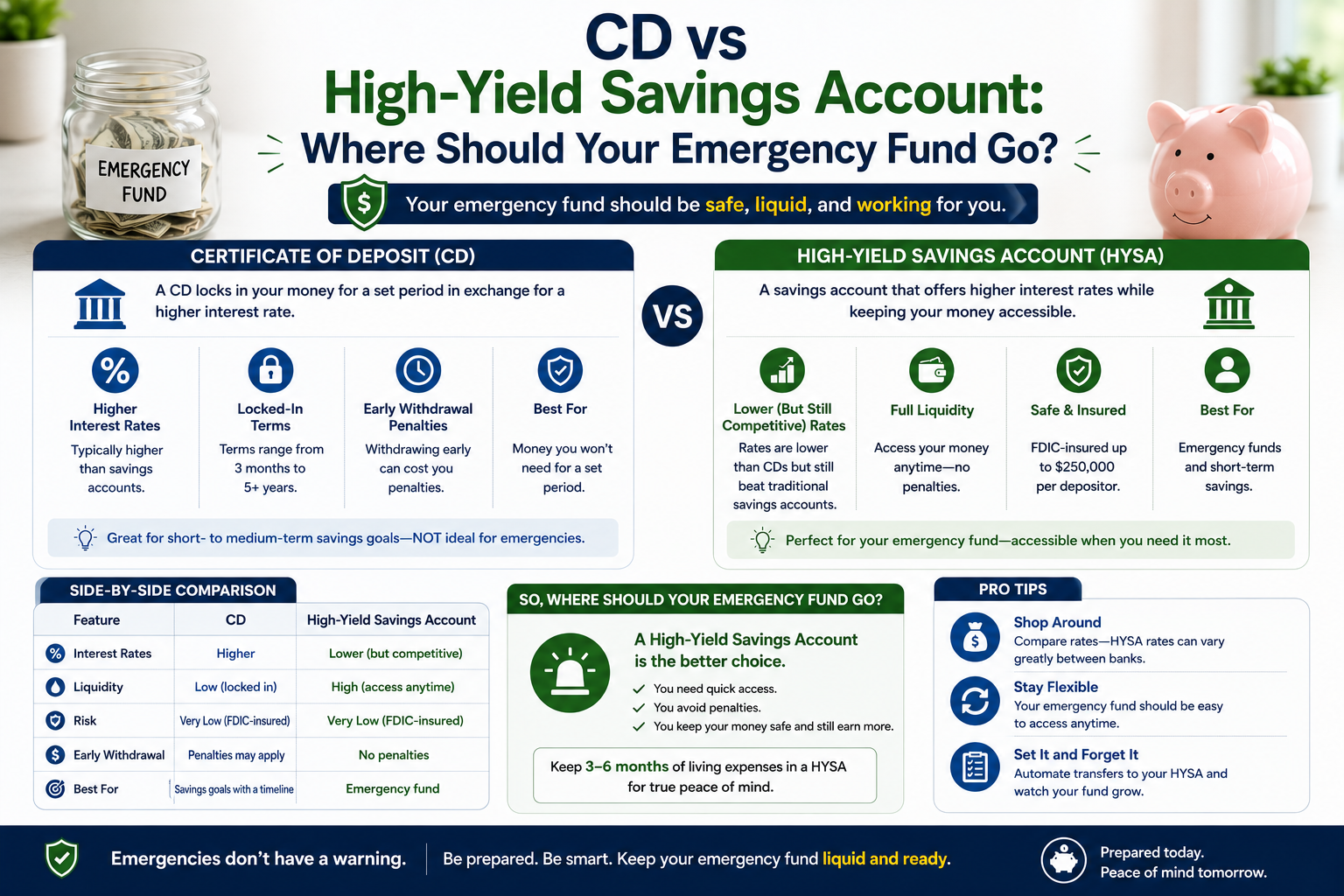
The Core Difference
A High-Yield Savings Account (HYSA) lets you deposit and withdraw money freely, with an interest rate that can change at any time based on market conditions. A Certificate of Deposit (CD) locks your money in for a fixed term — say 6 months, 1 year, or 5 years — in exchange for a fixed interest rate, with a penalty for early withdrawal.
Side-by-Side Comparison
| Factor | High-Yield Savings Account | Certificate of Deposit (CD) |
|---|---|---|
| Access to funds | Anytime, no penalty | Locked until maturity, or pay an early withdrawal penalty |
| Interest rate | Variable — can change anytime | Fixed for the entire term |
| Best for | Emergency funds, near-term flexible savings | Money you're confident you won't need until a specific date |
| FDIC insurance | Yes, up to $250,000 per depositor per bank | Yes, same coverage |
Why Liquidity Matters Most for Emergency Funds
The defining feature of an emergency fund is that you don't know when you'll need it — a job loss, medical bill, or car repair doesn't wait for a CD to mature. This is why a HYSA is generally the better home for an emergency fund: the ability to withdraw instantly without penalty is more valuable than a slightly higher CD rate, since being locked out of your own money during an actual emergency defeats the purpose of having the fund at all.
When a CD Might Make Sense
- You have savings for a specific, known future expense (a house down payment in 18 months, a planned purchase) where the timing is fixed and won't change
- You want to lock in today's rate because you expect rates to fall before your money would otherwise be needed
- You've already built a fully-funded, liquid emergency fund and have additional savings beyond that you're comfortable locking up
CD Laddering: A Middle-Ground Strategy
Instead of putting all your money into one CD term, laddering means splitting it across multiple CDs with staggered maturity dates (e.g., 3-month, 6-month, 9-month, 12-month). As each CD matures, you get periodic access to a portion of your funds while still benefiting from CD rates — a way to capture some of the CD's typical rate advantage without fully sacrificing liquidity.
Common Mistakes to Avoid
1. Locking your entire emergency fund into a CD. Even a small early-withdrawal penalty can be costly or inconvenient during an actual emergency — keep at least a meaningful portion of your emergency fund fully liquid in a HYSA.
2. Chasing a slightly higher CD rate without checking the penalty terms. Early withdrawal penalties vary significantly between banks and CD terms — a marginally better rate isn't worth it if the penalty is severe relative to your likely need for flexibility.
3. Ignoring that HYSA rates are variable. A HYSA's rate can drop after you open the account, especially during a falling-rate environment — check periodically to make sure your rate remains competitive, and don't assume it will stay the same as when you opened it.
4. Not comparing actual current rates before choosing. HYSA and CD rates both fluctuate with the broader interest rate environment — compare actual current offers rather than relying on general assumptions about which typically pays more.
5. Forgetting FDIC insurance limits when holding large balances. Both account types are FDIC-insured up to $250,000 per depositor, per bank — balances beyond that at a single institution aren't covered, which matters for larger emergency funds or savings goals.
Key Takeaway: For an emergency fund specifically, liquidity matters more than squeezing out a slightly higher rate — a HYSA is generally the better fit. CDs are better suited to savings with a known, fixed timeline where you're confident you won't need the money before maturity, or as part of a laddering strategy that balances rate and flexibility.
Frequently Asked Questions
Is my money safe in a HYSA or CD?
Both are FDIC-insured up to $250,000 per depositor, per bank, making them equally safe from a deposit-insurance standpoint. The main difference between them is liquidity and rate structure, not safety.
What happens if I withdraw from a CD early?
You typically face an early withdrawal penalty, often calculated as a certain number of months' worth of interest — the exact penalty varies by bank and CD term, so check the terms before committing funds.
Should I split my emergency fund between a HYSA and a CD?
Most financial planners suggest keeping the full emergency fund liquid in a HYSA, since you can't predict when you'll need it. A CD is better suited for savings goals with a known, fixed timeline beyond your emergency fund.
What is CD laddering and when does it make sense?
It's splitting savings across multiple CDs with staggered maturity dates, so you get periodic access to portions of your money while still earning CD rates. It's useful for balancing rate benefits with some ongoing liquidity.
Do HYSA interest rates change often?
Yes — unlike a CD's fixed rate, a HYSA's rate is variable and can be adjusted by the bank at any time, typically moving in line with broader interest rate trends.