
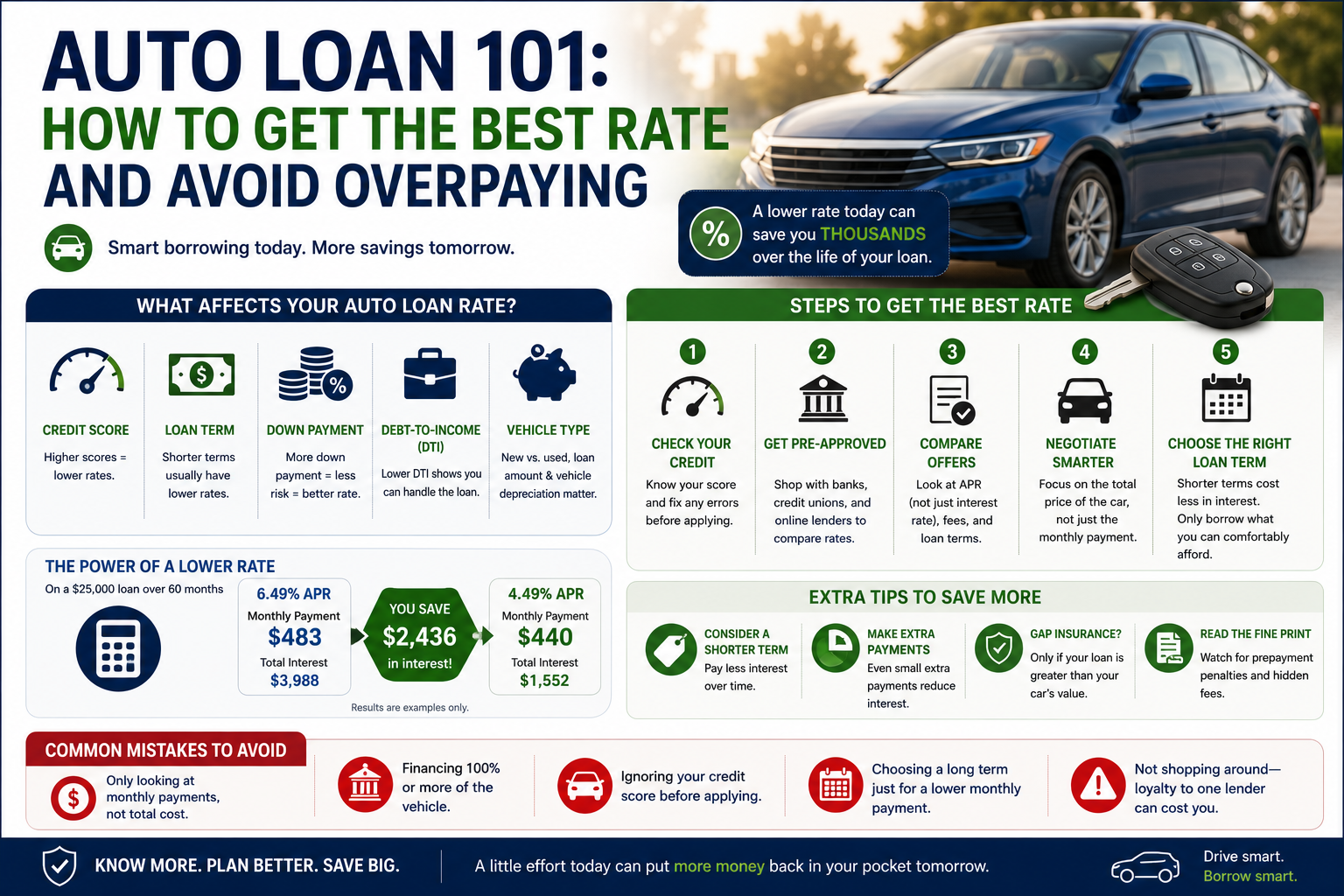
What Determines Your Auto Loan Rate
Your auto loan interest rate is driven primarily by your credit score, the loan term, whether the car is new or used, and the lender type you choose. Borrowers with strong credit typically qualify for meaningfully lower rates than those with fair or poor credit — the gap between the best and worst credit tiers can easily be several percentage points, which adds up to thousands of dollars over the life of a loan.
Where to Shop for a Loan
| Lender Type | Typical Trade-off |
|---|---|
| Credit unions | Often the lowest rates, but membership eligibility required |
| Banks | Competitive rates, especially with an existing relationship |
| Dealership financing | Convenient, but rates can be marked up — always compare against outside offers |
| Online lenders | Fast pre-approval, useful for rate-shopping before visiting a dealer |
Get Pre-Approved Before You Shop
Getting pre-approved from a bank, credit union, or online lender before visiting a dealership gives you a real rate to compare against, and negotiating leverage once you're there. Dealership finance offices sometimes mark up the rate a lender actually offered them, so walking in with your own pre-approval in hand protects you from overpaying without realizing it.
Loan Term: Shorter Usually Wins
A longer loan term (72 or 84 months) lowers your monthly payment but means paying significantly more in total interest and staying "underwater" (owing more than the car is worth) for longer. A shorter term (36-60 months) usually carries a lower interest rate and a much lower total interest cost, even though the monthly payment is higher — if you can afford the higher payment, it's almost always the cheaper choice overall.
New vs. Used Car Loans
New car loans typically qualify for lower interest rates than used car loans, partly because the collateral (the car) holds more predictable value. However, a used car's lower purchase price often more than offsets the slightly higher rate — run the total cost comparison rather than assuming new is always more expensive overall.
Common Mistakes to Avoid
1. Only comparing monthly payments, not total cost. A dealer can make almost any car "fit your budget" by stretching the loan term — always compare the total interest paid over the life of the loan, not just the monthly number.
2. Skipping pre-approval and relying only on dealer financing. Without an outside offer to compare against, you have no way to know if the dealership's rate is competitive or marked up.
3. Rolling negative equity from a trade-in into the new loan. If you still owe more than your trade-in is worth, rolling that gap into the new loan means starting the new loan already underwater, and paying interest on debt from your old car.
4. Not checking your credit report before applying. Errors on your credit report can lower your score and cost you a better rate — check it ahead of time and dispute any inaccuracies before shopping for a loan.
5. Focusing only on rate and ignoring add-ons. Extended warranties, gap insurance, and other add-ons pitched at the finance desk can meaningfully increase your total loan amount — decide on these separately, not as a bundled "yes" during rate negotiation.
Key Takeaway: The lowest monthly payment isn't always the cheapest loan — a shorter term, a strong credit score, and a pre-approved rate to negotiate against are what actually determine how much you pay in total. Shop your loan before you shop for the car, not after.
Frequently Asked Questions
Should I get pre-approved before going to the dealership?
Yes — a pre-approval gives you a real rate to compare against and protects you from a marked-up dealer financing rate, while also giving you negotiating leverage at the dealership.
Is a longer loan term ever a good idea?
It can make sense if the lower monthly payment is genuinely necessary for your budget, but be aware it usually costs more in total interest and keeps you underwater on the loan for longer.
Does my credit score really make that much of a difference?
Yes — the rate gap between strong and weak credit tiers can be several percentage points, which compounds into a meaningfully higher total cost over a multi-year loan.
Is dealership financing always worse than a bank or credit union?
Not always — dealerships sometimes offer promotional rates that beat outside lenders, especially on new cars. The key is comparing your pre-approved rate against whatever the dealer offers, rather than assuming either is automatically better.
What is negative equity and why does it matter?
It's when you owe more on your current car loan than the car is worth. Rolling that gap into a new loan means you start the new loan already underwater, paying interest on debt tied to a car you no longer own.