
529 Plan Explained: The Complete Guide to College Savings in 2026
Savings Writer
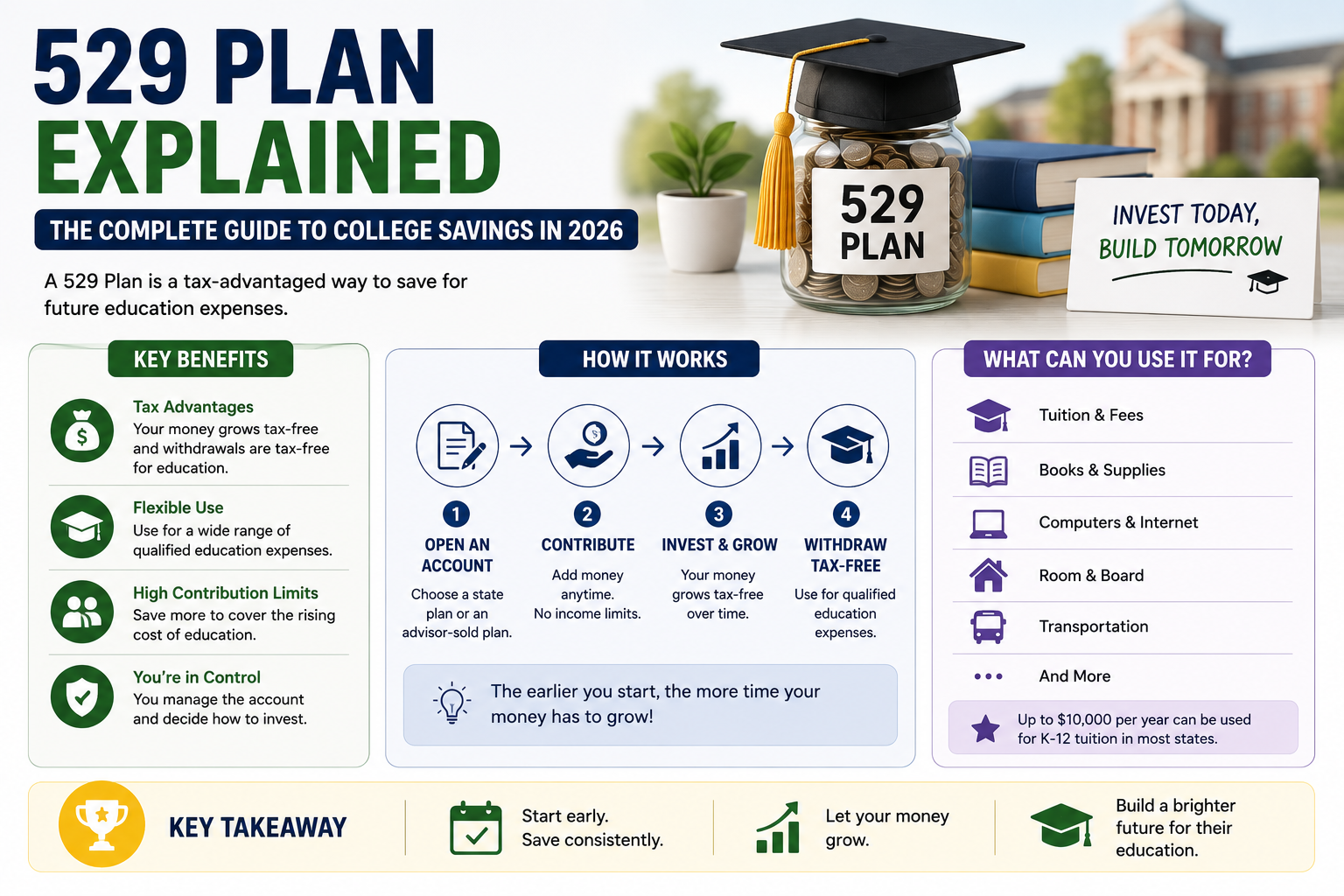
What Is a 529 Plan?
A 529 plan is a state-sponsored, tax-advantaged investment account built for education expenses. You contribute after-tax dollars, the money grows tax-deferred, and withdrawals are completely tax-free at the federal level as long as they're used for qualified education expenses — tuition, fees, room and board, books, supplies, and computers required for enrollment.
Named after Section 529 of the Internal Revenue Code, these plans are run by individual states, but you're not restricted to your own state's plan. You can open a 529 in Utah while living in Texas — the "529" just refers to the tax structure, not a single national program.
Education Savings Plan vs. Prepaid Tuition Plan
There are two structurally different types of 529 accounts:
- Education savings plans invest your contributions in a portfolio of mutual funds or age-based target-date funds, similar to a 401(k). Your balance rises and falls with the market. This is the version most families use, since it covers K-12 tuition, community college, four-year colleges, and even eligible trade and vocational schools.
- Prepaid tuition plans let you buy tuition credits at today's prices for use at a specific list of in-state public universities later. These protect you from tuition inflation but are far less flexible — only a handful of states still offer them, and they typically don't cover room and board.
The Tax Break, in Real Numbers
Say you invest $300/month starting when your child is born, and the account averages a 7% annual return over 18 years. By the time your child turns 18, you'd have contributed $64,800 — but the account would be worth roughly $128,000. In a normal taxable brokerage account, you'd owe capital gains tax on that $63,000+ of growth when you sold. In a 529, that entire gain comes out completely tax-free, as long as it's spent on qualified expenses.
On top of the federal tax-free growth, more than 30 states offer a state income tax deduction or credit for contributions to their own plan — some up to several thousand dollars per year, per taxpayer. If your state offers this, contributing through your own state's plan first is usually the easy win before shopping elsewhere.
Contribution Limits
There's no federal annual contribution cap on 529 plans — states set aggregate lifetime limits, typically between $235,000 and $575,000 per beneficiary. Where the IRS does get involved is gift tax treatment: contributions count as gifts to the beneficiary. In 2026, you can contribute up to the annual gift-tax exclusion per beneficiary without filing a gift tax return, and 529s uniquely allow "superfunding" — contributing five years' worth of that exclusion in one lump sum, spread over five years for gift-tax purposes. This is a common move for grandparents wanting to jump-start an account early.
What If Your Child Doesn't Use It All?
This is the #1 hesitation parents have, and it's largely outdated as a concern:
- Change the beneficiary — you can switch the account to another family member (sibling, cousin, even yourself) with no tax consequence, as often as you like.
- Use it for yourself — 529 funds can pay for your own continuing education or career-change coursework.
- Roll into a Roth IRA — as of recent rule changes, unused 529 funds can be rolled into a Roth IRA for the beneficiary, up to a $35,000 lifetime limit, provided the account has been open at least 15 years.
- Withdraw it anyway — you can always withdraw non-qualified, but you'll owe income tax plus a 10% penalty on the earnings portion only (never on your original contributions).
How to Actually Pick a Plan
Run through this order: First, check if your own state offers a tax deduction — if yes, get quotes on your state's plan first. Second, compare expense ratios; look for plans with underlying fund fees under 0.20%, since fees compound against you over 18 years just like returns compound for you. Third, look at investment options — most parents are best served by an age-based portfolio that automatically shifts from stocks to bonds as college approaches, so you don't have to manage it manually.
Common Mistakes to Avoid
Don't wait until high school to start — time in the market matters more than the amount you contribute early on. Don't over-fund a single beneficiary's account if you're unsure they'll use it all — you can always open additional accounts or add contributions later. And don't ignore the state tax deduction deadline — most states require contributions by December 31 to count for that tax year, not the April filing deadline.
FAQs
Can grandparents contribute to a 529 without owning the account? Yes — anyone can contribute to any 529 account regardless of who owns it, making it an easy structured gift for birthdays and holidays.
Does a 529 affect financial aid eligibility? A parent-owned 529 is counted as a parental asset on the FAFSA, which has a much smaller impact on aid eligibility than an asset owned directly by the student.
Can I use 529 funds for study abroad? Yes, as long as the foreign institution is eligible for U.S. federal student aid, which covers most major study-abroad programs.