
15-Year vs 30-Year Mortgage: Which Saves You More?
Home Buying Writer
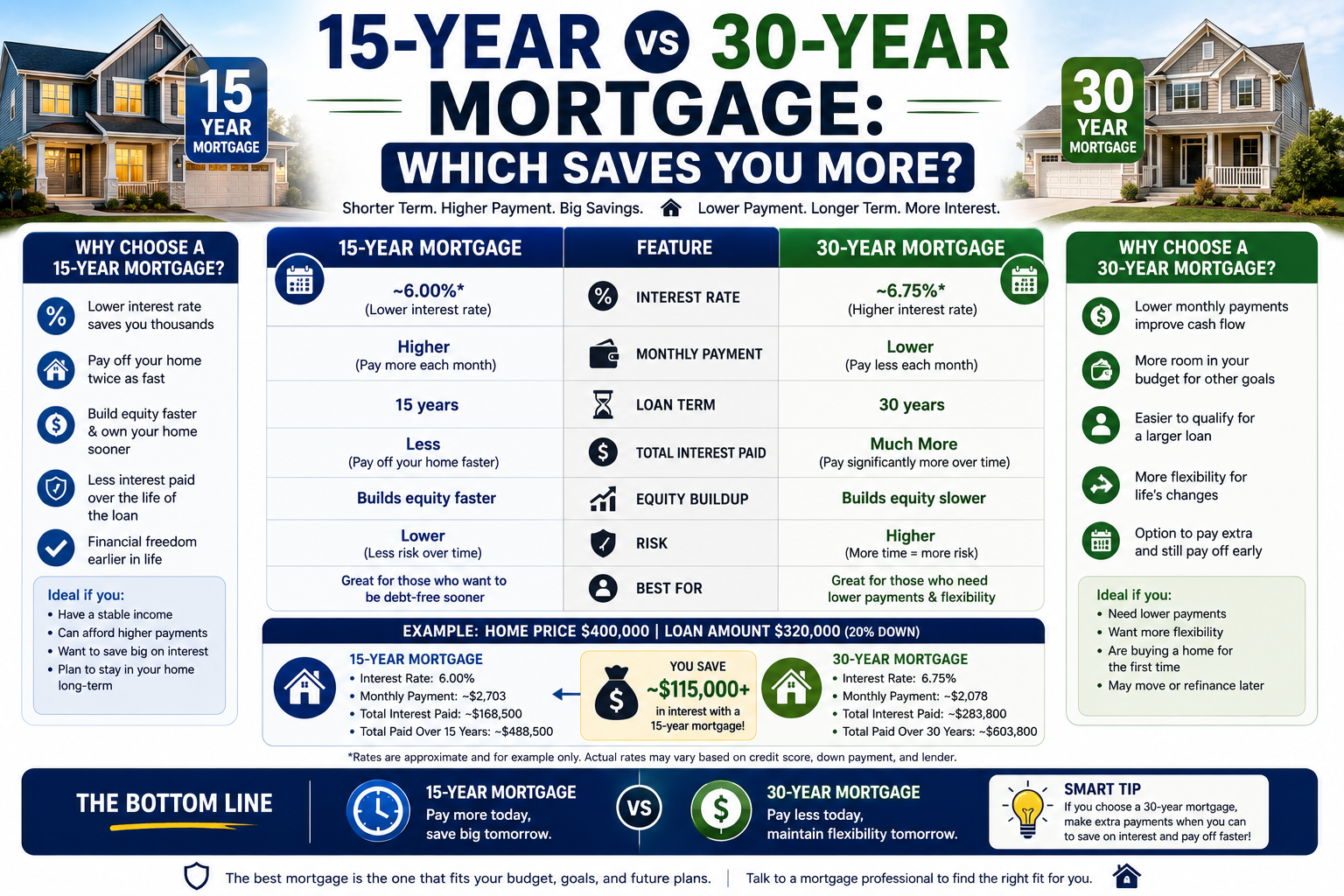
The Core Trade-off
A 15-year mortgage carries a higher monthly payment but significantly less total interest over the life of the loan. A 30-year mortgage carries a lower monthly payment but meaningfully more total interest, since you're paying interest for twice as long. Both are standard, widely available loan terms — the right choice depends on your monthly budget and long-term financial goals, not just which one "saves more" in isolation.
A Simplified Comparison
| Factor | 15-Year Mortgage | 30-Year Mortgage |
|---|---|---|
| Monthly payment | Higher | Lower |
| Total interest paid | Significantly less | Significantly more |
| Interest rate | Typically lower | Typically slightly higher |
| Equity buildup | Much faster | Slower |
| Monthly cash flow flexibility | Less | More |
Why 15-Year Loans Usually Have Lower Rates
Lenders generally offer a somewhat lower interest rate on 15-year loans compared to 30-year loans, because a shorter loan term means less risk exposure for the lender over time. This means the true cost difference between the two terms is even larger than the payment schedule alone suggests — you're not just paying interest for half as long, you're often paying a lower rate on top of that.
Who a 15-Year Mortgage Makes Sense For
- You can comfortably afford the higher monthly payment without straining your other financial goals (retirement savings, emergency fund)
- You want to be mortgage-free well before retirement
- You're refinancing later in your loan term and want to minimize total remaining interest
Who a 30-Year Mortgage Makes Sense For
- You want lower monthly payments to preserve cash flow for other goals — investing, an emergency fund, or simply more budget flexibility
- You'd rather invest the payment difference elsewhere (e.g., in a retirement account) if you can realistically earn a return higher than the mortgage rate
- You're a first-time buyer where affordability is the primary constraint
The "Invest the Difference" Strategy
Some buyers choose a 30-year mortgage specifically to invest the payment difference (versus a 15-year loan) into the stock market or retirement accounts, betting that long-term investment returns will exceed the mortgage's interest rate. This can work out favorably over long horizons, but it requires genuine discipline to actually invest the difference every month rather than spend it — and it does carry market risk that a straightforward 15-year payoff doesn't.
Common Mistakes to Avoid
1. Choosing 30 years just because the payment is lower, without a plan for the difference. If you're not going to actually invest or save the payment gap, you're simply paying more total interest with nothing to show for the trade-off.
2. Assuming a 15-year loan is always "better" because it saves interest. Total interest saved doesn't matter if the higher payment stretches your budget too thin, especially if it crowds out retirement contributions or an emergency fund.
3. Not considering a middle path. Many buyers take a 30-year mortgage but make extra principal payments voluntarily — this offers 30-year payment flexibility with much of the interest savings of a shorter term, without being locked into the higher required payment.
4. Forgetting that extra payments need to be applied correctly. If you do make extra payments on a 30-year loan to pay it down faster, confirm with your lender that the extra amount is applied to principal, not just to future scheduled payments.
5. Ignoring the opportunity cost either way. Whether you choose 15 or 30 years, the money isn't just "spent" — it's either building equity faster (15-year) or potentially available for other investments (30-year). Think through both sides, not just the interest total.
Key Takeaway: A 15-year mortgage saves significantly more in total interest and builds equity faster, but demands a higher monthly payment; a 30-year mortgage offers flexibility and lower payments at the cost of more total interest. Neither is universally "better" — the right choice depends on your monthly budget, other financial goals, and comfort with a hybrid strategy like voluntary extra payments.
Frequently Asked Questions
Is a 15-year mortgage always cheaper overall?
In terms of total interest paid, yes — significantly so, especially combined with the typically lower interest rate. But "cheaper overall" only matters if the higher monthly payment doesn't force you to cut back on other important financial priorities.
Can I switch from a 30-year to a 15-year mortgage later?
Yes, typically through refinancing into a new 15-year loan, though this involves closing costs and a new rate. Alternatively, making extra principal payments on your existing 30-year loan achieves a similar effect without refinancing.
Does a 15-year mortgage always have a lower interest rate?
Typically yes, since lenders view shorter-term loans as less risky, but the exact gap varies by lender and market conditions — always compare actual quoted rates rather than assuming a fixed difference.
Is making extra payments on a 30-year loan as good as a 15-year loan?
It can get close, especially on the interest savings side, while preserving the flexibility of a lower required payment. The main difference is you won't get the typically lower 15-year interest rate, and the extra payments require ongoing discipline.
Should I choose based on my age or when I want to retire mortgage-free?
That's a common and reasonable factor — many buyers choose a 15-year term (or extra payments on a 30-year term) specifically to be mortgage-free well before retirement, reducing fixed expenses during retirement years.