
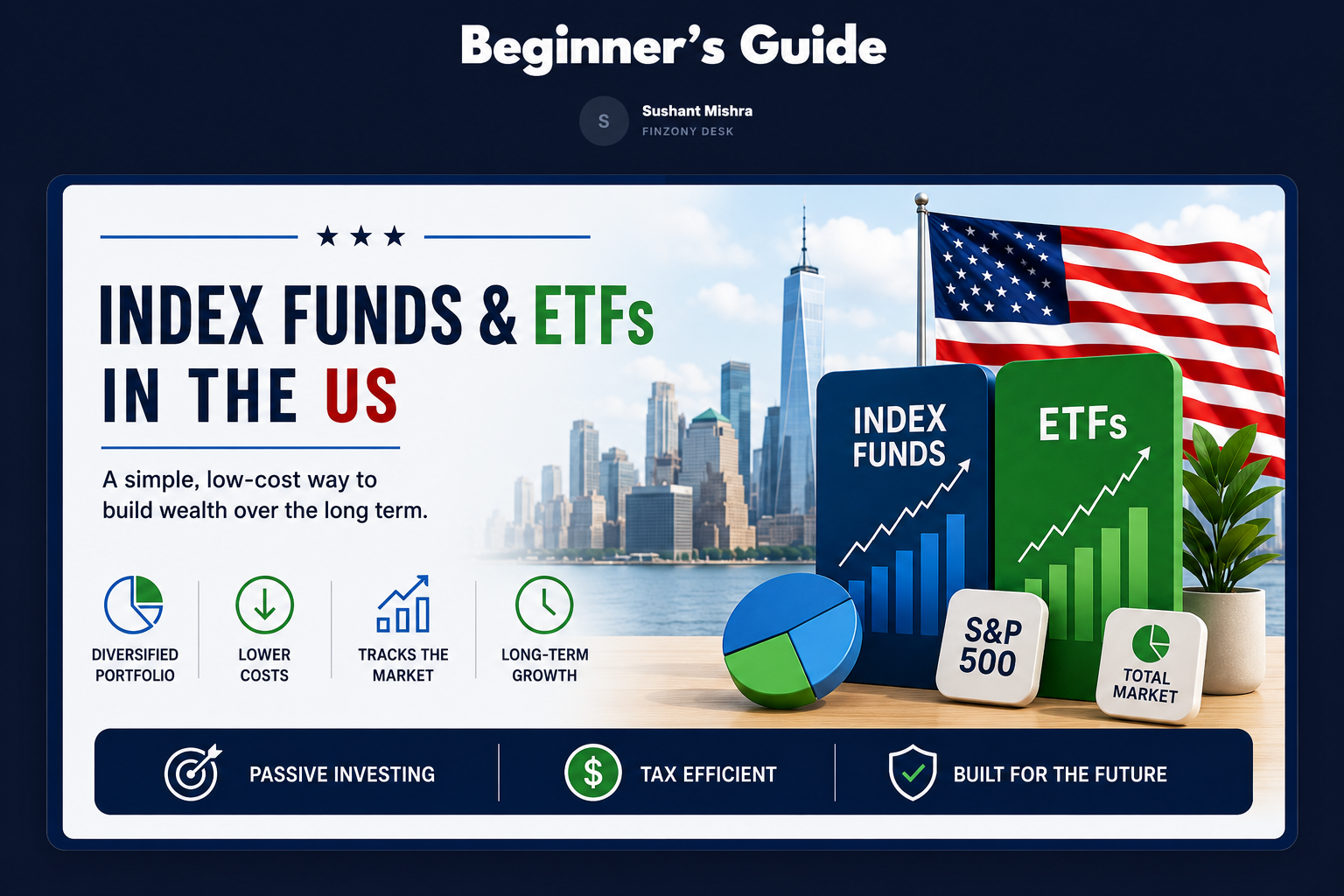
Index Funds & ETFs In US: The Complete Beginner's Guide
Sushant Mishra
Finzony Desk
Introduction
You've probably heard someone say "just invest in index funds" — but what does that actually mean?
If you've been confused about index funds, ETFs, ticker symbols, or how any of this works — you're in the right place.
In this guide, we'll break everything down in plain English. No jargon. No complicated math. Just clear, simple answers so you can start investing with confidence.
Let's go.
What Is an Index?
Before we talk about index funds, you need to understand what an "index" is.
An index is simply a list of stocks grouped together to represent a part of the market.
Think of it like a scoreboard. Instead of tracking one player, it tracks the whole team.
The most famous indexes in the US are:
- S&P 500 — tracks the 500 largest US companies (Apple, Microsoft, Amazon, etc.)
- Dow Jones (DJIA) — tracks 30 major US companies
- Nasdaq 100 — tracks the top 100 tech-heavy companies
When you hear "the market went up today" — they're usually talking about these indexes.
What Is an Index Fund?
An index fund is a type of investment fund that simply copies an index.
If you invest in an S&P 500 index fund, your money automatically gets spread across all 500 companies in the S&P 500.
You're not betting on one company. You own a tiny piece of hundreds of companies at once.
Simple example:
Imagine the S&P 500 is a pizza with 500 slices. Each slice = one company. An index fund buys all 500 slices for you automatically. When the pizza grows in value, so does your investment.
Why do people love index funds?
- ✅ Instant diversification — your money is spread across hundreds of companies
- ✅ Low cost — no expensive fund manager making decisions
- ✅ Historically proven — the S&P 500 has averaged ~10% return per year over the last 50 years
- ✅ Beginner friendly — no need to pick individual stocks
What Is an ETF?
ETF stands for Exchange-Traded Fund.
An ETF is very similar to an index fund — it also holds a basket of stocks. But there's one key difference:
ETFs trade on the stock market like a regular stock. You can buy and sell them any time during market hours, just like buying a share of Apple.
Index funds (the traditional kind) only let you buy or sell at the end of the trading day.
Index Fund vs ETF — What's the Difference?
This is where most beginners get confused. Let's make it super clear:
| Feature | Index Fund | ETF |
|---|---|---|
| Trades like a stock? | ❌ No | ✅ Yes |
| Buy/sell anytime? | ❌ End of day only | ✅ During market hours |
| Minimum investment | Sometimes $1,000+ | Price of 1 share ($1–$500) |
| Cost (expense ratio) | Very low | Very low |
| Best for | Long-term, set-and-forget | Flexible investors |
| Tax efficiency | Good | Slightly better |
Bottom line: Both are excellent. For most beginners, an ETF is easier to start with because you can buy even 1 share with little money.
What Are Index ETFs?
An index ETF is simply an ETF that tracks an index — combining the best of both worlds.
- It tracks an index (like S&P 500) ✅
- It trades on the stock exchange like a stock ✅
- It has very low fees ✅
Most popular ETFs you'll hear about are index ETFs. Examples: VOO, SPY, QQQ, IVV.
What Are Index Fund Ticker Symbols?
A ticker symbol is a short code used to identify a stock or fund on the market.
Just like every person has a name, every fund has a ticker symbol.
Here are the most popular US index fund & ETF ticker symbols:
S&P 500 Index Funds / ETFs
| Ticker | Full Name | Expense Ratio |
|---|---|---|
| VOO | Vanguard S&P 500 ETF | 0.03% |
| SPY | SPDR S&P 500 ETF Trust | 0.0945% |
| IVV | iShares Core S&P 500 ETF | 0.03% |
| FXAIX | Fidelity 500 Index Fund | 0.015% |
Total Market Index Funds / ETFs
| Ticker | Full Name | Expense Ratio |
|---|---|---|
| VTI | Vanguard Total Stock Market ETF | 0.03% |
| ITOT | iShares Core S&P Total US Stock Market ETF | 0.03% |
| FSKAX | Fidelity Total Market Index Fund | 0.015% |
Nasdaq / Tech Index Funds / ETFs
| Ticker | Full Name | Expense Ratio |
|---|---|---|
| QQQ | Invesco QQQ Trust (Nasdaq 100) | 0.20% |
| QQQM | Invesco Nasdaq 100 ETF (cheaper QQQ) | 0.15% |
International Index ETFs
| Ticker | Full Name | Expense Ratio |
|---|---|---|
| VXUS | Vanguard Total International Stock ETF | 0.07% |
| VEA | Vanguard FTSE Developed Markets ETF | 0.05% |
Expense ratio = the annual fee the fund charges. 0.03% means on $10,000 invested, you pay just $3/year. Very cheap!
Best US Index Funds to Consider
For most beginners, these 3 are all you need:
1. VOO (Vanguard S&P 500 ETF)
The most popular index ETF in the world. Tracks the 500 biggest US companies. Low cost, proven track record. If you only pick one — pick this.
2. VTI (Vanguard Total Stock Market ETF)
Covers not just the top 500, but the entire US stock market — over 3,500 companies. Even more diversified than VOO.
3. QQQ (Invesco Nasdaq 100 ETF)
More focused on technology companies. Higher growth potential but also more ups and downs. Good if you believe in tech long-term.
How to Start Investing in Index Funds (Step by Step)
Step 1 — Open a brokerage account
Use platforms like Fidelity, Charles Schwab, or Robinhood. All free to open.
Step 2 — Add money
Connect your bank and transfer as little as $1 (on some platforms).
Step 3 — Search the ticker symbol
Type VOO, VTI, or QQQ in the search bar.
Step 4 — Buy shares
Choose how many shares (or dollar amount) you want to buy and confirm.
Step 5 — Keep investing regularly
The real power comes from investing consistently every month — this is called dollar-cost averaging. You don't need to time the market. Just keep going.
Common Beginner Questions
Q: Is it safe to invest in index funds?
All investing has risk. But index funds are considered one of the safest ways to invest long-term because you're diversified across hundreds of companies. Historically the US market has always recovered from downturns and grown over time.
Q: How much money do I need to start?
With ETFs like VOO, you can start with the price of 1 share (~$530). Many brokerages also offer fractional shares — meaning you can start with just $1.
Q: Should I pick VOO or VTI?
Both are excellent. VOO = top 500 US companies. VTI = entire US market. They perform very similarly. You really can't go wrong with either.
Q: What's the difference between ETF and index fund in simple terms?
Same idea, different packaging. ETF = trades like a stock anytime. Index fund = buy/sell once per day. For beginners, ETFs are usually easier.
Q: How long should I stay invested?
The longer the better. Index funds are a long-term game — think 10, 20, 30 years. Time in the market beats timing the market.
Final Thoughts
Index funds and ETFs are the simplest, most proven way for everyday people to build wealth over time.
You don't need to be a finance expert. You don't need to pick stocks. You just need to start, stay consistent, and let time do the work.
Pick a low-cost ETF like VOO or VTI, invest regularly, and be patient. That's the whole strategy.
Ready to learn more? Explore Finzony's investing tools to track your portfolio and calculate your returns.