
XIRR Explained: The Right Way to Calculate SIP Returns
Investing Writer
Why Regular Return Formulas Don't Work for SIPs
A simple CAGR (Compound Annual Growth Rate) calculation assumes a single lump-sum investment made once and withdrawn once. But a SIP involves multiple investments on different dates — each installment has been invested for a different length of time. Using CAGR on a SIP gives a misleading number, because it can't account for the fact that your first installment has been growing for years while your most recent one just started.
What Is XIRR?
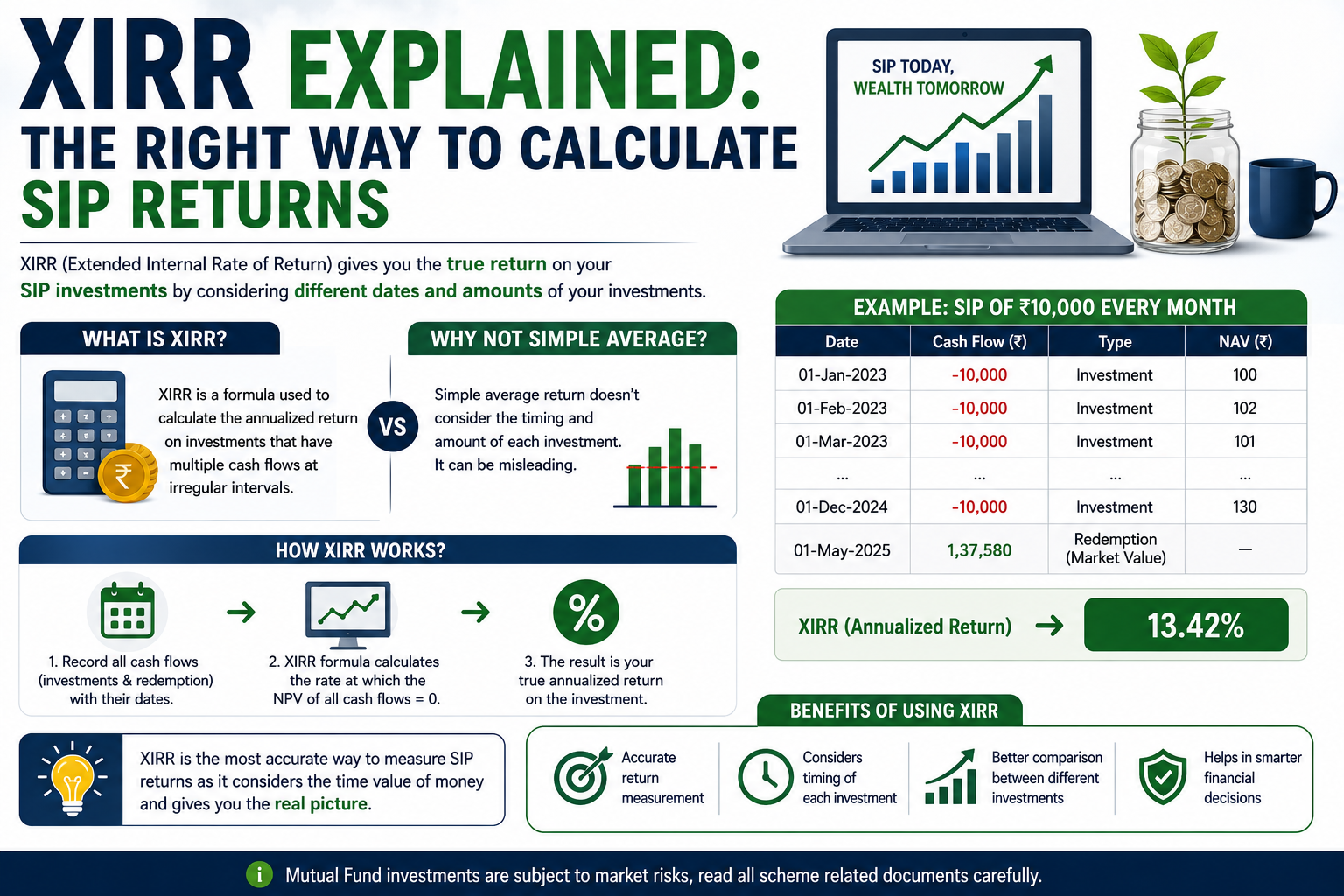
XIRR (Extended Internal Rate of Return) is a formula that calculates a single annualized return rate across multiple cash flows happening on different, irregular dates. It's specifically built for exactly the SIP situation: several investments (cash outflows) at different times, followed by one final value (cash inflow) today.
How XIRR Actually Works
XIRR finds the single interest rate that, if applied consistently to every individual cash flow based on its exact date, would make the sum of all discounted cash flows equal zero. In plain terms: it weighs each SIP installment by how long it's actually been invested, then works backward to find the one annual rate that explains your total ending value. You don't calculate this by hand — Excel's XIRR() function, Google Sheets, or any SIP calculator on a platform does it instantly once you enter the dates and amounts.
XIRR vs. Absolute Return vs. CAGR
| Metric | Best For | Limitation |
|---|---|---|
| Absolute Return | Total gain over the full period, any investment type | Doesn't account for time — a 20% gain in 1 year looks the same as 20% in 10 years |
| CAGR | Single lump-sum investments only | Breaks down with multiple cash flows at different times, like SIPs |
| XIRR | SIPs and any investment with multiple irregular cash flows | None for this use case — it's the standard for SIP returns |
A Simplified Example
Say you invested ₹5,000 monthly into a mutual fund SIP for 3 years, and your total investment of ₹1.8 lakh has grown to ₹2.25 lakh today. A naive "absolute return" calculation would say (2.25-1.8)/1.8 = 25% total gain — but that doesn't tell you the annualized rate, since each ₹5,000 installment was invested for a different length of time (the first one for 3 years, the last one for barely a month). XIRR takes all 36 individual cash flows and their exact dates, and calculates the single annualized rate — say, roughly 14-15% — that actually reflects your true return.
Common Mistakes to Avoid
1. Using CAGR to evaluate SIP performance. CAGR assumes one lump-sum investment — applying it to a SIP with 12, 24, or 60 separate installments gives a number that doesn't reflect reality.
2. Comparing absolute return across investments of different durations. A 30% absolute return over 5 years and a 30% absolute return over 2 years are very different outcomes — always convert to an annualized figure like XIRR before comparing.
3. Forgetting to include the exact dates of each installment. XIRR's accuracy depends entirely on using the actual transaction dates, not approximate or rounded ones — most platforms pull this automatically from your statement, but manual calculations need care here.
4. Not accounting for SIP pauses or missed installments. If you skipped a few months, those gaps matter for XIRR's date-weighted calculation — make sure your data reflects what actually happened, not an idealized regular schedule.
5. Ignoring XIRR for SWPs or partial withdrawals too. XIRR isn't just for SIPs — any investment with cash flows going both in and out at different times (including systematic withdrawal plans) should also be evaluated using XIRR rather than a simple return percentage.
Key Takeaway: XIRR is the correct way to measure SIP returns because it accounts for the fact that every installment has a different investment duration — a simple percentage gain or CAGR figure will either overstate or understate your true annualized return. Most mutual fund apps and platforms calculate this automatically, so always check for the "XIRR" label rather than relying on a generic "returns" percentage.
Frequently Asked Questions
Why can't I just use CAGR for my SIP returns?
CAGR assumes a single investment made once. A SIP has many installments made at different times, each with a different holding period — CAGR can't account for that, which is exactly what XIRR is designed to solve.
Do I need to calculate XIRR manually?
No — most mutual fund platforms, apps, and even your fund house's statement display XIRR automatically. Excel and Google Sheets also have a built-in XIRR() function if you want to calculate it yourself from a transaction list.
Is a higher XIRR always better?
Generally yes, when comparing similar types of investments over similar periods. But XIRR alone doesn't account for risk — a fund with a higher XIRR may also have taken on significantly more volatility to get there.
Can XIRR be negative?
Yes — if your current investment value is lower than what you put in (accounting for time), XIRR will show a negative annualized return, just like any other return metric would.
Does XIRR work for lump-sum investments too?
Yes — for a single lump-sum investment, XIRR and CAGR will give you the same result. XIRR is simply the more general formula that also handles multiple cash flows, which is why it's the standard choice for SIPs.