
HRA Exemption Explained: How to Save Tax on Rent
Tax Planning Writer
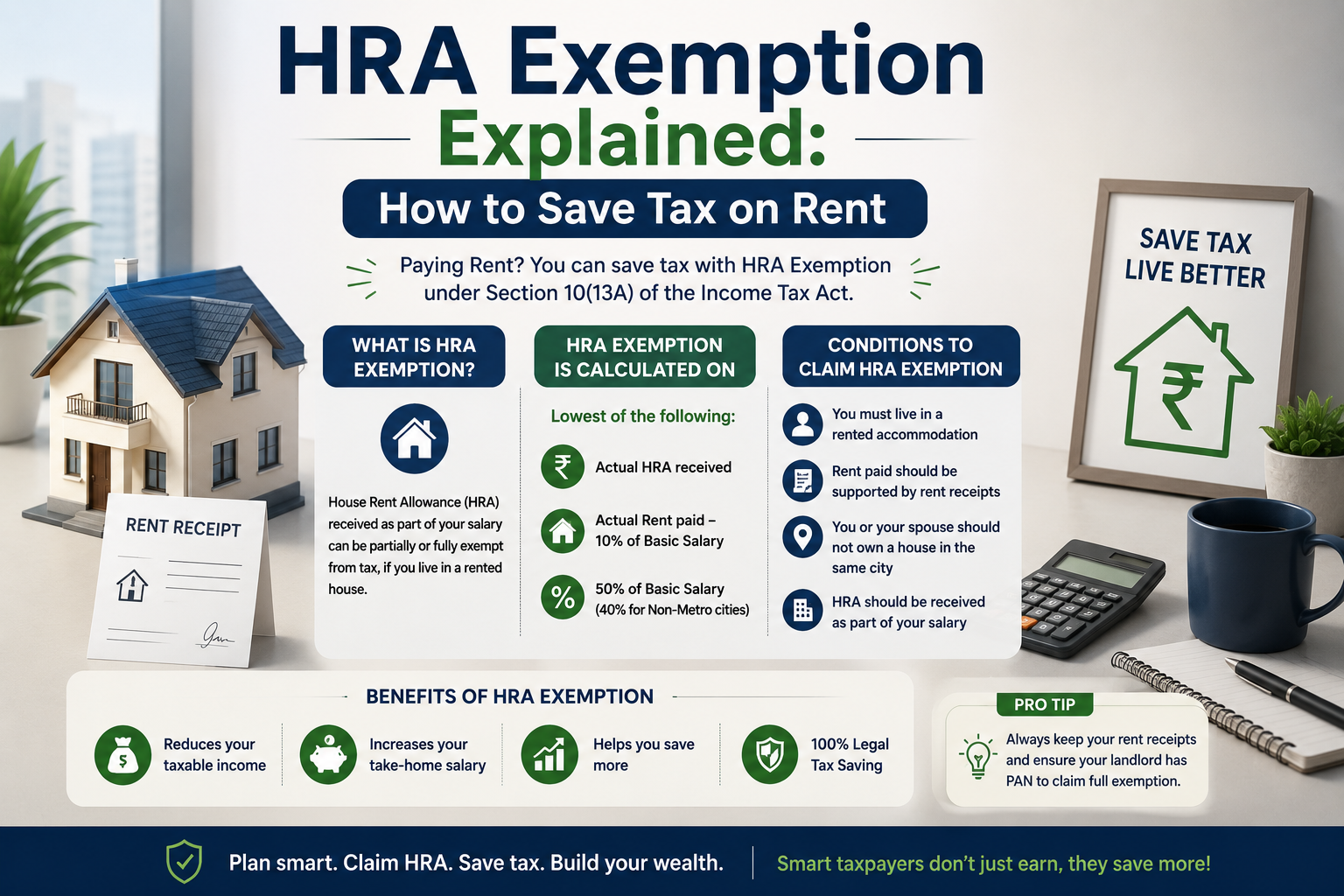
What Is HRA Exemption?
House Rent Allowance (HRA) is a salary component most employers pay to help cover rent, and a portion of it can be exempt from tax if you actually live in rented accommodation. Under the earlier Income Tax Act, 1961, this exemption fell under Section 10(13A). Under the new Income Tax Act, 2025, this has been renumbered to Section 14(10) — the core calculation rules remain the same, just under a new section number.
Important: Only Available Under the Old Tax Regime
HRA exemption can only be claimed if you're filing under the old tax regime. If you've opted for the new tax regime, your entire HRA becomes fully taxable — this is one of the biggest reasons some salaried employees with significant rent expenses still choose the old regime over the new one.
The Three-Condition Formula
Your HRA exemption is the lowest of these three amounts:
- Actual HRA received from your employer
- 50% of (Basic Salary + DA) if you live in a metro city, or 40% if you live in a non-metro city
- Actual rent paid minus 10% of (Basic Salary + DA)
Whichever of these three numbers is smallest becomes your tax-exempt HRA amount for the year — anything above that gets added back to your taxable salary.
Important Update: The Metro City List Is Expanding
For FY 2025-26, only Delhi, Mumbai, Kolkata, and Chennai qualify for the higher 50% exemption rate. However, from FY 2026-27 onward, four more cities — Bengaluru, Hyderabad, Pune, and Ahmedabad — have been added to the metro list under the new Income Tax Rules, also qualifying for the 50% rate instead of the earlier 40%. If you live in one of these four cities, this is a meaningful change worth tracking for your tax planning from FY 2026-27 onward.
A Worked Example
| Item | Annual Amount |
|---|---|
| Basic Salary + DA | ₹6,00,000 |
| Actual HRA received | ₹2,40,000 |
| Rent paid | ₹2,00,000 |
| City type | Non-metro (40%) |
Condition 1: Actual HRA received = ₹2,40,000. Condition 2: 40% of ₹6,00,000 = ₹2,40,000. Condition 3: ₹2,00,000 − (10% of ₹6,00,000 = ₹60,000) = ₹1,40,000. The lowest of these three is ₹1,40,000 — that's the exempt amount, with the remaining ₹1,00,000 of the HRA received added to taxable salary.
Documents You Need
- Rent receipts for the relevant period
- Rental agreement
- Landlord's PAN, mandatory if annual rent exceeds ₹1 lakh
Common Mistakes to Avoid
1. Claiming HRA under the new tax regime. HRA exemption simply isn't available under the new regime — if you've opted for it, your full HRA is taxable regardless of actual rent paid.
2. Using gross salary instead of Basic + DA in the formula. The 50%/40% and 10% calculations use only Basic Salary plus Dearness Allowance, not your full CTC or gross salary — using the wrong base significantly overstates your exemption.
3. Forgetting the landlord's PAN for high rent. If your annual rent crosses ₹1 lakh, missing the landlord's PAN can lead to your HRA claim being rejected or flagged during processing.
4. Not checking the updated metro city list for FY 2026-27. Employees in Bengaluru, Hyderabad, Pune, and Ahmedabad should specifically confirm they're getting the new 50% rate rather than the old 40% non-metro rate starting FY 2026-27.
5. Paying rent to a family member without proper documentation. HRA claims involving rent paid to a spouse or parent are heavily scrutinized — genuine rental agreements, actual bank transfers, and proper documentation are essential if you go this route.
Key Takeaway: HRA exemption — now under Section 14(10) of the new Income Tax Act — can meaningfully reduce your taxable income if you're in the old tax regime and pay genuine rent, but it's calculated as the lowest of three specific values, not simply your full HRA received. Keep an eye on the expanded metro city list taking effect from FY 2026-27 if you're in Bengaluru, Hyderabad, Pune, or Ahmedabad.
Frequently Asked Questions
Is HRA exemption still called Section 10(13A)?
Under the new Income Tax Act, 2025, it's been renumbered to Section 14(10). The underlying calculation formula and conditions remain essentially the same, just under the new section number.
Which cities count as metro for the higher 50% HRA exemption?
For FY 2025-26, only Delhi, Mumbai, Kolkata, and Chennai qualify for 50%. From FY 2026-27, Bengaluru, Hyderabad, Pune, and Ahmedabad have also been added to the metro list at the 50% rate.
Can I claim HRA exemption if I opt for the new tax regime?
No — HRA exemption is only available under the old tax regime. Under the new regime, your full HRA amount is added to taxable income regardless of rent paid.
Can I claim HRA if I pay rent to my parents?
Yes, this is allowed, but it requires a genuine rental agreement, actual rent payments via bank transfer, and your parents declaring the rental income in their own tax returns — such claims face closer scrutiny, so documentation matters.
Do I need the landlord's PAN for every HRA claim?
Only if your annual rent exceeds ₹1 lakh. Below that threshold, rent receipts and a rental agreement are generally sufficient, though requirements can vary based on your employer's documentation policy.