
Bank Statements, Hidden Fees & Transfer Methods: The Everyday Banking Guide
Banking Writer
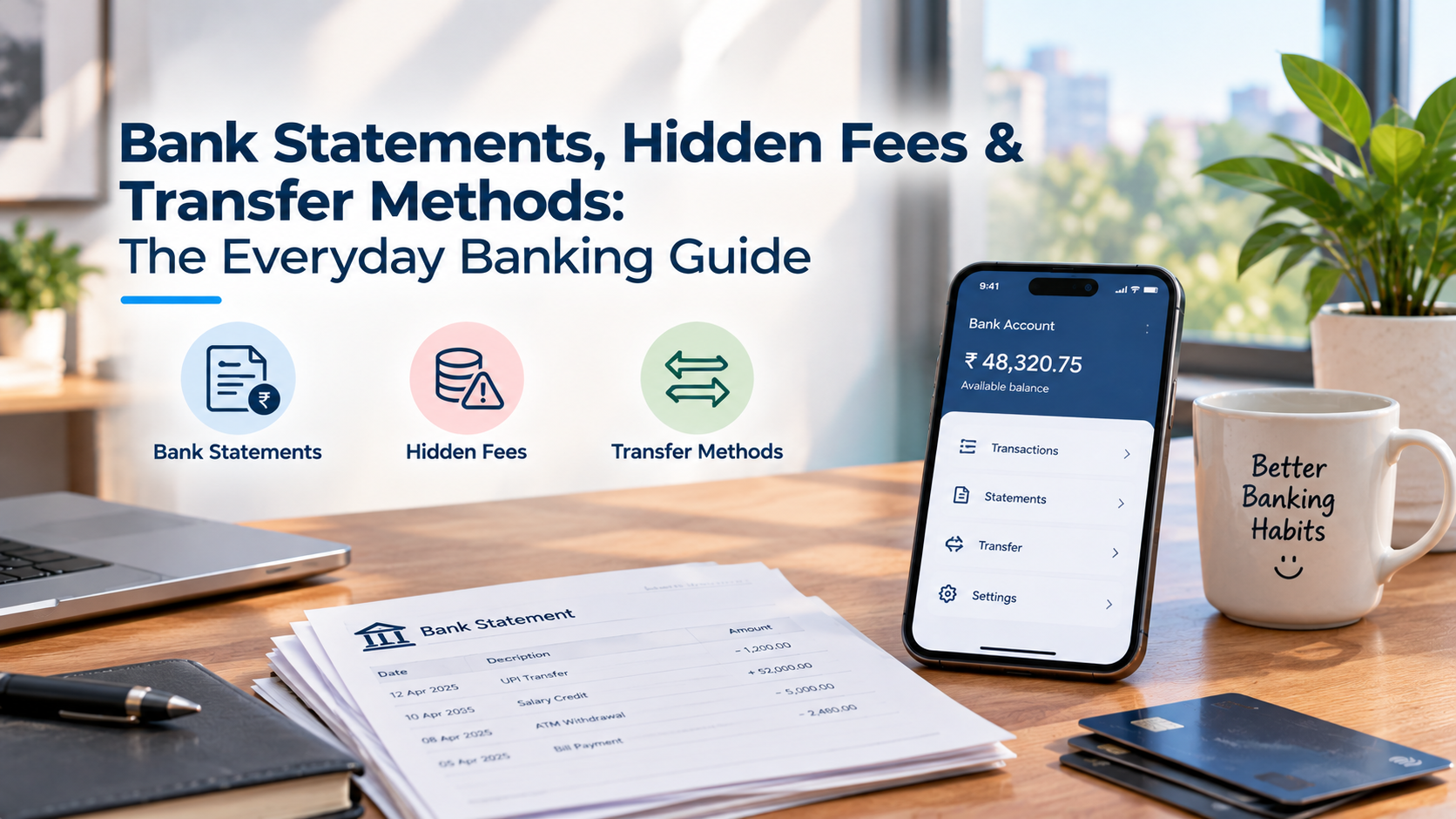
The Banking Habits Nobody Teaches You
Most people learn how to open a bank account, and then never think about it again — no one teaches you how to actually read your statement, why a ₹200 charge appeared out of nowhere, or which transfer method to use for a ₹50,000 payment vs a ₹5 lakh one. These are the everyday habits that separate someone who banks efficiently from someone quietly bleeding money to fees they never noticed.
Reading Your Bank Statement Properly
A bank statement isn't just a list of debits and credits — it's the only place where hidden charges show up in plain sight, if you know what to look for. SMS alert fees, ATM charges beyond your free limit, annual maintenance charges, and small "service fee" line items often go unnoticed for months because they're small individually but add up significantly over a year.
How to actually audit your own statement line by line is covered in Understanding Bank Statements & Charges.
The Minimum Balance Penalty Most People Don't See Coming
Minimum balance rules aren't just a savings-account footnote — they're one of the most common sources of silent, recurring charges in Indian banking. The penalty is usually deducted quietly each quarter, without an SMS alert flagging it as a "fee" the way an ATM charge would. Many people discover months of accumulated penalties only when reviewing a full year's statement.
The exact rules, how minimum balance is calculated (average vs end-of-day), and how to avoid the penalty entirely, is in Minimum Balance Rules & Hidden Fees.
Choosing the Right Transfer Method
NEFT, RTGS, IMPS, and cheque all move money between accounts — but using the wrong one costs you time, money, or both. IMPS is built for instant urgency; NEFT is the free, near-instant default for most planned transfers; RTGS exists specifically for high-value transfers above ₹2 lakh; and cheques still matter wherever a formal paper trail is expected, like security deposits.
A full breakdown of speed, limits, and which method fits which situation is in Cheque, NEFT, RTGS, IMPS — What's the Difference?.
How These Three Add Up
| Habit | Cost of Getting It Wrong |
|---|---|
| Not reading statements | Small recurring fees go unnoticed for months, compounding over a year |
| Ignoring minimum balance rules | Quiet quarterly penalties with no clear alert |
| Using the wrong transfer method | Failed transactions, unnecessary charges, or slower settlement than needed |
Key Takeaway: None of these three habits are complicated on their own — the problem is they're easy to ignore precisely because the cost shows up in small, scattered amounts rather than one obvious hit. A five-minute monthly statement review catches almost all of it.
Frequently Asked Questions
How often should I actually check my bank statement?
Monthly is enough for most people — it's frequent enough to catch recurring fees or errors early, without becoming a chore.
Is minimum balance calculated daily or monthly?
Most banks use a Monthly Average Balance (MAB) — the average of your end-of-day balances across the month — rather than requiring the minimum every single day.
Does RTGS work on weekends?
Yes — RTGS and NEFT both run 24x7, including weekends and holidays, since the RBI's round-the-clock settlement rollout.
Which transfer method is cheapest for a large one-time payment?
RTGS is typically the standard choice for high-value transfers like property payments — free or low-cost at most banks, with no upper cap and same-day settlement.