
EPF vs PPF: Which Retirement Tool Should You Choose?
Retirement Writer
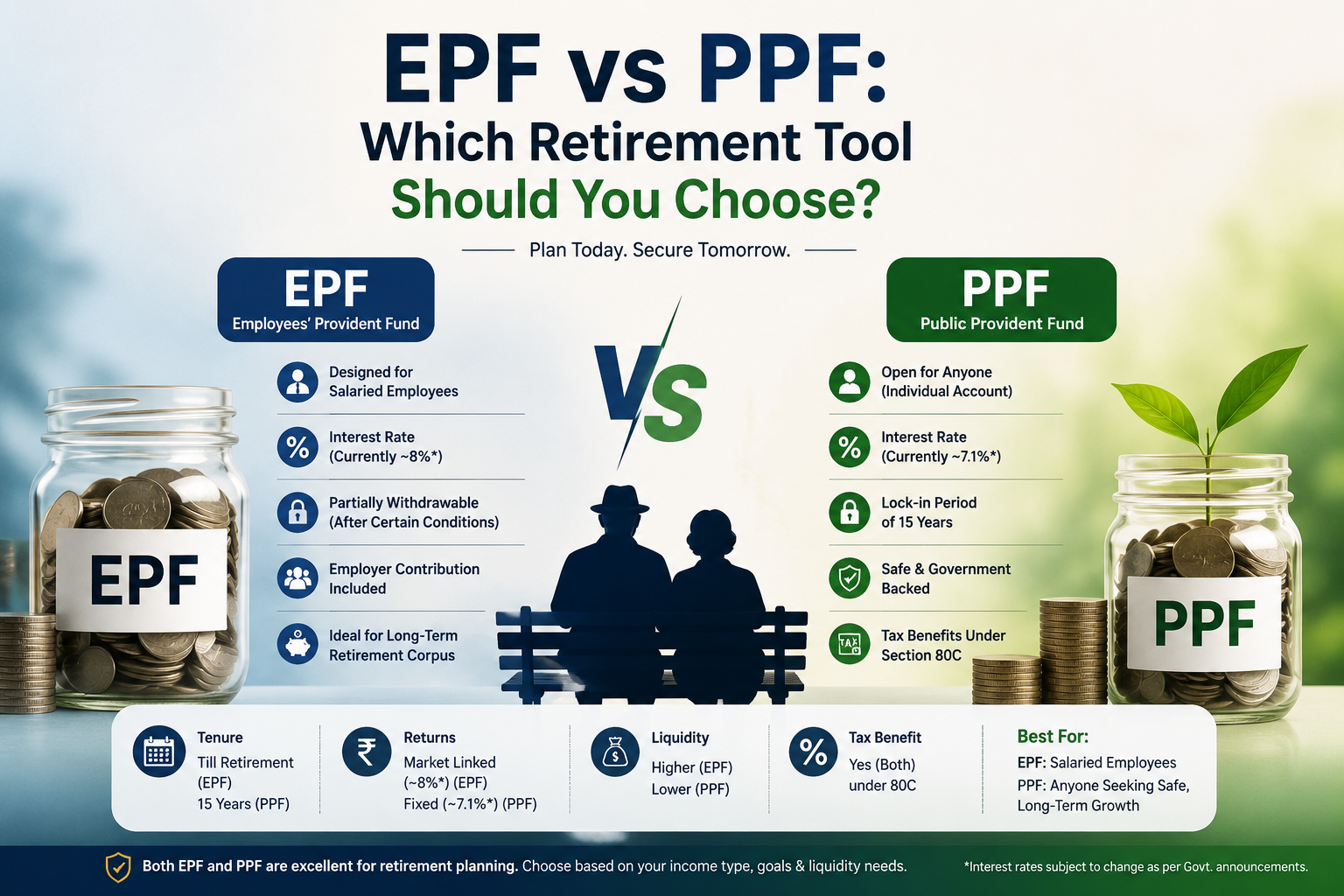
EPF vs PPF: The Core Difference
EPF (Employees' Provident Fund) and PPF (Public Provident Fund) both offer tax-free, government-backed returns, but they serve different situations. EPF is mandatory for most salaried employees at companies with 20+ employees, funded jointly by you and your employer. PPF is voluntary and open to anyone — salaried, self-employed, or not working at all — funded entirely by your own contributions.
Current Interest Rates
| Scheme | Current Rate | Reviewed |
|---|---|---|
| EPF | 8.25% (FY 2025-26) | Annually, by EPFO's board of trustees |
| PPF | 7.1% (unchanged since April 2020) | Quarterly, by the Ministry of Finance |
EPF has consistently offered a somewhat higher rate than PPF in recent years, but both are backed by the government and both offer interest that's tax-free under normal contribution limits.
Contribution Rules
EPF: You contribute 12% of your basic salary, matched by your employer (with part of the employer's share routed to EPS, the pension scheme). This is automatic through payroll — you don't actively decide the amount each month.
PPF: You choose how much to contribute, anywhere from ₹500 to ₹1.5 lakh per financial year, in up to 12 deposits. There's no employer contribution — it's entirely self-funded, which makes it useful even for freelancers, business owners, or non-working spouses.
Lock-In and Withdrawal Rules
EPF is tied to your employment — you can withdraw the full balance when you leave a job (after a waiting period) or retire, and partial withdrawals are allowed for specific reasons like a home purchase, medical emergency, or wedding. PPF has a fixed 15-year lock-in from account opening, extendable in 5-year blocks, with partial withdrawals allowed from the 7th year onward and loans against the balance available from the 3rd to 6th year.
Which One Should You Use?
- If you're salaried: EPF happens automatically and usually offers a slightly better rate — there's little reason to opt out even if allowed. Use PPF alongside it as a second, more flexible-contribution retirement bucket.
- If you're self-employed or a freelancer: PPF is likely your primary tax-free, government-backed retirement option, since EPF isn't available without a qualifying employer relationship.
- If you want more control over contribution timing: PPF lets you decide exactly how much and when (within annual limits); EPF is fixed by your salary structure.
Common Mistakes to Avoid
1. Withdrawing EPF between jobs instead of transferring it. Many people withdraw their EPF balance when switching jobs instead of transferring it to the new employer's account — this breaks the compounding and can also trigger tax if withdrawn before 5 years of continuous service.
2. Treating PPF's 15-year lock-in as a dealbreaker. The lock-in feels long, but partial withdrawals are allowed from year 7, and the account can be extended indefinitely in 5-year blocks after maturity — it's more flexible long-term than it first appears.
3. Only relying on EPF for retirement. EPF alone, even with employer matching, often isn't enough to fully fund retirement — pairing it with PPF, NPS, or equity investments builds a more diversified retirement corpus.
4. Missing the annual PPF contribution deadline. PPF requires a minimum ₹500 deposit each financial year to keep the account active — missing this technically makes the account "discontinued," requiring a penalty to reactivate.
5. Not checking whether EPF interest above ₹2.5 lakh is taxable. If your own EPF contribution in a year exceeds ₹2.5 lakh, the interest on the excess becomes taxable — this mainly affects high earners with large voluntary (VPF) contributions.
Key Takeaway: EPF and PPF aren't really competing options — EPF is largely automatic for salaried employees and offers a slightly higher rate, while PPF is a flexible, self-directed complement available to everyone. Most salaried individuals benefit from using both rather than choosing one over the other.
Frequently Asked Questions
Can I have both an EPF and a PPF account?
Yes — there's no restriction on holding both simultaneously. Many salaried employees contribute to EPF through payroll while also maintaining a separate PPF account for additional tax-free savings.
Which offers a better interest rate right now, EPF or PPF?
EPF currently offers 8.25% (FY 2025-26) versus PPF's 7.1%, which has stayed unchanged since April 2020. EPF's rate is reviewed annually, while PPF is reviewed every quarter.
Can self-employed people open an EPF account?
Generally no — EPF requires an employer-employee relationship at a qualifying organization. Self-employed individuals typically rely on PPF, NPS, or other retirement instruments instead.
What happens to my EPF if I change jobs?
You can transfer the balance to your new employer's EPF account, which keeps the compounding continuous and avoids tax issues. Withdrawing instead of transferring can trigger tax if done before 5 years of continuous service.
Is PPF's 15-year lock-in a problem for retirement planning?
Not usually — partial withdrawals are allowed from year 7, loans are available even earlier, and the account can be extended in 5-year blocks after maturity, making it well-suited to long-term retirement goals despite the lock-in.