
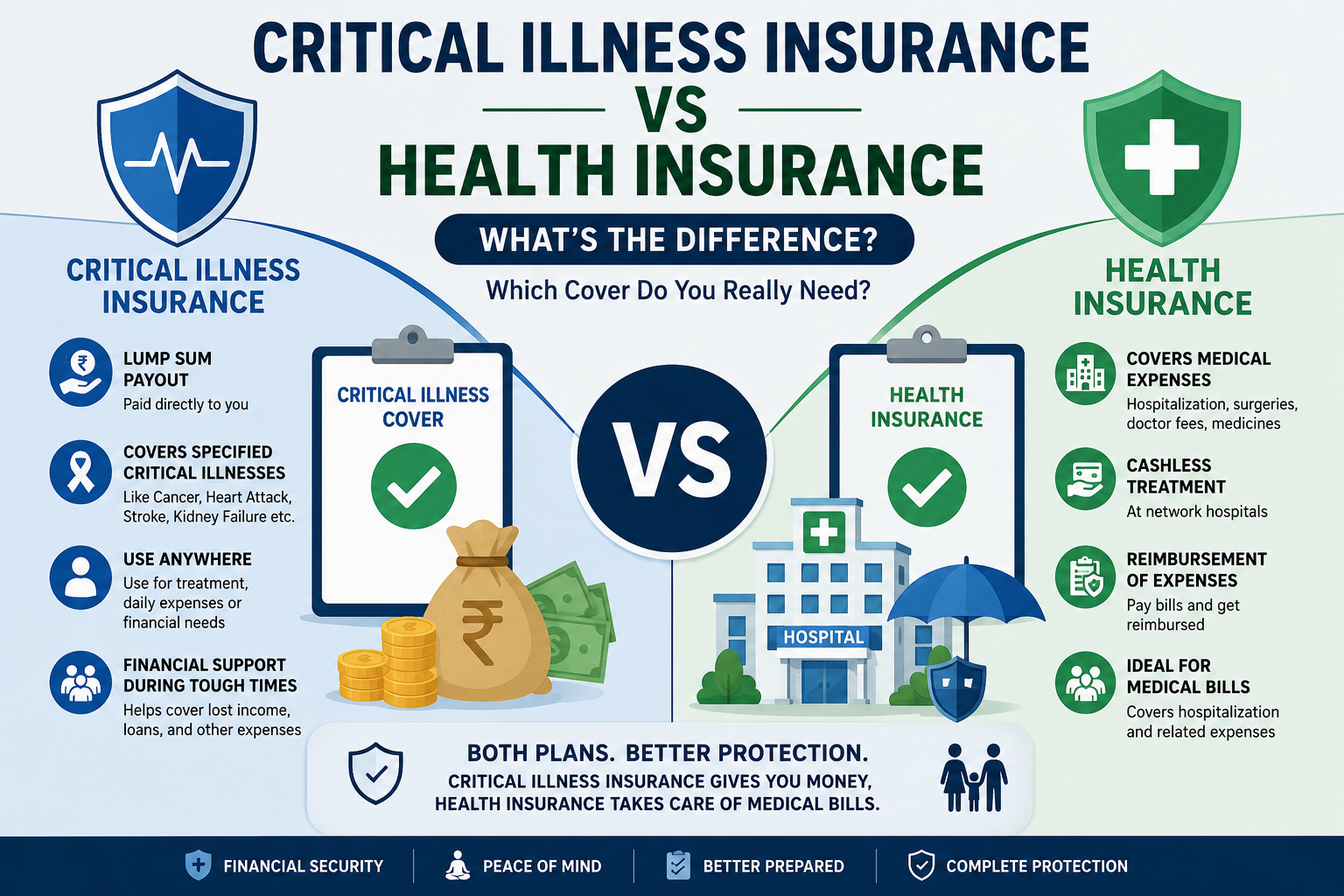
What Health Insurance Actually Covers
Health insurance (mediclaim) reimburses or directly pays your hospital bills — room rent, doctor's fees, surgery costs, medicines, diagnostic tests, and pre/post-hospitalisation expenses. It works on a cashless or reimbursement basis: the insurer settles with the hospital directly (cashless network) or pays you back after you submit bills. The payout is tied exactly to what you actually spent, up to your policy's sum insured.
What Critical Illness Insurance Actually Covers
Critical illness insurance is completely different in how it pays out. Instead of reimbursing bills, it pays a fixed lump sum — say ₹10 lakh — the moment you're diagnosed with one of a specific list of serious illnesses (typically cancer, heart attack, stroke, kidney failure, major organ transplant, and 10-40 other conditions depending on the plan). The money is paid regardless of what you actually spend, and you're free to use it however you want — hospital bills, a caregiver's salary, your child's school fees, or simply replacing your lost income while you're unable to work.
Health Insurance vs Critical Illness Insurance: Key Differences
| Aspect | Health Insurance | Critical Illness Insurance |
|---|---|---|
| Payout type | Reimburses actual hospital bills | Fixed lump sum on diagnosis |
| Trigger | Any hospitalisation covered by the policy | Diagnosis of a listed critical illness only |
| How the money is used | Paid to hospital or against bills | Paid to you, use it for anything |
| Covers income loss? | No | Yes — that's its main purpose |
| Waiting period for illness | Usually covered after initial waiting period | Survival period of 15-30 days after diagnosis, plus a waiting period |
| Can claim both together? | Yes — they're independent policies | Yes — critical illness payout doesn't reduce your health insurance claim |
A Worked Example
Suppose you're diagnosed with a heart condition requiring bypass surgery. Hospital and treatment costs come to ₹8 lakh, and you're unable to work for 4 months, losing roughly ₹3 lakh in income.
- Health insurance (sum insured ₹10L) reimburses the ₹8 lakh treatment cost directly to the hospital or to you against bills.
- Critical illness insurance (cover ₹15L), if your diagnosis matches a listed condition, pays you the full ₹15 lakh in one lump sum — regardless of your actual hospital bill. You can use part of it to cover the income you lost, and the rest for recovery, rehabilitation, or anything else.
Without critical illness cover, that ₹3 lakh income gap would have come straight out of your savings.
Do You Need Both?
For most people, yes — they solve two different problems. Health insurance protects your savings from hospital bills. Critical illness insurance protects your household income and lifestyle during a long recovery, which health insurance was never designed to do. A ₹5-10 lakh critical illness cover, layered on top of a solid health insurance policy, is a common and affordable combination — premiums for critical illness plans are usually much lower than equivalent health insurance sums insured, since payouts are for a limited, defined list of conditions.
Common Mistakes to Avoid
1. Assuming critical illness insurance replaces health insurance. It doesn't — it's a supplement, not a substitute. Skipping health insurance because you have a critical illness rider leaves everyday hospitalisations (accidents, infections, surgeries) completely uncovered.
2. Not checking the exact list of covered illnesses. "Critical illness" isn't a generic label — every insurer lists specific conditions and specific diagnostic criteria (e.g., a heart attack claim may require proof of a defined severity level). Read the policy wording, not just the marketing brochure.
3. Ignoring the survival period clause. Most critical illness policies only pay out if you survive a minimum period (commonly 15-30 days) after diagnosis. This is a standard clause, but people are often surprised by it during a claim.
4. Buying too small a cover. A ₹2-3 lakh critical illness cover barely dents a year of lost income plus treatment costs. Size the cover around 1-2 years of your annual income, not just treatment cost estimates.
5. Letting the policy lapse after one payout. Most standalone critical illness policies pay out once and then terminate (or the specific illness category becomes excluded going forward). Understand whether your plan is a one-time payout or offers multiple-claim options before assuming you're still covered after a claim.
Key Takeaway: Health insurance pays your hospital, critical illness insurance pays you. They cover different financial risks — one protects your savings, the other protects your income — so the strongest protection usually comes from having both, not choosing one over the other.
Frequently Asked Questions
Can I claim both health insurance and critical illness insurance for the same illness?
Yes. They're independent contracts — your health insurance claim is settled based on actual hospital bills, and your critical illness payout is a separate lump sum triggered purely by diagnosis. One doesn't reduce or affect the other.
Is critical illness insurance worth it if I already have good health insurance?
Usually yes, especially if you're the primary earner in your household. Health insurance won't replace your salary while you recover from a serious illness — critical illness cover fills exactly that gap.
How many illnesses does a typical critical illness policy cover?
Most Indian insurers cover somewhere between 10 and 40 listed conditions, most commonly cancer, heart attack, stroke, kidney failure, major organ transplant, and paralysis. The exact list and diagnostic criteria vary by insurer, so always check the policy document.
What is the survival period in a critical illness policy?
It's the minimum number of days (commonly 15-30) you must survive after being diagnosed with a covered illness for the claim to be valid. It's a standard clause across almost all critical illness policies in India.
Does critical illness insurance pay out more than once?
It depends on the plan. Many standalone critical illness policies pay out once and then terminate. Some newer plans offer multiple-claim structures across different illness categories — check this specifically before buying if it matters to you.
How much critical illness cover should I buy?
A common rule of thumb is 1-2 times your annual income, so the payout can realistically replace lost earnings for a year or two of recovery, on top of covering any treatment costs your health insurance doesn't.