
Gratuity Explained: How Much You're Actually Entitled To After 5 Years
Retirement Writer
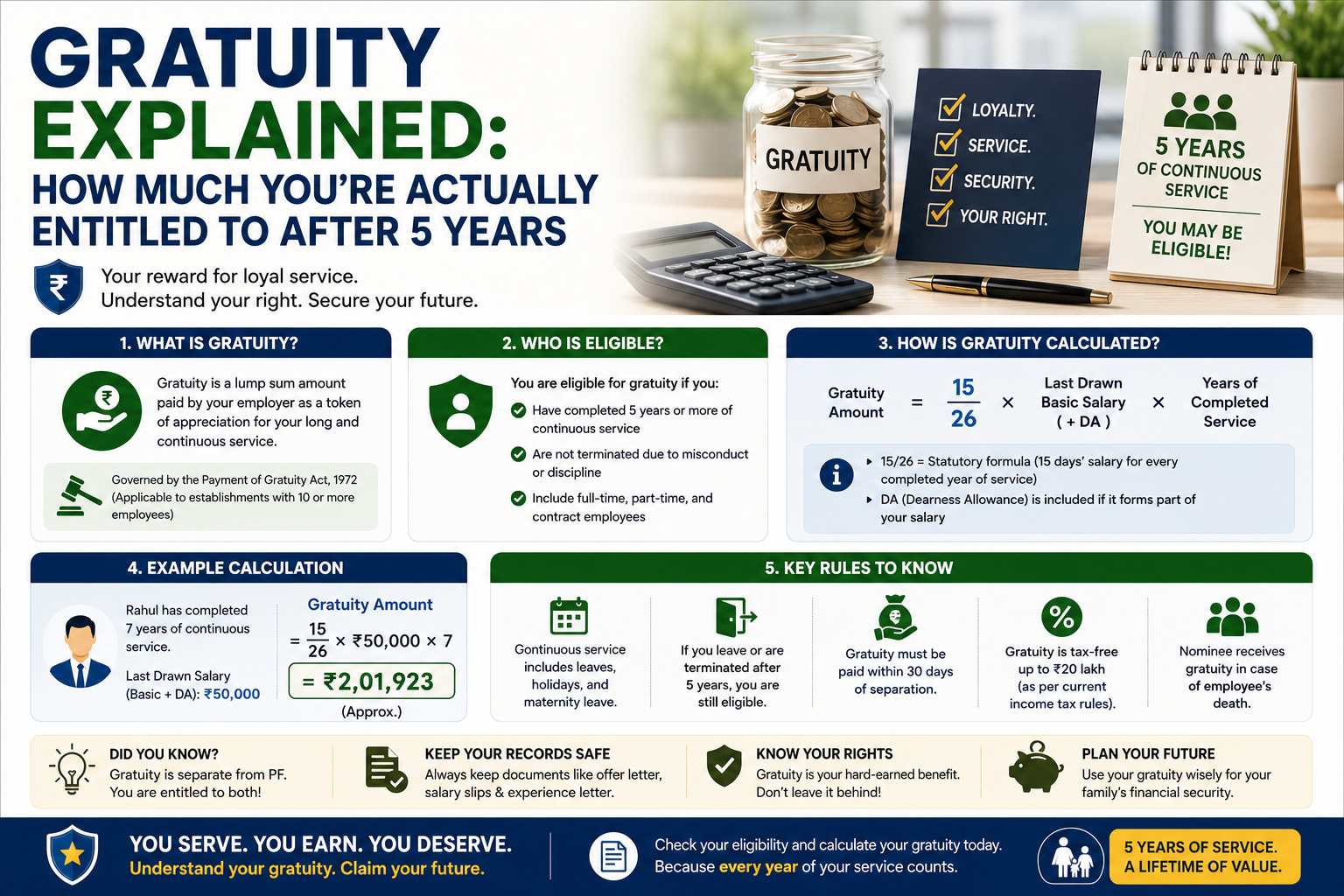
What Is Gratuity?
Gratuity is a lump-sum payment your employer is legally required to give you as recognition for long-term service, governed by the Payment of Gratuity Act, 1972 (now enhanced under the new Labour Codes). It's paid when you leave a job — through resignation, retirement, superannuation, death, or disablement — and it's separate from your salary, EPF, or any other retirement benefit.
Important Update: New Eligibility Rule for Fixed-Term Employees
Under the new Labour Codes, effective November 21, 2025, a significant change was introduced: fixed-term contract employees now qualify for gratuity after just 1 year of service (if they've worked 240+ days in that period), calculated on a pro-rata basis — a major shift from having to wait the full 5 years. Permanent employees still need the standard 5 years of continuous service to qualify, so this update specifically benefits contract workers who previously received nothing if they left before hitting the 5-year mark.
Who Qualifies and When
| Situation | Service Required |
|---|---|
| Permanent employee, resignation/retirement | 5 years of continuous service |
| Fixed-term contract employee | 1 year (if 240+ working days completed) — pro-rata amount |
| Death of employee | No minimum service required — paid to nominee/legal heirs |
| Disablement (accident or disease) | No minimum service required |
How Gratuity Is Calculated
For employers covered under the Act (generally those with 10+ employees), the formula is:
Gratuity = (Last Drawn Basic Salary + DA) × 15 × Years of Service ÷ 26
The "26" represents working days in a month (excluding Sundays), and "15" represents 15 days' wages for each year of service. Any period of service beyond 6 months in the final year is rounded up to a full year.
A Worked Example
| Item | Value |
|---|---|
| Last drawn Basic + DA | ₹50,000/month |
| Years of service | 10 years, 7 months → rounded to 11 years |
| Gratuity calculation | (₹50,000 × 15 × 11) ÷ 26 |
| Gratuity payable | ≈ ₹3,17,308 |
Tax Treatment of Gratuity
- Government employees: Fully tax-exempt, with no upper monetary limit
- Private sector employees (covered under the Act): Tax-exempt up to the lowest of — the actual gratuity received, the statutory limit of ₹20 lakh (lifetime aggregate across all employers), or the amount calculated using the 15/26 formula. Anything above this is taxed as regular income.
Common Mistakes to Avoid
1. Assuming fixed-term contract workers get nothing before 5 years. This is now outdated — under the new Labour Codes, fixed-term employees qualify for pro-rata gratuity after just 1 year (240+ working days), a change many employees and even some employers aren't yet aware of.
2. Using gross salary instead of Basic + DA in the calculation. The gratuity formula only uses Basic Salary plus Dearness Allowance, not your full CTC — using the wrong base significantly misestimates the payable amount.
3. Not rounding the final year of service correctly. Any period beyond 6 months in your last year of service is rounded up to a full year for calculation purposes — many employees miss this and undercount their eligible years.
4. Forgetting the ₹20 lakh limit is a lifetime aggregate. The tax-exempt limit for private sector employees applies cumulatively across all employers over your career, not freshly per job — this matters if you've received gratuity from a previous employer already.
5. Not following up if payment is delayed. Employers are required to pay gratuity within 30 days of it becoming due; delays attract mandatory interest — don't assume a delayed payment means you're not entitled to it.
Key Takeaway: Gratuity is a statutory right, not a discretionary bonus — and the recent Labour Code changes have significantly expanded who qualifies, particularly benefiting fixed-term contract workers who can now claim pro-rata gratuity after just 1 year instead of waiting the full 5. Know your exact eligibility category and double-check the calculation using your Basic + DA, not gross salary.
Frequently Asked Questions
Do I still need 5 years of service to get gratuity?
If you're a permanent employee, yes — the 5-year rule still applies. However, if you're on a fixed-term contract, the new Labour Codes allow you to qualify for pro-rata gratuity after just 1 year (240+ working days).
Is gratuity taxable?
For government employees, it's fully tax-exempt with no limit. For private sector employees, it's exempt up to ₹20 lakh (lifetime aggregate), calculated as the lowest of the actual amount received, the statutory limit, or the formula-based amount.
What salary components are used to calculate gratuity?
Only your last drawn Basic Salary plus Dearness Allowance (DA) — not your full CTC or gross salary, which often includes other allowances not counted in the gratuity formula.
What happens to gratuity if an employee dies before completing 5 years?
The 5-year minimum service requirement is waived in cases of death or disablement — gratuity is payable to the nominee or legal heirs regardless of how long the employee had worked.
How long does an employer have to pay gratuity after it becomes due?
Employers must pay within 30 days of the gratuity becoming due. Delayed payments attract mandatory interest, so employees should follow up if payment doesn't arrive within this window.