
Credit Card Habits: What Helps Your Score vs. What Quietly Hurts It
Banking Writer
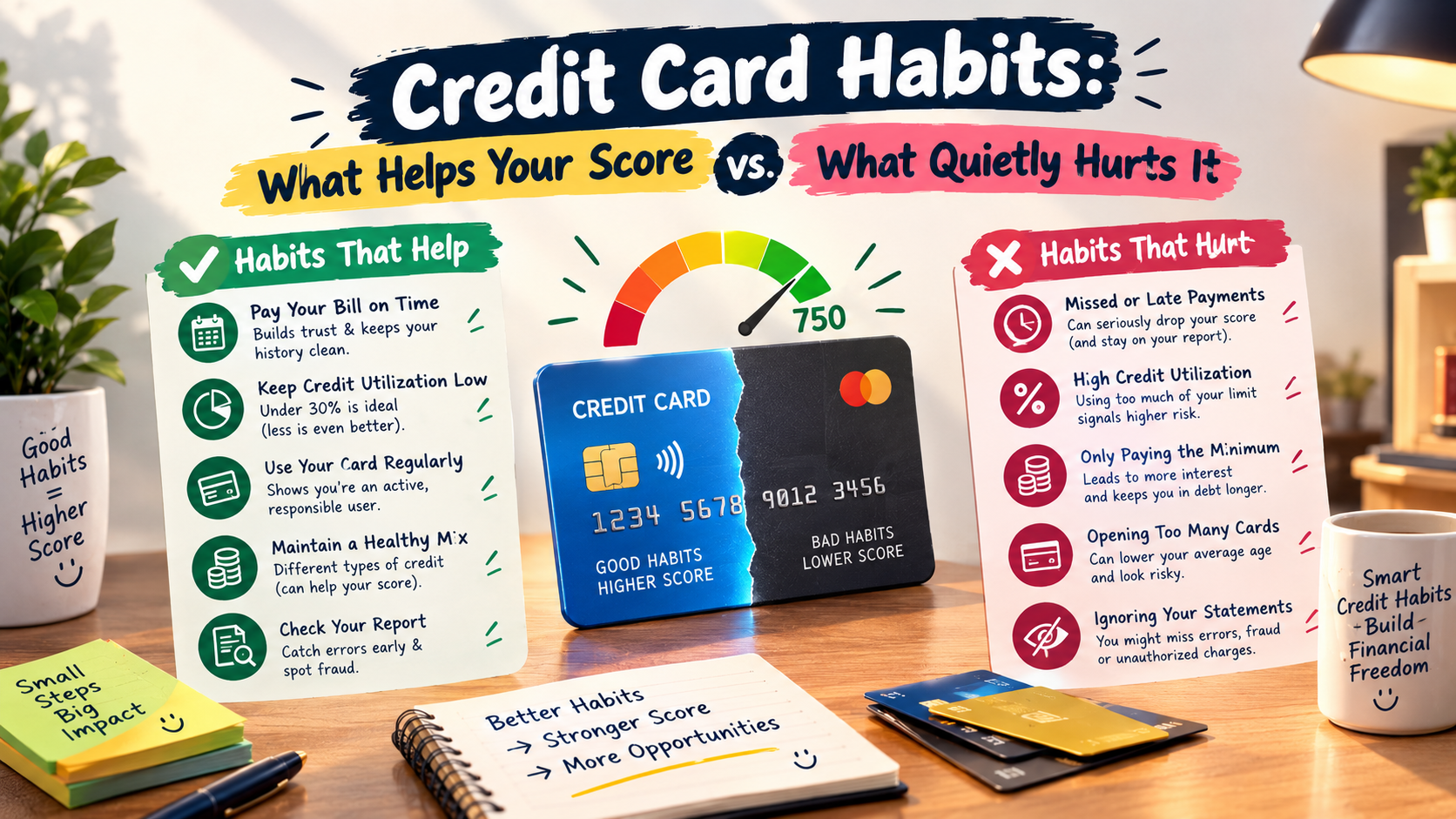
Same Card, Very Different Outcomes
Two people can carry the exact same credit card, with the exact same limit, and end up with wildly different credit scores a year later — not because of luck, but because of habits. A handful of everyday decisions (how much you pay each month, how many applications you file, how you pick a card in the first place) quietly compound into either a strong score or a slow-building debt problem. This guide walks through six of those decisions — three that commonly hurt scores, and three that shape how well a card actually works for you.
The Minimum Due Trap
Paying only the minimum amount due feels responsible — it keeps your account in good standing and avoids a late fee. But it doesn't stop interest from accruing on your entire outstanding balance, not just the unpaid portion. A bill that looks manageable at minimum-due level can end up costing two to three times its original value over a year or more, purely from compounding finance charges.
The full worked example, a month-by-month breakdown of how the balance barely shrinks, and how to break the cycle, is in Minimum Due vs Full Payment — The Trap Explained.
Credit Utilization: The Score Factor You Can Fix This Month
Even if you pay your bill in full every time, a high balance on your statement date alone can pull your score down — this is your credit utilization ratio, and it's second only to payment history in how heavily it's weighted. Unlike payment history, which takes months to rebuild after a mistake, utilization is one of the few factors you can improve within a single billing cycle.
How it's calculated per-card vs. overall, what counts as a "good" ratio, and the fastest ways to lower it, are covered in Credit Utilization Ratio — Why It Matters More Than You Think.
Choosing the Right Card in the First Place
A lot of card-related regret starts before the first swipe — with a card chosen for its flashiest reward offer rather than how it actually fits your spending. A rewards-points card only outperforms a simple cashback card if you'll genuinely track and redeem those points well; otherwise, the guaranteed value of cashback usually wins.
How annual fees stack up against realistic rewards value, and how to match a card to your actual spending pattern, is in Best Practices: Choosing a Card, Rewards & Cashback.
Late Payments and Defaults: The Heaviest-Weighted Mistake
Payment history carries more weight in your score than any other single factor — which is exactly why a missed payment stings so much. But the damage isn't permanent: most issuers don't report a payment as "late" to the bureau until it's 30+ days past due, and the impact of an old missed payment fades significantly within 1-2 years of clean payment behavior afterward.
How reporting timelines actually work, how long a mark stays visible, and how to recover after one, is covered in How Late Payments and Defaults Hurt Your Score.
Applying for Too Many Cards, Too Fast
Every formal credit application triggers a hard inquiry — a small, visible dip in your score. One application on its own is a minor blip, but several within a short window (like applying to three banks just to compare offers) compound into a much larger, more visible impact, and can signal financial stress to future lenders even when that isn't the case.
The difference between hard and soft inquiries, and a smarter way to compare cards without the damage, is in Too Many Card Applications — The Hidden Cost.
Getting Out Once the Balance Has Already Grown
The debt trap rarely arrives as one dramatic event — it builds gradually from minimum-due payments, rising utilization, and the occasional missed payment stacking together. The way out is always the same: get an honest, complete picture of every balance and rate, then follow a structured payoff plan rather than just continuing to pay minimums.
A full comparison of the avalanche and snowball payoff methods, balance transfers, and consolidation loans is in Credit Card Debt Trap — How to Get Out.
How These Six Habits Fit Together
| Habit | Effect on Your Score |
|---|---|
| Minimum Due Only | Keeps utilization high and balance barely shrinking, month after month |
| High Credit Utilization | Directly lowers score, even with a perfect payment record |
| Wrong Card for Your Spending | Leads to unnecessary fees or unused rewards — an indirect financial drag |
| Late Payment or Default | Largest single-factor score impact, though it fades over time |
| Too Many Applications | Compounding short-term dip, plus a risk signal to lenders |
| Unmanaged Debt Trap | Combines several of the above into one larger, harder-to-reverse problem |
Key Takeaway: None of these six habits exist in isolation — a minimum-due payment raises utilization, a missed payment can trigger a scramble for new credit (more inquiries), and left unchecked, all of it can compound into a genuine debt trap. The good news is the reverse is also true: fixing one habit, like switching to full payments, tends to improve several of these factors at once.
Frequently Asked Questions
Which of these habits affects my score the most?
Payment history (late payments and defaults) typically carries the heaviest weight, followed closely by credit utilization — both matter more than card choice or application frequency.
If I fix my utilization, will my score recover fast?
Often within one reporting cycle — once your lower balance is reported on your next statement date, the improved utilization is usually reflected in your next score update.
Can good habits on one card offset a mistake on another?
To some extent, yes — your overall score reflects your entire credit profile, so consistently good behavior on other accounts can help balance out one problem account over time.
Where should I start if I'm dealing with more than one of these issues at once?
Start with whichever is causing ongoing damage — usually stopping minimum-due payments and pausing new applications — before tackling a structured payoff plan for any existing balance.