
Your Real Stock Market Return Isn't Just the Price Chart
Finzony Team
Finzony Desk
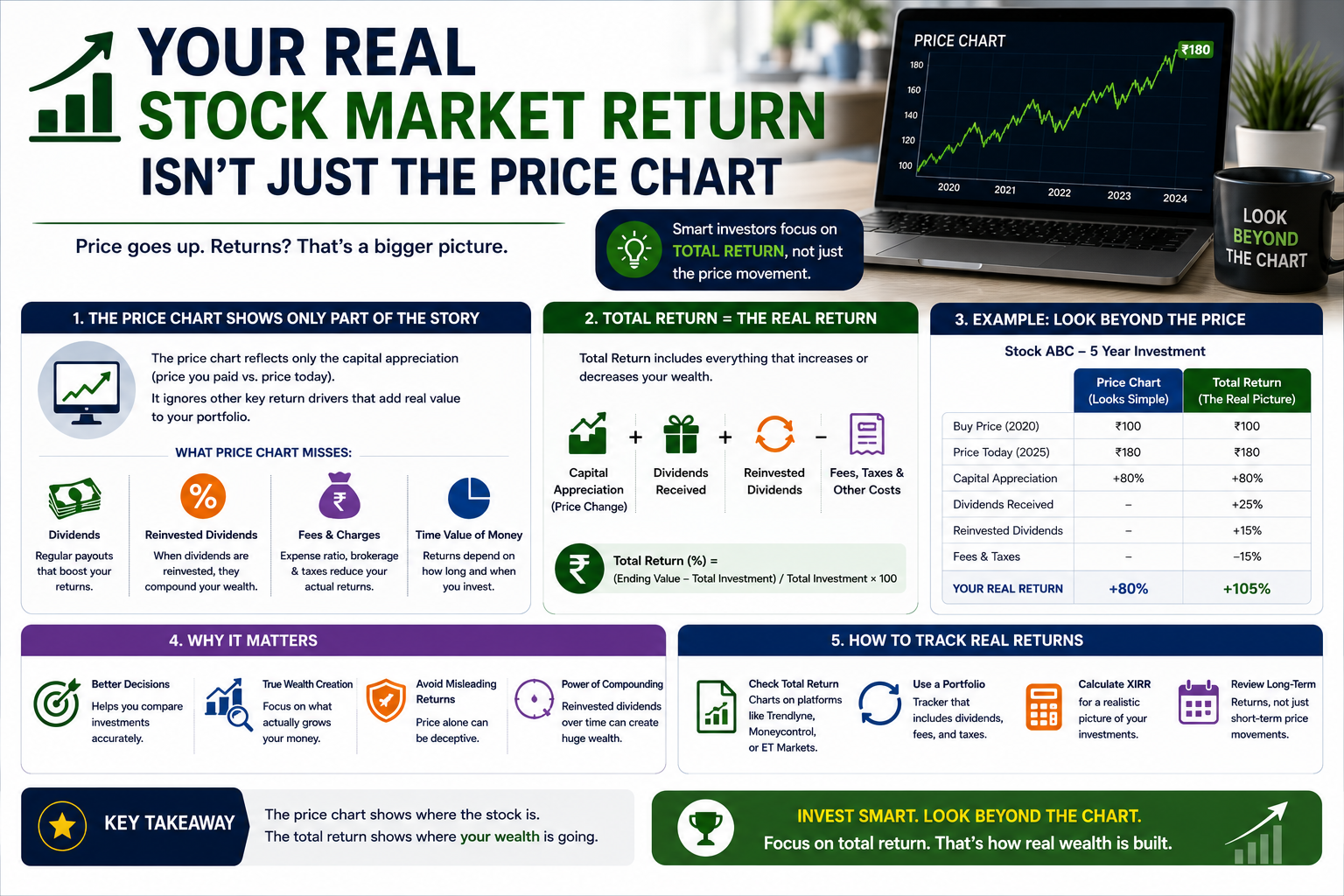
If you check a stock's return by comparing today's price to what you paid, you're not seeing the full picture. That number — called price return — leaves out dividends entirely, and dividends can be a meaningful chunk of your actual gains, especially over long holding periods.
Price return vs. total return
- Price return: Just the change in share price. Buy at $100, it's now $130 — that's a 30% price return.
- Total return: Price change plus all dividends received, whether you spent them or reinvested them. This is your actual return on the money you put in.
For dividend-paying stocks and index funds, the gap between these two numbers compounds over time — and it's often bigger than people expect.
Why dividend reinvestment matters so much
When you reinvest dividends instead of taking them as cash, each dividend buys more shares — which then earn their own dividends and price appreciation. Over a 20–30 year holding period, reinvested dividends can account for a substantial share of an index fund's total return, not just a minor bonus on top of price growth.
A simple total return calculation
Total Return (%) = [(Ending Value − Beginning Value + Dividends Received) ÷ Beginning Value] × 100
Example: You buy $10,000 worth of a stock. Over 5 years, it grows to $14,000 in price, and you collect $1,200 in dividends along the way (not reinvested).
- Price return alone: ($14,000 − $10,000) ÷ $10,000 = 40%
- Total return: ($14,000 − $10,000 + $1,200) ÷ $10,000 = 52%
That's a 12-percentage-point difference — purely from dividends the price chart never showed you.
Annualizing your return (CAGR)
A 52% total return over 5 years doesn't mean 10.4% a year — because of compounding, it's actually less than that in annual terms. The correct way to annualize is the Compound Annual Growth Rate:
CAGR = (Ending Value ÷ Beginning Value)^(1/Years) − 1
This is the number that lets you fairly compare two investments held for different lengths of time.
Watch out for timing when you add or remove money
If you added money partway through — say, a lump sum in year 3 — a simple beginning-to-end calculation gets distorted. Dollar-weighted return methods (like XIRR) account for exactly when each cash flow happened, which matters a lot if you invest through regular contributions rather than a single lump sum.
Why this matters for comparing investments
Comparing two stocks or funds using only price return can be misleading — a high-dividend stock with modest price growth might have a lower price return than a high-growth, no-dividend stock, while actually delivering a similar or better total return. Always compare total returns when evaluating performance, not headline price charts.
Calculate your actual return
Use Finzony's Stock ROI Calculator to see your real total return, including dividends, on any position you're tracking.
This article is for educational purposes only and does not constitute investment advice. Past performance does not guarantee future results — consult a financial advisor before making investment decisions.