
What Is a Step-Up SIP and Why It Beats a Regular SIP Over Time
Investing Writer
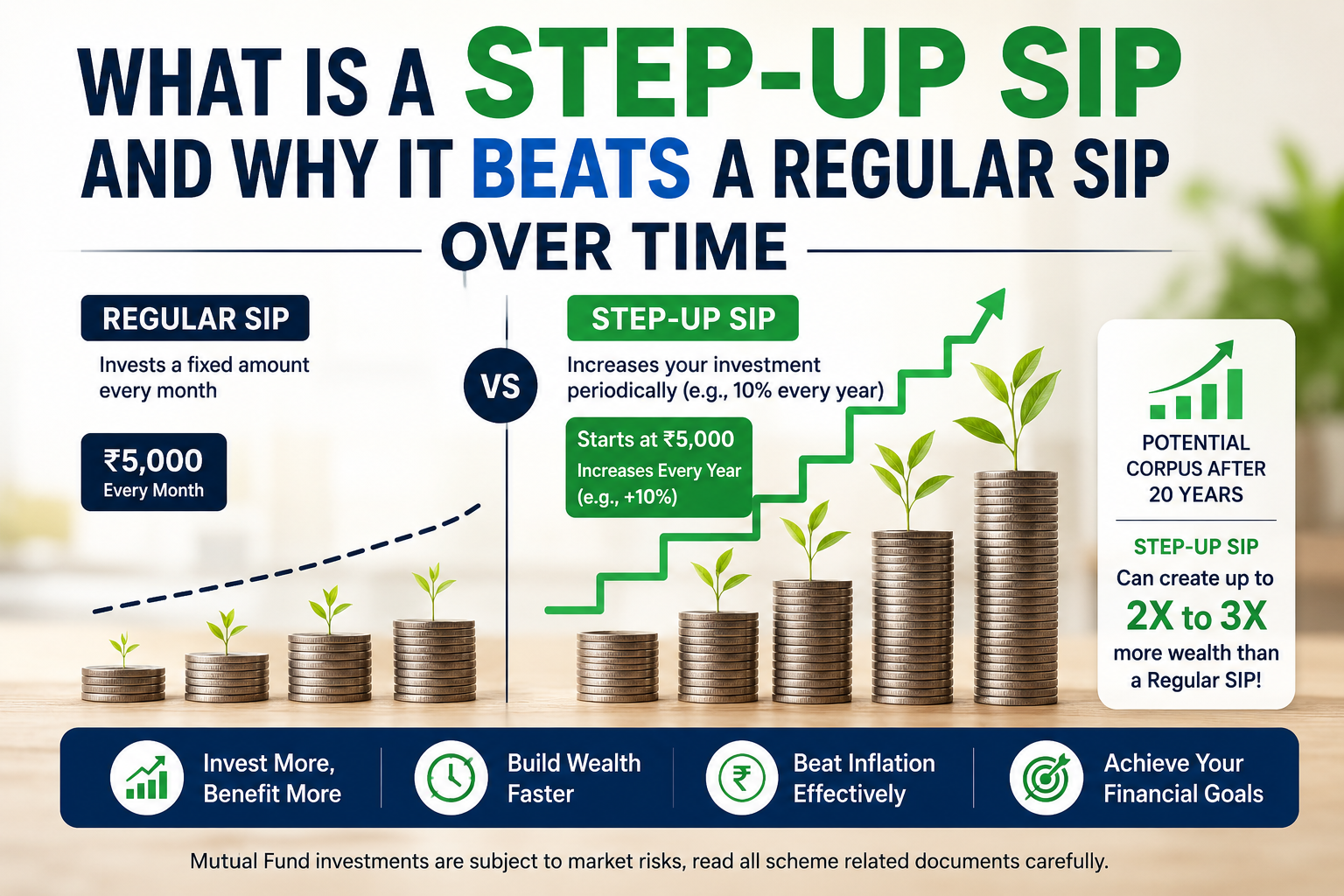
What Is a Step-Up SIP?
A Step-Up SIP (also called a Top-Up SIP) is a mutual fund SIP where you increase your monthly investment amount by a fixed percentage or amount every year, instead of keeping it constant. For example, you might start with a ₹10,000 monthly SIP and increase it by 10% each year — so it becomes ₹11,000 in year 2, ₹12,100 in year 3, and so on — rather than investing a flat ₹10,000 every month for the entire duration.
Why It Beats a Regular SIP Over Time
The core idea is simple: your income typically grows every year, but a regular SIP amount stays frozen unless you manually change it. A Step-Up SIP automatically aligns your investment with your rising income, so a larger share of your growing earnings goes toward wealth building rather than lifestyle inflation. Over a long horizon, this compounds significantly — both because you're investing more each year and because that extra money has more time to grow.
A Worked Example
| SIP Type | Monthly Amount | Total Invested (20 yrs) | Approx. Value @ 12% p.a. |
|---|---|---|---|
| Regular SIP | ₹10,000 (flat) | ₹24 lakh | ~₹1.00 crore |
| Step-Up SIP (10% annual increase) | ₹10,000 → grows yearly | ~₹68.7 lakh | ~₹1.98 crore |
The step-up version invests significantly more over the 20 years, but because the increases happen gradually and largely track income growth, it doesn't feel like a jump in the monthly budget the way starting at a much higher flat SIP would.
Who Should Use a Step-Up SIP?
- Salaried professionals expecting regular annual increments
- Anyone starting their SIP journey early in their career with a smaller initial amount
- Investors who find it psychologically easier to start small and increase gradually, rather than committing to a large SIP amount from day one
Common Mistakes to Avoid
1. Setting the step-up percentage too aggressively. A 20-25% annual increase may not be sustainable if your income doesn't actually grow that fast — 10% is a commonly used, more realistic benchmark tied to typical salary growth.
2. Forgetting to review it periodically. A step-up SIP set up years ago should still be checked against your current income and goals — a fixed percentage set once doesn't automatically account for a job change, career break, or shift in financial priorities.
3. Treating it as "set and forget" forever. Automating the step-up is convenient, but it shouldn't replace an annual check-in on whether your overall asset allocation and fund choice still make sense.
4. Starting too small to matter. The step-up feature amplifies whatever base amount you start with — starting extremely small delays meaningful wealth accumulation even with a high step-up percentage.
5. Confusing step-up SIP with step-up in fund allocation. A step-up SIP increases the investment amount; it doesn't automatically change which fund or asset class you're invested in — that's a separate decision.
Key Takeaway: A Step-Up SIP lets your investments grow in step with your income, rather than staying frozen at whatever amount you could afford when you first started — over a long horizon, that difference compounds into a meaningfully larger corpus than a flat SIP of the same starting amount.
Frequently Asked Questions
What step-up percentage should I choose?
10% annually is a commonly used, realistic benchmark that roughly tracks typical salary growth. You can adjust it higher or lower based on your own expected income growth and comfort level.
Can I change or stop the step-up feature later?
Yes — most fund houses and platforms let you modify or cancel the step-up instruction, or pause it during a year when your income doesn't grow as expected, without disrupting the underlying SIP itself.
Is a Step-Up SIP riskier than a regular SIP?
Not inherently — the risk depends on the underlying fund you're investing in, not the step-up feature itself. The step-up only changes how much you invest each year, not what you're invested in.
Does a Step-Up SIP work for all mutual fund categories?
Yes, most AMCs and platforms allow the step-up feature across equity, debt, and hybrid fund SIPs — it's a feature of how the SIP is set up, not tied to a specific fund category.
How much more can a Step-Up SIP grow compared to a regular SIP?
It depends on your step-up percentage, tenure, and returns, but even a modest 10% annual step-up over 15-20 years can result in a meaningfully larger corpus than a flat SIP of the same starting amount — often 40-80% more, depending on the exact numbers.