
SWP Explained: How to Turn Your Mutual Fund Corpus into a Monthly Income
Retirement Writer
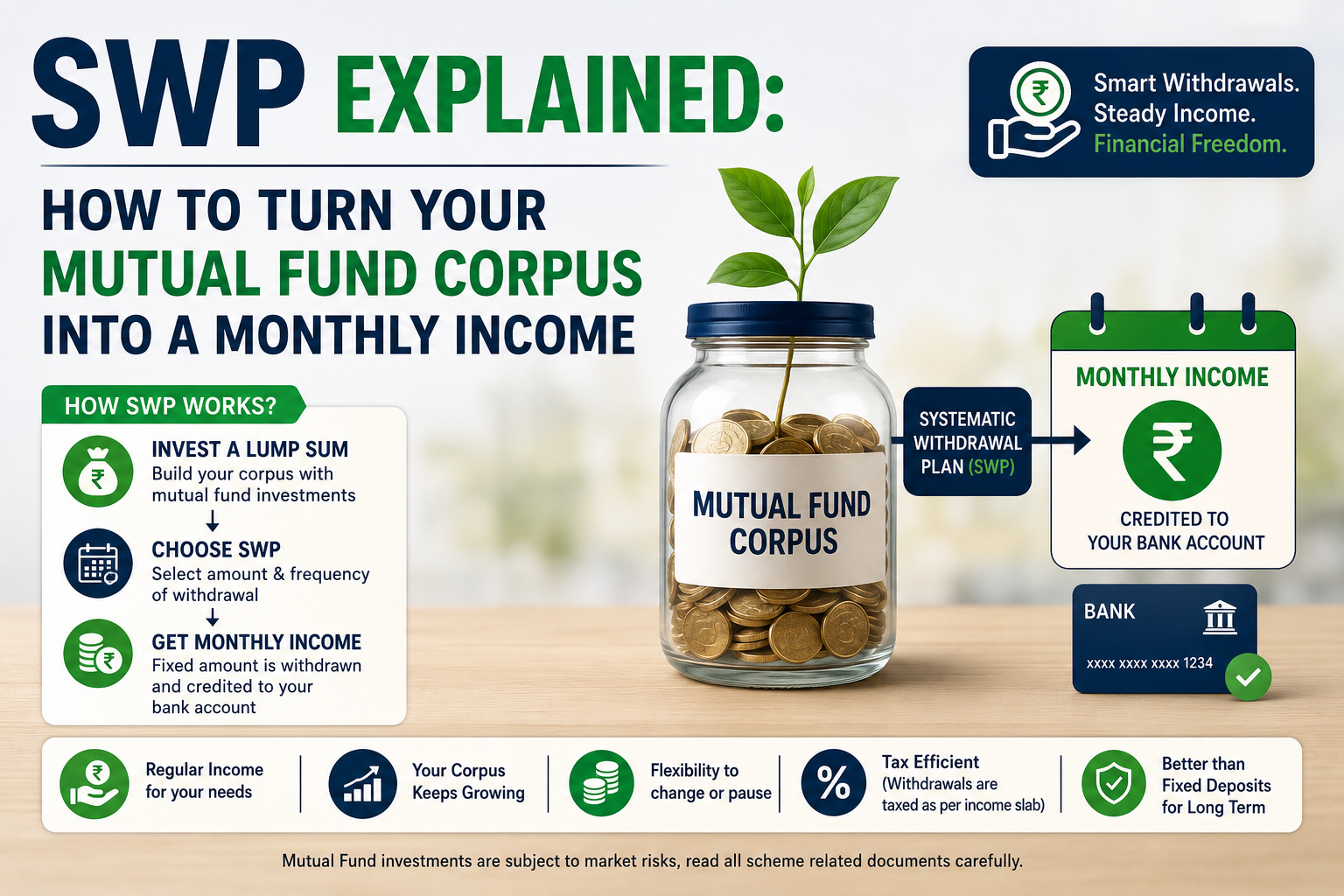
What Is a Systematic Withdrawal Plan (SWP)?
A Systematic Withdrawal Plan lets you withdraw a fixed amount from your mutual fund investment at regular intervals — monthly, quarterly, or annually — while the rest of your money stays invested and continues to grow. It's essentially the reverse of a SIP: instead of putting money in regularly, you're taking money out regularly, in a structured, predictable way.
How SWP Actually Works
You choose a fund (typically already accumulated through years of SIP or lump-sum investing), set a withdrawal amount and frequency, and the fund house redeems units automatically to pay you that amount each period. The remaining units stay invested and continue earning returns, which is what makes SWP different from simply withdrawing your entire corpus and putting it in a savings account.
Why People Use SWP
- Retirement income: Turning a retirement corpus into a monthly "paycheck" without fully cashing out the investment
- Tax efficiency: Only the gains portion of each withdrawal is taxed (not the full withdrawal amount), which can be more tax-efficient than an FD's fully taxable interest
- Continued growth: The remaining corpus stays invested and can continue compounding, unlike a fixed lump-sum drawdown
SWP vs. Just Withdrawing Manually
| Factor | SWP | Manual Withdrawal |
|---|---|---|
| Discipline | Automatic, fixed schedule | Depends on your own consistency |
| Tax efficiency | Only gains portion taxed per withdrawal | Same rule applies, but less predictable planning |
| Remaining corpus | Continues to grow | Same, but easier to overspend without a fixed plan |
The Risk: Withdrawing More Than the Fund Earns
If your SWP withdrawal rate is higher than the fund's actual returns, you're eating into your principal, not just the gains — and the corpus can deplete faster than expected, especially during a period of poor market returns. This is the single most important thing to get right: the withdrawal rate should be sustainable relative to realistic long-term returns, not just a number that "feels comfortable" today.
A Simplified Example
Say you have a ₹50 lakh corpus in an equity mutual fund and set up an SWP of ₹25,000 per month (₹3 lakh per year, a 6% annual withdrawal rate). If the fund averages 10-12% annual returns over the long run, your corpus can potentially sustain this withdrawal and still grow over time. But if you set the withdrawal at ₹40,000 per month (₹4.8 lakh per year, a 9.6% withdrawal rate) against similar expected returns, you're likely drawing down the principal over time, especially factoring in any bad market years along the way.
Common Mistakes to Avoid
1. Setting the withdrawal rate too high. A withdrawal rate that exceeds the fund's realistic long-term return means you're slowly liquidating your principal, not just living off the gains — check this ratio carefully before starting.
2. Starting SWP in a volatile equity fund without a debt cushion. Withdrawing fixed amounts during a market downturn forces you to sell more units at lower prices — a hybrid or debt allocation as a buffer can reduce this risk, especially for near-term income needs.
3. Not adjusting the withdrawal amount for inflation over time. A fixed ₹25,000 monthly withdrawal today won't have the same purchasing power in 10-15 years — periodically reviewing and adjusting the amount keeps the plan realistic.
4. Ignoring the tax treatment of each withdrawal. Understanding whether withdrawals are being taxed as short-term or long-term capital gains (depending on the fund type and holding period) matters for accurate income planning.
5. Treating SWP as a "set and forget" forever plan. Market conditions, fund performance, and your own income needs all change over the years — periodic review of the SWP amount and the fund itself is important, not a one-time setup.
Key Takeaway: An SWP is a useful way to convert an investment corpus into a predictable income stream while keeping the remainder invested and growing — but the withdrawal rate has to stay realistic relative to the fund's actual expected returns, or you risk quietly depleting your principal faster than planned.
Frequently Asked Questions
Is SWP better than a Fixed Deposit for retirement income?
It depends on your risk appetite. SWP from an equity or hybrid fund can offer better tax efficiency and continued growth potential, but carries market risk that an FD doesn't — a mix of both is common for retirement income planning.
What withdrawal rate is considered safe for SWP?
There's no single universal number, but keeping the withdrawal rate meaningfully below the fund's realistic long-term average return gives the corpus room to keep growing rather than depleting over time.
Can I change or stop my SWP anytime?
Yes — most fund houses let you modify the withdrawal amount, frequency, or stop the SWP entirely at any point, without penalty (beyond any applicable exit load on the fund itself).
Is the entire SWP withdrawal amount taxable?
No — only the gains portion of each withdrawal is taxable as capital gains, not the full withdrawal amount. The original invested portion is simply a return of your own capital.
Should I start SWP immediately after building a corpus, or wait?
It generally makes sense to start SWP once you actually need the regular income — for example, at retirement. Starting earlier than necessary just reduces the time your full corpus has to compound.