
Sukanya Samriddhi Yojana Explained: Save for Your Daughter's Future
Savings Writer
What Is Sukanya Samriddhi Yojana?
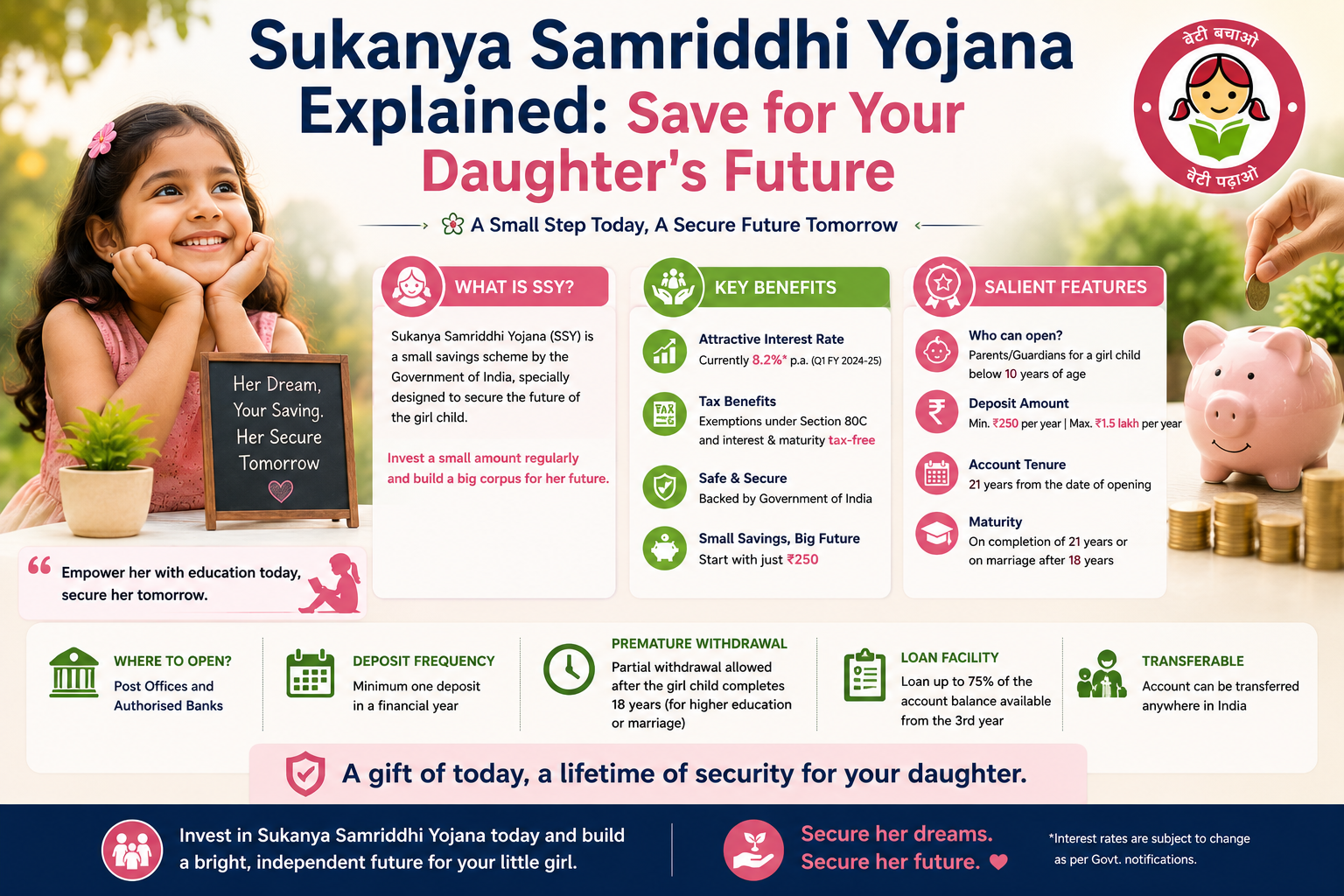
Sukanya Samriddhi Yojana (SSY) is a government-backed small savings scheme launched under the "Beti Bachao Beti Padhao" initiative, specifically designed to help parents build a long-term corpus for a girl child's education or marriage. It offers one of the highest interest rates among government small savings schemes, along with full tax-free treatment on contributions, interest, and maturity proceeds.
Eligibility
- Account must be opened for a girl child below 10 years of age by a parent or legal guardian
- The girl must be a resident Indian citizen
- Generally, one account per girl child, up to two accounts per family (a third account is allowed in the case of twin or triplet girls)
Key Scheme Details
| Feature | Detail |
|---|---|
| Current interest rate | 8.2% p.a. (reviewed quarterly by the Ministry of Finance) |
| Minimum deposit | ₹250 per financial year |
| Maximum deposit | ₹1.5 lakh per financial year |
| Contribution period | 15 years from account opening |
| Maturity period | 21 years from account opening (or on marriage after age 18) |
| Partial withdrawal | Up to 50% allowed after the girl turns 18 or passes Class 10, mainly for higher education |
The Triple Tax Benefit (EEE Status)
SSY enjoys "Exempt-Exempt-Exempt" (EEE) tax treatment, one of the most favorable tax structures available in India:
- Contributions: Deductible up to ₹1.5 lakh annually under the Section 80C limit (old tax regime only)
- Interest earned: Fully tax-exempt, regardless of the amount
- Maturity proceeds: Fully tax-exempt when withdrawn
Why Only 15 Years of Contributions, but 21 Years to Maturity?
This structure is one of the most commonly misunderstood aspects of SSY. You only need to actively contribute for the first 15 years — after that, no further deposits are required, but the account continues to earn interest on the accumulated balance for the remaining years until it matures at 21 years from opening. This means your money keeps compounding for 6 extra years without needing additional contributions.
A Simplified Example
If you open an SSY account when your daughter is 5 and contribute ₹1 lakh annually for 15 years, your total principal invested would be ₹15 lakh. At the current 8.2% rate (compounded annually, though this can change over the years), the corpus at maturity — when your daughter turns 26 — could grow to a substantially larger sum, tax-free, purely through the effect of long-term compounding on top of your contributions.
Common Mistakes to Avoid
1. Missing the minimum annual deposit. Failing to deposit at least ₹250 in a financial year makes the account "irregular," requiring a penalty to reactivate — set up an auto-debit if possible to avoid this.
2. Opening the account too late. Since eligibility closes at age 10, and the corpus benefits significantly from a longer compounding period, opening the account as early as possible after birth maximizes the eventual maturity value.
3. Not understanding the partial withdrawal rules. The 50% partial withdrawal is specifically meant for higher education expenses once the girl turns 18 or passes Class 10 — it's not a general-purpose withdrawal option before that point.
4. Assuming the interest rate is locked in for the full 21 years. The 8.2% rate is reviewed quarterly by the government and can change over time — the actual maturity amount depends on rates prevailing throughout the account's life, not just today's rate.
5. Opening more than the permitted number of accounts. Generally limited to two accounts per family (with an exception for twins/triplets) — attempting to open additional accounts beyond this limit isn't allowed under the scheme rules.
Key Takeaway: Sukanya Samriddhi Yojana combines a government guarantee, one of the highest available small-savings interest rates, and full tax-free treatment at every stage — making it one of the strongest options specifically for long-term, goal-based savings toward a daughter's education or marriage. Opening the account as early as possible captures the maximum benefit from its long compounding window.
Frequently Asked Questions
Can I open an SSY account for my daughter if she's already 9 years old?
Yes, as long as she's under 10 at the time of opening. However, opening earlier maximizes the compounding period, so it's generally beneficial to open the account as soon as possible after birth.
Do I need to keep contributing for all 21 years until maturity?
No — contributions are only required for the first 15 years. After that, the account continues to earn interest on the existing balance without needing further deposits, until it matures at 21 years from opening.
Is the SSY interest rate fixed for the entire tenure?
No — the rate is reviewed and potentially revised every quarter by the government. The current rate is 8.2% p.a., but this can change over the account's 21-year life.
Can I withdraw the full amount before my daughter turns 21?
A partial withdrawal of up to 50% is allowed for higher education once she turns 18 or passes Class 10. Full withdrawal is generally only available at maturity (21 years) or upon her marriage after age 18.
Is SSY better than a regular Fixed Deposit for my daughter's future?
For long-term, girl-child-specific goals, SSY generally offers a higher interest rate and full tax-free treatment (EEE) compared to a standard FD, whose interest is taxable. The trade-off is SSY's longer lock-in and contribution structure.