
NPS Explained: Retirement Planning with the National Pension System
Retirement Writer
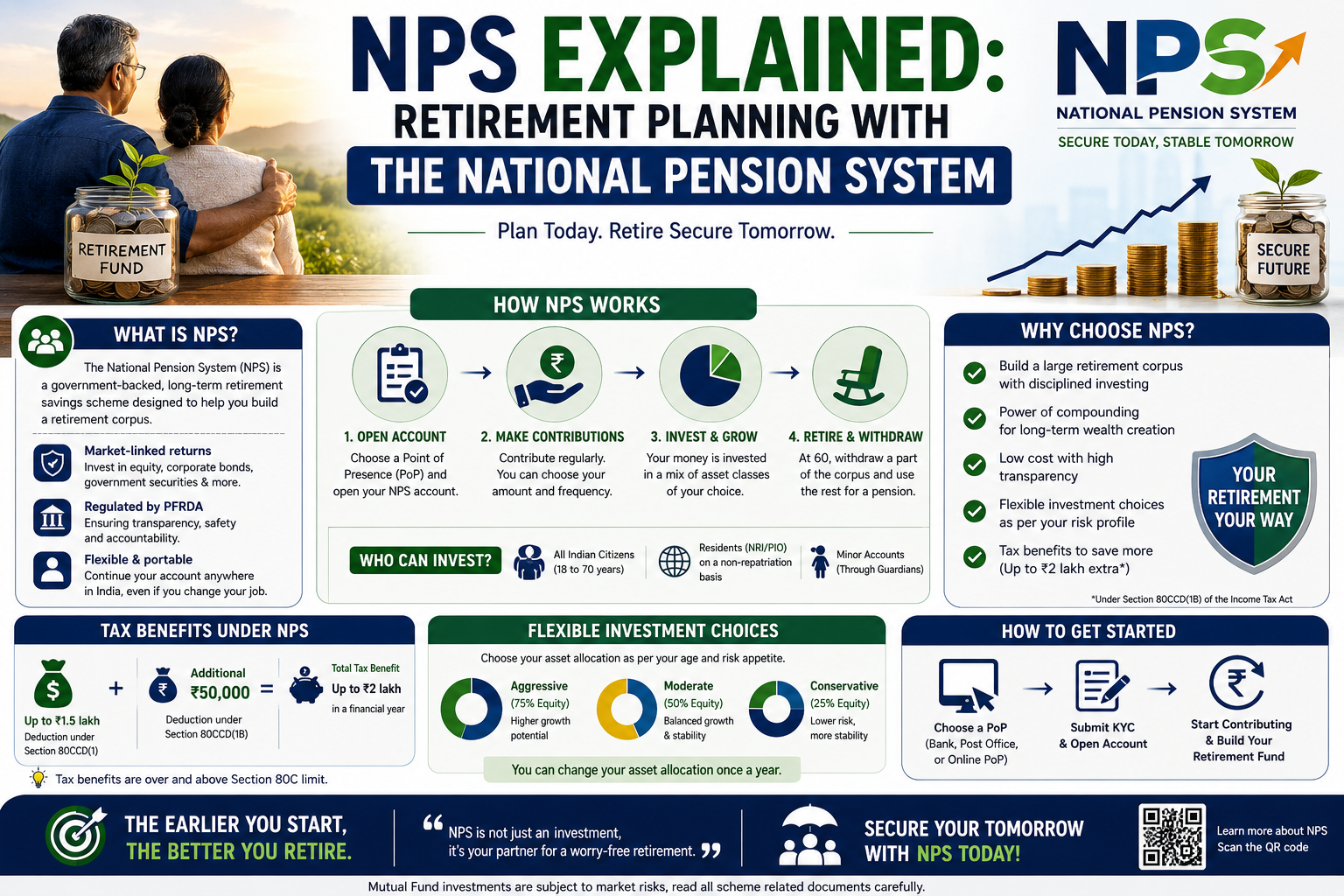
What is NPS?
The National Pension System (NPS) is a voluntary, government-regulated retirement savings scheme open to all Indian citizens aged 18–70. You contribute regularly into an individual account, the money is invested in a mix of equity, corporate bonds, and government securities based on your choice, and at retirement a portion is paid out as a lump sum while the rest is used to buy an annuity that gives you a monthly pension for life.
It's regulated by the Pension Fund Regulatory and Development Authority (PFRDA), and unlike PPF or EPF, your returns are market-linked rather than fixed — which means both the upside and the risk are higher.
Tier 1 vs Tier 2 Accounts
NPS has two account types. Tier 1 is the primary retirement account — contributions are locked in until age 60, and this is where the tax benefits apply. Tier 2 is a voluntary savings account with no lock-in, functioning more like a flexible investment account, but it doesn't carry the same tax advantages.
How Your Money is Invested
NPS offers two investment approaches:
- Active Choice: You decide the allocation yourself across Equity (E), Corporate Bonds (C), Government Securities (G), and Alternative Assets (A), subject to a cap of 75% in equity.
- Auto Choice: The system automatically adjusts your equity exposure downward as you age, following a lifecycle fund approach — aggressive in your 20s and 30s, conservative as you approach 60.
The Tax Benefits That Make NPS Attractive
NPS is one of the few instruments where you can claim tax deductions beyond the standard 80C limit:
- Section 80CCD(1): Contributions up to ₹1.5 lakh count within the overall 80C limit.
- Section 80CCD(1B): An additional ₹50,000 deduction exclusively for NPS, over and above the 80C limit — this is the big draw for salaried employees looking to reduce taxable income further.
- Employer contribution (80CCD(2)): If your employer contributes to your NPS account, that amount is deductible separately too, subject to limits.
Together, this means a taxpayer in the 30% bracket can meaningfully reduce their tax liability while simultaneously building a retirement corpus.
What Happens at Retirement (Age 60)
At maturity, you can withdraw up to 60% of your corpus as a tax-free lump sum. The remaining 40% must compulsorily be used to purchase an annuity from a PFRDA-empanelled insurance company, which then pays you a regular monthly pension for life. The pension income itself is taxable as per your income slab in the year you receive it.
NPS vs Other Retirement Options
- NPS vs PPF: PPF offers fixed, tax-free returns with a 15-year lock-in and no equity exposure. NPS offers potentially higher, market-linked returns but locks your money until 60 and taxes the pension.
- NPS vs EPF: EPF is largely debt-oriented and employer-linked for salaried employees. NPS is available to everyone, including self-employed individuals, and allows equity exposure.
Most planners suggest NPS as one part of a diversified retirement portfolio rather than the only one — it complements PPF and EPF rather than replacing them.
Estimating Your NPS Corpus
Your final corpus depends on your monthly contribution, the number of years until retirement, and the returns your chosen asset mix generates. Use the NPS calculator to model different contribution amounts and see the projected corpus and estimated monthly pension at age 60.
Who Should Consider NPS?
NPS makes the most sense for salaried individuals who have already maxed out their 80C limit and want the extra ₹50,000 deduction under 80CCD(1B), and for anyone comfortable with market-linked growth over a long horizon in exchange for a structured, disciplined retirement payout.
Bottom Line
NPS won't suit someone who wants guaranteed, fixed returns or full liquidity before 60. But for long-term retirement planning with a genuine tax edge, it's one of the most efficient tools available to Indian taxpayers today.