
Home Loan EMI Explained: How It's Calculated and How to Reduce It
Loans Writer
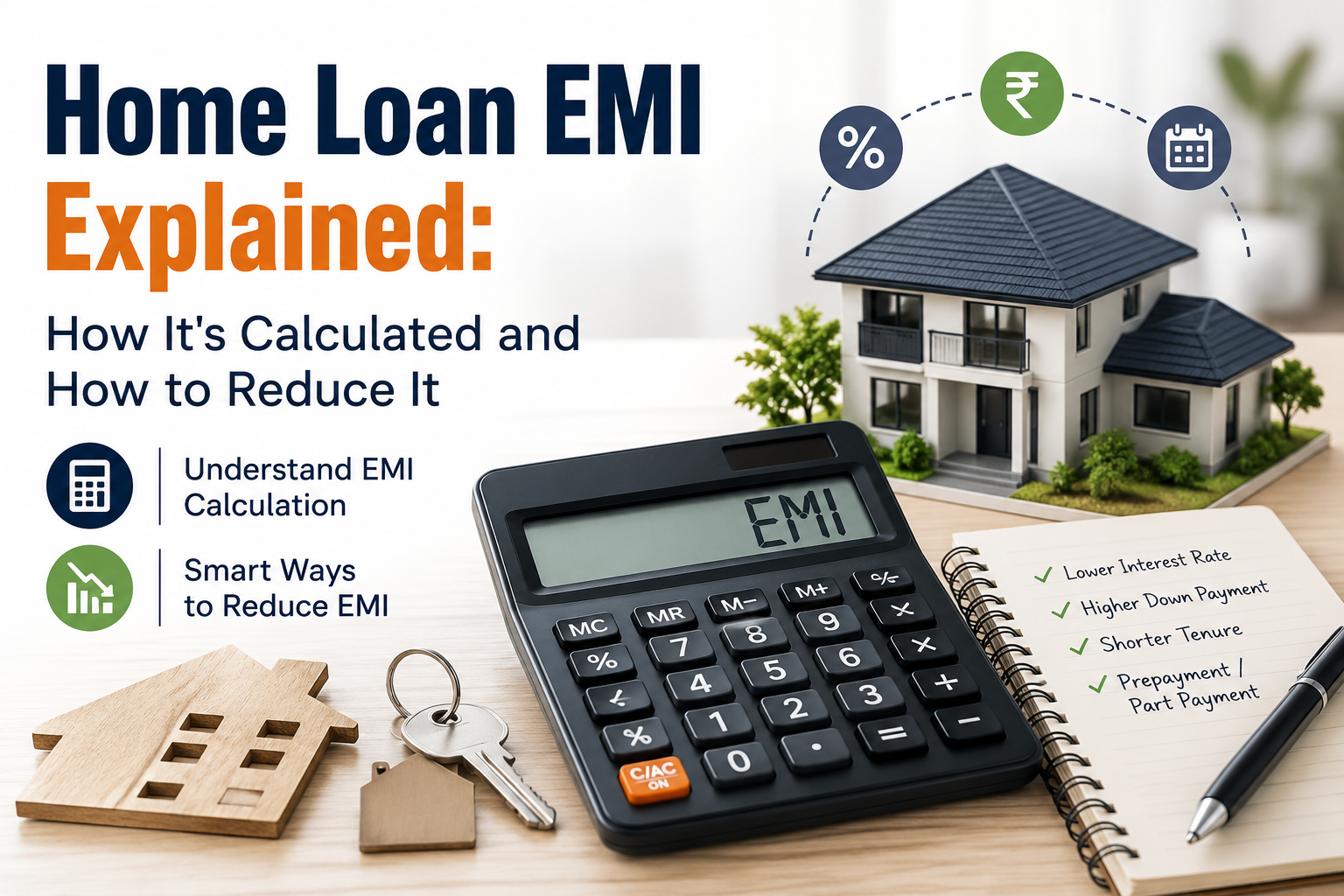
What Is an EMI?
EMI stands for Equated Monthly Installment — the fixed monthly amount you pay toward your home loan, covering both principal and interest. Even though the EMI amount stays constant throughout the loan tenure (for a fixed-rate loan), the split between principal and interest within each EMI changes over time.
How EMI Is Calculated
EMI is calculated using the loan amount, interest rate, and tenure, based on a standard formula: EMI = P × r × (1+r)^n / [(1+r)^n - 1], where P is the principal loan amount, r is the monthly interest rate (annual rate divided by 12), and n is the total number of monthly installments. You don't need to calculate this by hand — any bank's website or a simple EMI calculator does it instantly once you enter the loan amount, rate, and tenure.
Why Interest Dominates Early EMIs
In the early years of a home loan, a much larger portion of each EMI goes toward interest rather than principal, because interest is calculated on the outstanding loan balance, which is highest at the start. As you continue paying, the outstanding balance shrinks, so a progressively larger share of each EMI goes toward principal — this is why loan amortization schedules show interest "front-loaded" in the early years.
A Simplified Example
| Loan Details | Value |
|---|---|
| Loan amount | ₹40,00,000 |
| Interest rate | 8.5% p.a. |
| Tenure | 20 years |
| Monthly EMI | ~₹34,700 |
| Total interest paid over 20 years | ~₹43.3 lakh |
| Total amount paid (principal + interest) | ~₹83.3 lakh |
Notice that the total interest paid over the loan's life can end up being more than the principal itself — this is a direct result of the loan tenure and interest rate, and it's exactly why reducing either one meaningfully lowers your total cost.
How to Reduce Your Total Interest Cost
- Make prepayments when possible: Even occasional lump-sum prepayments toward principal (bonus, tax refund, etc.) can meaningfully cut total interest, since it's calculated on the outstanding balance
- Choose a shorter tenure if affordable: A shorter tenure means a higher EMI but significantly less total interest paid
- Negotiate or refinance to a lower rate: Even a 0.25-0.5% rate reduction can meaningfully lower total interest over a 15-20 year loan, especially through a balance transfer to another lender
- Increase EMI amount when your income grows: Many lenders allow voluntary EMI step-ups, which shortens the effective tenure without needing a lump-sum prepayment
Fixed vs. Floating Interest Rate EMIs
A fixed-rate loan keeps your EMI amount constant for the entire tenure, offering predictability. A floating-rate loan's EMI can change as market interest rates move — when rates fall, your EMI (or tenure) can decrease; when rates rise, it can increase. Most home loans in India are floating-rate by default, with fixed-rate options usually carrying a higher initial rate as a trade-off for stability.
Common Mistakes to Avoid
1. Only comparing EMI amounts across lenders, not total interest. A lower EMI from a longer tenure can mean paying significantly more total interest — always compare the full loan cost, not just the monthly figure.
2. Not making prepayments even when funds are available. Many borrowers let surplus cash sit in low-yield savings instead of prepaying a loan with a comparatively higher interest rate — prepayment is often the better use of that surplus, especially early in the loan tenure.
3. Ignoring the impact of a rate hike on a floating loan. When rates rise, some lenders increase the EMI while others extend the tenure instead — understanding which approach your lender uses helps you plan and budget accordingly.
4. Not checking prepayment or foreclosure charges. While most floating-rate home loans in India don't carry prepayment penalties for individual borrowers, it's worth confirming your loan's specific terms before assuming this.
5. Overlooking the balance transfer option. If your current lender's rate is notably higher than what's available elsewhere, transferring the balance to a lower-rate lender can meaningfully reduce total interest — but factor in processing fees before deciding.
Key Takeaway: Your EMI stays fixed on paper, but the interest-to-principal split shifts heavily toward interest in the early years — which is exactly why prepayments, a shorter tenure, or a lower rate have an outsized effect on total interest paid. Always evaluate a home loan by its total cost over the tenure, not just the monthly EMI number.
Frequently Asked Questions
Why does my EMI stay the same but the interest portion change?
Interest is calculated on your outstanding loan balance, which decreases over time. Since the EMI itself is fixed, more of it goes toward principal (and less toward interest) as the loan progresses.
Does prepaying my home loan actually save significant money?
Yes, especially if done early in the loan tenure — prepayments directly reduce the outstanding principal, which lowers all future interest calculations on that loan, often saving substantially more than the prepaid amount itself over time.
Should I choose a fixed or floating interest rate home loan?
Floating rates are more common and can work out cheaper over time if rates stay stable or fall, but come with payment uncertainty. Fixed rates offer predictability at a typically higher starting rate — the right choice depends on your comfort with rate fluctuation.
Can I increase my EMI amount voluntarily?
Many lenders allow voluntary EMI step-ups as your income grows, which shortens your effective loan tenure and reduces total interest, without requiring a separate lump-sum prepayment.
Are there charges for prepaying a home loan in India?
For individual borrowers on floating-rate loans, most Indian lenders don't charge prepayment or foreclosure penalties, per RBI guidelines. Fixed-rate loans may still carry such charges — always confirm your specific loan's terms.