
Federal Student Loan Repayment Has Changed: SAVE Is Gone, Here's What Replaced It
Finzony Team
Finzony Desk
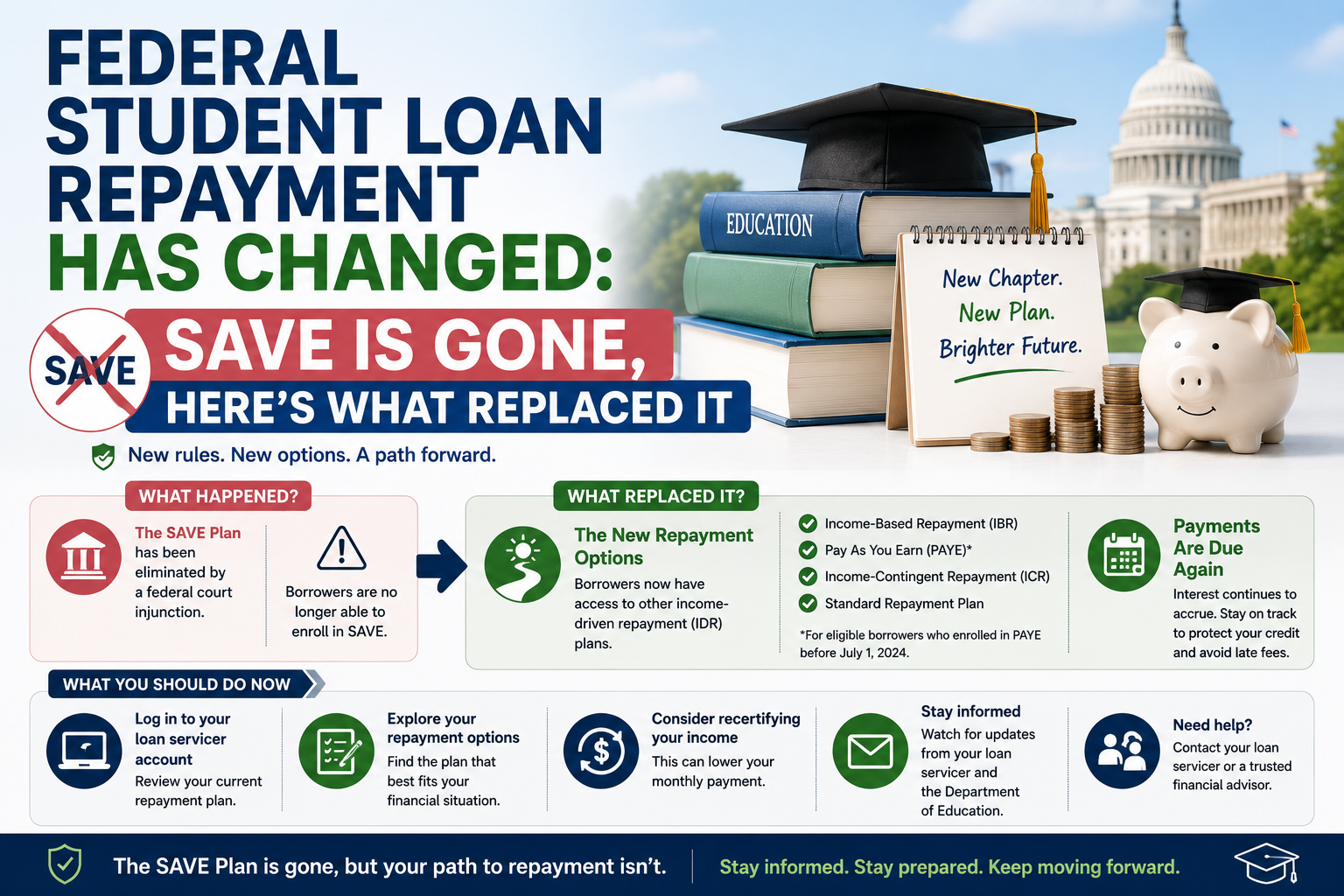
Federal student loan repayment changed more in 2026 than in the previous decade combined. If you're still budgeting around the SAVE plan, your numbers are already out of date — here's what actually replaced it.
What happened to the SAVE plan?
A federal court vacated the Saving on a Valuable Education (SAVE) plan in March 2026. The Department of Education began transitioning all SAVE borrowers starting July 1, 2026 — each borrower gets a 90-day window from their individual notice date to pick a new plan. Anyone who doesn't choose in time is auto-enrolled into the Standard Plan or the new Tiered Standard Plan, both of which typically carry higher monthly payments than SAVE did.
What replaced it: RAP and the Tiered Standard Plan
Under the One Big Beautiful Bill Act, two new repayment options launched July 1, 2026:
- Repayment Assistance Plan (RAP): The new income-driven option. Monthly payments are set at 1%–10% of your adjusted gross income, with a $10/month minimum for very low earners. Full, on-time payments protect you from runaway interest — any unpaid interest is waived, so your balance can't grow past what you actually owe. Forgiveness kicks in after 30 years of qualifying payments.
- Tiered Standard Plan: A fixed monthly payment with a term of 10, 15, 20, or 25 years depending on your loan balance — larger balances get longer terms and lower monthly payments. No income-based calculation, no forgiveness track.
What happens to other existing plans
- IBR (Income-Based Repayment): Survives long-term, but only for loans first disbursed before July 1, 2026.
- PAYE and ICR: Stop accepting new enrollees July 1, 2026, and sunset completely by July 1, 2028. Anyone still on them at that point is automatically moved to RAP (if eligible) or IBR.
- Standard, Graduated, Extended Plans: Still available for loans disbursed before July 1, 2026.
Which plan applies to you depends on when you borrowed
This is the part that trips people up — your options depend on your loan disbursement date, not just when you're reading this:
- All loans disbursed before July 1, 2026, no new borrowing since: You keep access to Standard, Graduated, Extended, and IBR, plus the new RAP option.
- Any loan disbursed on or after July 1, 2026 (including a new consolidation): Your only options for all your Direct Loans become RAP or the Tiered Standard Plan — no legacy plans, even for older loans.
Public Service Loan Forgiveness (PSLF)
If you're working toward PSLF, note that SAVE no longer counts. You need to be enrolled in an eligible income-driven plan — IBR or RAP — for your payments to keep counting toward the required 120 qualifying payments.
What to do right now
- Log in at StudentAid.gov and check which repayment plan you're currently on
- If you're on SAVE, don't wait for your notice — you can switch proactively at StudentAid.gov/idr
- Compare your projected payment under RAP vs. the Tiered Standard Plan vs. any legacy plan you still qualify for before choosing
- If you're pursuing PSLF, confirm your new plan is IBR or RAP specifically
Run your numbers through Finzony's Student Loan Calculator to compare total interest and payoff timelines across the plans you're eligible for.
This article is for educational purposes only and does not constitute financial or legal advice. Federal student loan rules are actively changing through 2028 — verify your specific situation at StudentAid.gov or with your loan servicer before making a decision.