
401(k) vs Roth IRA: Which Retirement Account Should You Choose?
Finzony Editorial Team
Finzony Desk
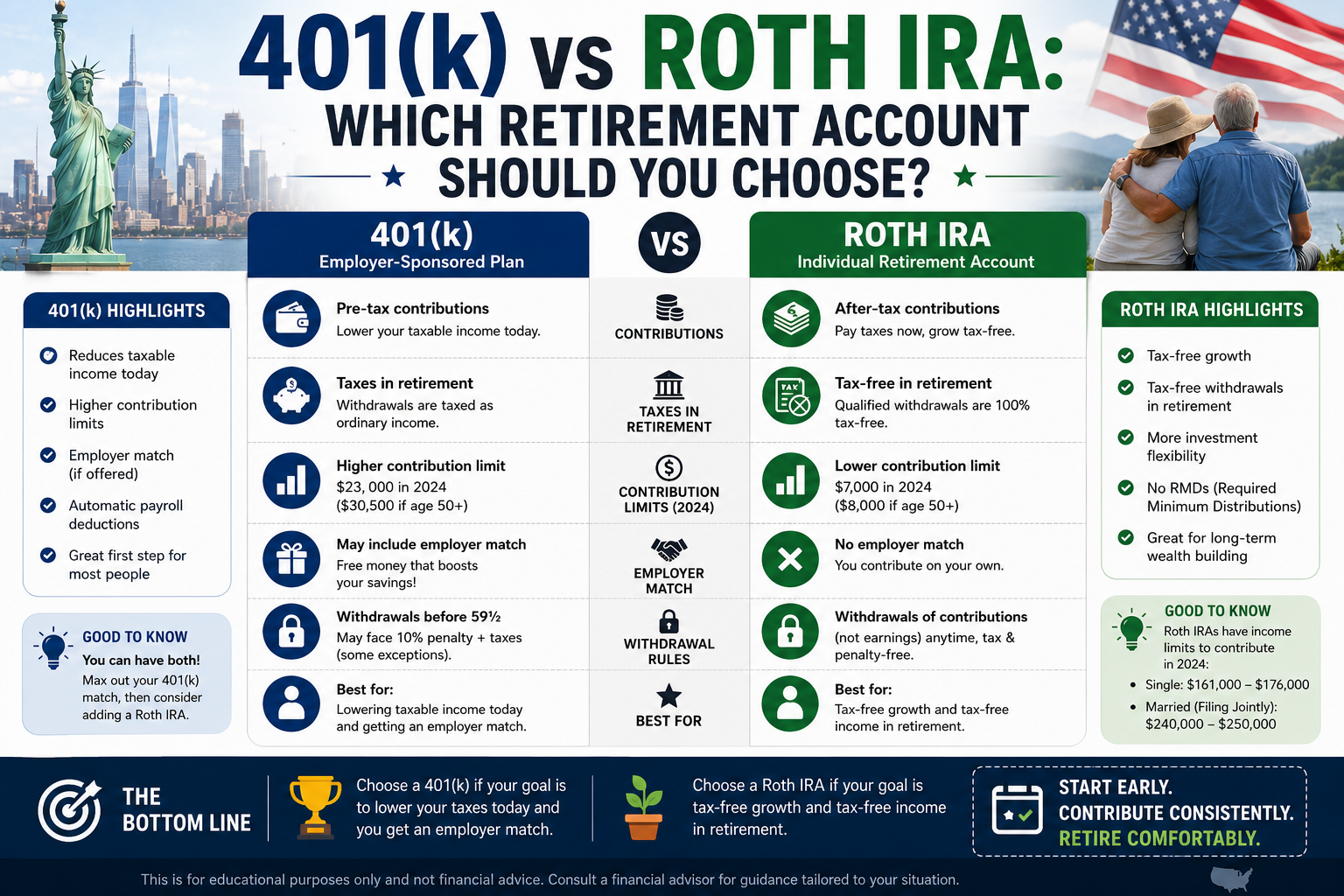
A 401(k) and a Roth IRA both help you build retirement savings, but they're taxed at completely opposite ends of the timeline. Here's how to decide where your next dollar should actually go.
The Core Difference: When You Pay Tax
Every retirement account decision eventually comes down to one question: do you want the tax break now, or later? A traditional 401(k) gives you the break now — contributions are pre-tax, lowering your taxable income today, and you pay tax when you withdraw in retirement. A Roth IRA flips that: you contribute after-tax dollars today, but qualified withdrawals in retirement are completely tax-free, including all the growth.
Side-by-Side Comparison
| Traditional 401(k) | Roth IRA | |
|---|---|---|
| Tax treatment | Pre-tax contributions, taxed on withdrawal | After-tax contributions, tax-free withdrawal |
| Who offers it | Through your employer only | Opened independently at any brokerage |
| 2026 contribution limit | Higher — set annually by the IRS, well above IRA limits | Lower — capped annually, and phases out at higher incomes |
| Employer match | Common — essentially free money | Not applicable |
| Income restrictions | None | Yes — high earners may be phased out of direct contributions |
| Required withdrawals | Yes, starting at a set age | No, during the original owner's lifetime |
Contribution limits and income phase-out ranges are adjusted by the IRS most years, so always check the current-year figures before maxing out either account.
The Employer Match Changes Everything
If your employer matches 401(k) contributions — say, 50 cents per dollar up to 6% of your salary — that match is an immediate, guaranteed return that no other investment can beat. The standard advice, and a good one: contribute enough to your 401(k) to get the full match before putting a single dollar into a Roth IRA.
Walking away from an employer match to prioritize a Roth IRA is one of the most common — and most expensive — retirement planning mistakes. It's leaving guaranteed money on the table for a tax benefit you can capture later.
Why a Roth IRA Still Deserves a Place in Your Plan
Once you've captured the full employer match, a Roth IRA becomes attractive for a few reasons: it gives you tax diversification in retirement (some accounts taxed, some not, letting you manage your tax bracket flexibly), it has no required withdrawals during your lifetime, and contributed amounts (not earnings) can be withdrawn penalty-free in a genuine emergency — a flexibility a 401(k) doesn't offer.
A Simple Order of Operations
- Contribute enough to your 401(k) to get the full employer match.
- Max out a Roth IRA, if your income qualifies.
- Go back and increase your 401(k) contributions further, up to the annual limit.
This order captures free money first, then tax-free growth, then additional pre-tax savings — in roughly that order of value for most people.
What If You Can't Do Both?
If your employer offers no match at all, a Roth IRA often becomes the better starting point, especially early in your career when your income (and tax bracket) is likely lower than it will be in retirement — meaning the tax-free growth on a Roth becomes more valuable over decades.
Frequently Asked Questions
Can I contribute to both a 401(k) and a Roth IRA in the same year?
Yes, and for many people it's the ideal approach — they aren't mutually exclusive, and using both gives you tax diversification in retirement.
What happens if I withdraw from a Roth IRA early?
Contributions (the money you put in) can generally be withdrawn anytime without penalty, but withdrawing investment earnings before age 59½ and before the account is five years old typically triggers taxes and a 10% penalty, with some exceptions.
Is a Roth 401(k) the same as a Roth IRA?
No. A Roth 401(k) is an employer-sponsored account with Roth (after-tax) tax treatment but 401(k) contribution limits and rules — it combines features of both, and not every employer offers it.
Want the full picture — contribution limits, catch-up rules, and how much you actually need? Our free Retirement Savings course in the Finzony Academy breaks it down step by step.